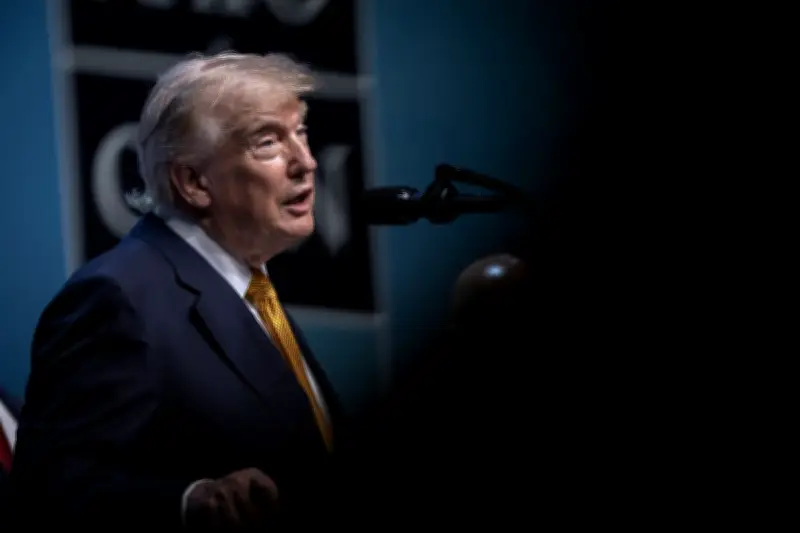
Donald Trump held a press conference at the 36th Nato summit in Ankara, Turkey, on Wednesday, where he veered from praising the alliance to threatening Iran and confusing world leaders' names. Addressing journalists with Ukrainian President Volodymyr Zelenskyy by his side, Trump surprised attendees by directing his affections at an alliance he had spent the previous day criticizing over grievances including Greenland.
"We just had our Nato meeting, and it was a great meeting," Trump said. "There was a lot of love in that room today, a lot of unity. It couldn't have gone much better." This marked a stark contrast from earlier, when he sat beside Nato Secretary General Mark Rutte and aired complaints about lack of support on Iran and Spain's refusal to meet defense spending targets.
Zelenskyy and Unexpected Comity
Even Zelenskyy, once the target of a notorious Oval Office browbeating, seemed to have risen in Trump's estimation. "We have some good stories to tell," Trump said, talking up a deal to end Ukraine's four-and-a-half-year war with Russia. "He has done an amazing job." Treasury Secretary Scott Bessent explained the harmony: "Sir, all the Europeans attributed to you, saving Nato and they want to do what they're supposed to do."

Threats Against Iran
Darkness descended when the subject turned to Iran. Trump recently agreed to a memorandum of understanding for a 60-day halt to hostilities, but on Wednesday he declared the ceasefire all but over after US forces struck Iranian targets. He asserted that Iran violated terms by attacking three vessels in the Strait of Hormuz, supposedly reopened under the agreement. "We have a score to settle," he said, invoking past Iranian transgressions including roadside bombs that killed US troops.
Having hailed his deal as necessary to prevent an economic disaster equal to the Great Depression, Trump now dismissed the possibility of agreement with Iran's leadership. "They violate the agreement every day. They lie, they cheat, they kill people. They knocked out the USS Cole," he said, citing Iran's role in an al-Qaida attack on a US warship in October 2000. He shifted the goal from reopening the Strait of Hormuz—through which 20% of the world's fuel supplies pass—to "denuclearization."
"We're going to have a deal. We may just do it without a deal, because it's easier," he said menacingly. "My whole life is deals, [but] I don't see it with them. Maybe a big attack, and it'll knock out a lot of stuff." US forces would "probably" carry out major attacks on Wednesday evening, he said, potentially including power stations and desalination plants.
Verbal Miscues and Misnomers
Trump's diatribe strayed into malapropisms. Referring to missiles aimed at the USS Abraham Lincoln, he said they were fired by "the Islamic Republic of Japan." In a homily about Iran's military, he suddenly switched to say "we'll give them the right to make Patriot" missiles, apparently referring to Ukraine. After questions about the Russia-Ukraine war, he asked journalists if they had a question for "President Putin" while Zelenskyy sat feet away.
The moment resembled a verbal miscue by Joe Biden at the 2024 Nato summit in Washington. Trump attempted a cover-up, insisting he meant to say Putin because he had a scheduled phone call. His most revealing misstatement was calling Iran's late supreme leader Ali Khamenei "Khomeini," after Ayatollah Ruhollah Khomeini, who led the 1979 Iranian revolution and the 444-day US embassy siege. By conjuring that name, Trump may have subconsciously revealed his preoccupation with an age-old US grievance and signaled his urge to get even.