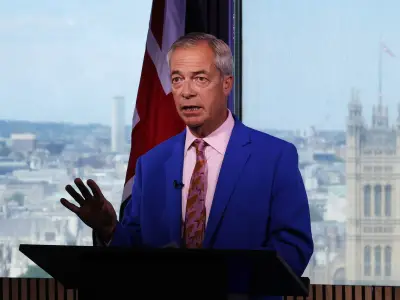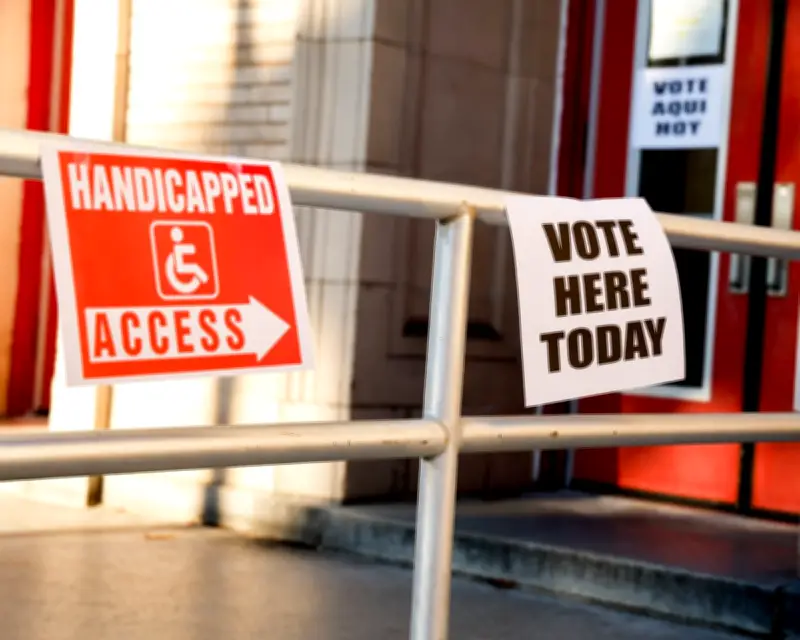
Donald Trump and his allies quickly seized on an announcement from New Jersey Governor Mikie Sherrill on Tuesday that 6,600 noncitizens had registered to vote due to a software error, and fewer than 400 of them voted. They used the disclosure to escalate false claims that there are scores of noncitizens on voter rolls.
Trump's misleading claims
Trump seized on the news days after he said in a primetime speech that the Department of Homeland Security identified 278,000 noncitizens on voter rolls in New Jersey and three other states. However, a Guardian review of DHS letters to the states shows the agency expressed less certainty about the number and offered no explanation of its methodology.
Since 2018, New Jersey has had automatic voter registration, meaning anyone interacting with a motor vehicle office is automatically registered unless they opt out. Between 2023 and 2024, about 6,600 people who indicated they were not citizens were nonetheless registered. Around 400 cast a ballot, Sherrill said. This represents a small fraction of the more than 6.6 million registered voters in the state.

Experts debunk fraud claims
Within hours of the announcement, Trump and other election deniers inflated the number. Trump posted on Truth Social: "35,152 is the new number just released by Homeland Security of non-citizens registered to vote in New Jersey. These are just the ones that got caught. The real numbers will prove to be many times this amount. They are all Dumocrats!" Sherrill said both Democrats and Republicans were erroneously registered, with the majority unaffiliated.
Experts say the incident is far from proof of widespread fraud. Stephen Richer, a Republican who oversaw elections in Maricopa County, Arizona, said: "These people were trying to do the right thing and acknowledge that they’re not citizens, and then the vast majority of them, even though registered and presumably [were] sent election mail materials, ignored that and didn’t vote."
David Becker, an election administration expert, called the number a "minuscule fraction" of active registered voters. "The number of potential ballots cast from those incorrect registrations would represent roughly 0.009% of all ballots cast in New Jersey’s 2024 general election."
DHS data under scrutiny
The firestorm over New Jersey came as Trump escalated incendiary rhetoric ahead of the midterms. In a primetime address, he claimed DHS found 278,000 noncitizens on rolls in California, Nevada, Pennsylvania, and New Jersey. DHS letters expressed less certainty, calling it a ceiling, and offered little methodology. The agency gave states two weeks to respond.
Becker called the letter "laughable," saying: "Imagine someone said to you: ‘Some of the items in your fridge are poisonous. Write us back in two weeks and tell us what you’re going to do about that.’" He added: "This is designed to create a false argument post-election that the election was stolen."
DHS Secretary Markwayne Mullin cited the 278,000 number as evidence states should share voter information, threatening prison time for noncompliance. Senator Marsha Blackburn said: "We know there are roughly 278,000 noncitizens registered to vote. The last three presidential elections were decided by fewer votes."
Nevada Secretary of State Cisco Aguilar refuted the claims: "We can affirm that on its face, we refute these claims. These numbers are wildly speculative at best." DHS had not provided Nevada a list of suspected noncitizens.
In a letter to New Jersey, DHS said there may be up to 35,152 noncitizens on rolls, matching 19,497 voter records to a noncitizen but offering no explanation for the rest. Sherrill said DHS provided no evidence: "We have asked them for any evidence of this, where they got that number, who this is. We’ve received nothing back yet."
Experts note DHS likely lacked identifiers for high-quality matching. Charles Stewart III, an MIT professor, wrote: "Anyone with experience in these data-matching exercises should expect those numbers to melt as quickly as ice cream in a Phoenix August." DHS did not respond to requests for comment.

Becker said: "I am about as certain as I can be... that these numbers cannot be even remotely credible. What I can’t tell you is whether they just made them up." Claims of widespread noncitizen voting often start with headline-grabbing statistics that whittle down after investigation. In 2019, Texas announced nearly 100,000 suspected noncitizens on rolls, later admitting the claim was based on bad data.