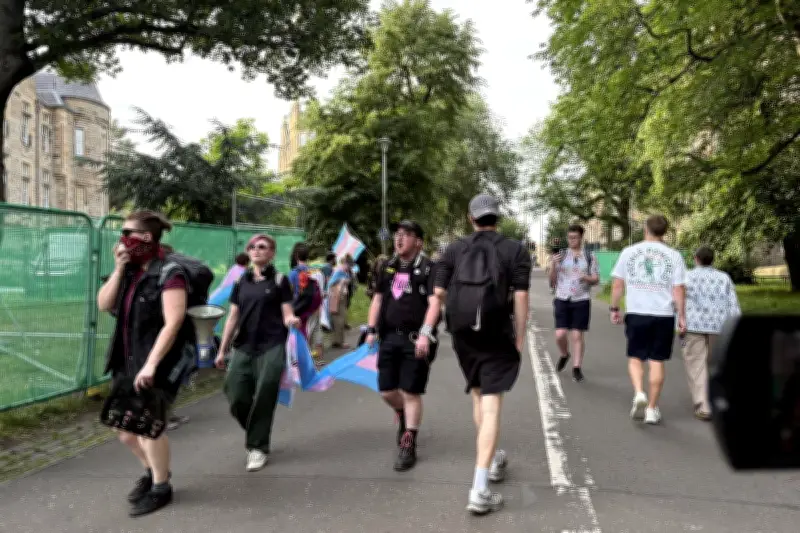
Approximately 80 trans rights campaigners gathered in Edinburgh on Thursday evening to protest the Equality and Human Rights Commission’s (EHRC) updated guidance on single-sex spaces, as the 40-day scrutiny period ended.
Protest at the Meadows
The Resisting Transphobia in Edinburgh event took place at the top of the middle Meadows near Teviot Place. Demonstrators lined the pavement, handing out fliers, playing drums, holding signs, and waving flags to raise awareness against the new code of practice.
Lila Goodwyn, a 20-year-old from Sydney, Australia now living in Edinburgh, expressed anger: “We’re quite angry, it’s kind of the next thing in a long line of absolute humiliation.” She added, “We think this is completely unfair, it’s a trampling of our rights and an attempt to erase trans people from public spaces.”

Guidance Details
The code of practice, published in May, covers England, Scotland and Wales. It confirms that services such as bathrooms and changing rooms must be used on the basis of biological sex – or sex assigned at birth – to be classed as single-sex under the Equality Act, following the Supreme Court ruling in April 2025.
Thursday marked the end of the 40-day scrutiny period since the guidance was laid in Parliament, during which it could have been rejected. However, parliamentary procedure means it could still be weeks before the code formally comes into force.
Impact on Women
Leslie Cunningham, 65, a trans man from Edinburgh, said the guidance will have a “very, very bad impact” on many women, including those who do not identify as trans. “Anybody that doesn’t conform to patriarchal stereotypes in femininity, particularly women of colour, are liable to being challenged. It’s absolutely not on.” He noted that his trans sisters are bearing the brunt of media criticism.
Despite frustration, Cunningham emphasized the community’s focus on love and solidarity: “We don’t want to be just seen screaming, howling, and outraged. We just want to point out that basically we’re like everybody else – we just want to get on living our lives peacefully, co-existing happily with other members of our community and everybody, and having some fun.”
For Women Scotland’s View
For Women Scotland (FWS), which claimed victory in the Supreme Court ruling, hailed the guidance as a “significant milestone in ensuring women’s rights are upheld and protected.” A FWS spokeswoman said: “It’s important to remember that the code does not represent a change in the law, just practical help for implementing it. If businesses have been complying with the law, there shouldn’t be a need for major changes.”
Government Response
Earlier this week, a Government spokesperson stated: “Many businesses will already be largely compliant with the code so there will be no cost at all. For those that do need to make changes, these are likely to be small, such as changing signs on existing facilities. This is about giving organisations the guidance they need, not changing the law or creating new rules. The draft code is clear that a provider’s size and the facilities they have available will be factors in how they follow the law.”