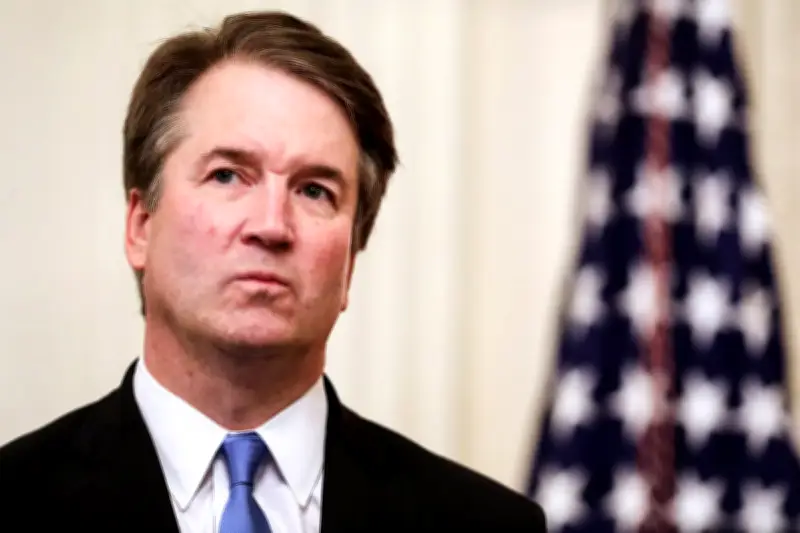
Of the conservative justices on the Supreme Court, Clarence Thomas and Samuel Alito have voted most consistently to support Donald Trump in his cases this session, at 89 and 88 percent, according to the Wall Street Journal. Yet perhaps the most influential justice to advance key parts of Trump's radical agenda has a slightly lower rating at 76 percent, and performed not so much by lofty abstractions of originalism and textualism, but by contriving an assortment of glib schemes at justification.
Kavanaugh's Role in Immigration Enforcement
Kavanaugh issued an unusual sole concurring opinion on 8 September 2025 in Noem v Vasquez Perdomo, staying a lower court's temporary restraining order that had restricted ICE from targeting individuals based primarily on race, language or occupation. Kavanaugh stated that stopping people based on ethnic appearance, speaking Spanish and laboring at certain jobs was a 'relevant factor' and 'common sense' to establish 'reasonable suspicion'. Justice Sonia Sotomayor, in a blistering dissent, accused the court of legitimizing 'racial profiling on a massive scale'. She wrote: 'We should not have to live in a country where the Government can seize anyone who looks Latino, speaks Spanish, and appears to work a low wage job.'
Legal scholars were devastating in their analyses. Jennifer Chacón, professor and vice-dean at Stanford Law School, wrote that Kavanaugh's 'invocation' of 'common sense' came 'at the expense of facts and evidence'. Duncan Hosie, an academic fellow at Stanford Constitutional Law Center, described Kavanaugh's claims as 'factual revisionism' (ie, falsehoods). Sherrilyn Ifill, professor at Howard Law School, wrote: 'Almost every word of this is preposterous.'

Since Kavanaugh's rationalization of what have become known as 'Kavanaugh Stops', within the first month more than 170 US citizens were detained, 'dragged, tackled, beaten, tased and shot', according to a ProPublica report, while through July of this year, 32 American children have been detained, 31 people have died at ICE detention camps, six people have been shot and killed, including two US citizens.
Tariffs and Birthright Citizenship
Kavanaugh applied a similar method to Trump's tariffs in the principal dissent on 20 February in Learning Resources, Inc v Trump, in which a six-to-three majority struck down Trump's claim of absolute power to impose tariffs under the International Emergency Economic Powers Act (IEEPA). Kavanaugh's opinion rested on factual revisionism, citing 'history, and precedent' to justify Trump's unilateral action. He invented an imaginary historical pattern: no president before Trump had used IEEPA to levy broad tariffs. Kavanaugh also engaged in highly unusual speculation about other statutes that 'might justify most (if not all) of the tariffs at issue in this case', laying out a roadmap for Trump to skirt the court's denial.
Then came Kavanaugh's dissent in the birthright citizenship case on 30 June, Trump v Barbara, in which he stated that Trump's executive order violated federal law but was not unconstitutional. His argument was a compound of 'factual revisionism', historical nonsense, sophistry, illogic and political consulting. He speculated about what the Framers of the Fourteenth Amendment 'likely would not have anticipated', reverse-engineering originalist method into parody.
Kavanaugh's suggestion that Trump revive his executive order by a supporting act of Congress would not 'pass constitutional muster' as he insists. Within minutes, Trump hailed Kavanaugh's idea, and Speaker Mike Johnson echoed him. A bill was proposed that has no chance of enactment.
Background and Impact
Kavanaugh's controversial nomination in 2018 centered around allegations of high school sexual misconduct that he denied. His apprenticeship as a staffer was largely overlooked: he worked as an associate special counsel for Ken Starr, convincing him to launch an investigation into the suicide of Clinton White House deputy counsel Vince Foster, which dragged out for three years. As one of the lawyers for the George W. Bush campaign in the Florida contest of 2000, he advanced the notion that because counties counted votes differently, the vote count as a whole should be halted, becoming the basis for Bush v Gore.

Now, wearing the black robe, Kavanaugh charts roadmaps for Trump on how to work around adverse decisions. He acts as though he is in an ex-officio capacity to the administration's legal staff writing option memos.