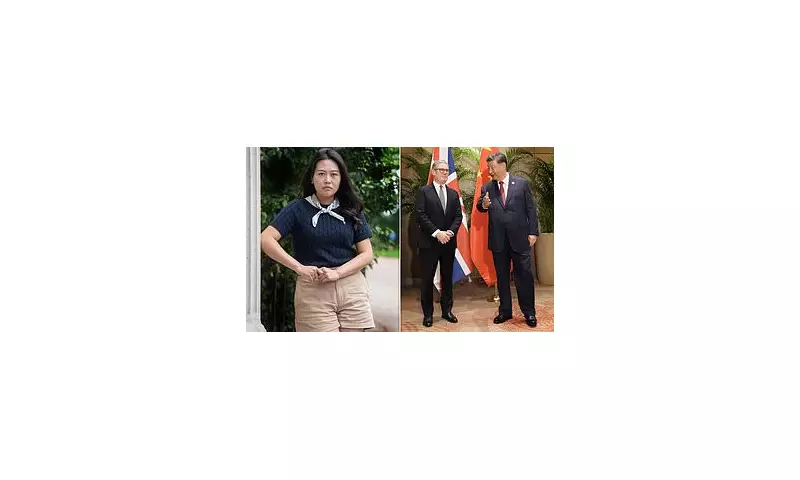
A Hong Kong pro-democracy activist granted sanctuary in Britain has become the victim of a grotesque campaign of harassment, which now includes AI-generated fake pornographic images mailed directly to her neighbours.
A Campaign of Digital Terror
The disturbing images depict a young Asian woman in explicit sexual poses. Advertised with captions in broken English and physical measurements, they falsely portray Carmen Lau, 30, as a prostitute. The pictures, however, are sophisticated fakes created using artificial intelligence, sent from Macau with the clear intent to destroy her reputation and endanger her safety.
Carmen Lau fled Hong Kong for the UK four years ago, seeking refuge from state persecution. Instead, she has found the long arm of Chinese harassment reaching her new home in Berkshire. "No one should be targeted with such sexual violence," she stated. "I feel angry, I feel betrayed, I feel terrified."

An Escalating Pattern of Intimidation
The AI porn attack in December is merely the latest escalation. Earlier in 2024, 'Wanted' posters offering a bounty of one million Hong Kong dollars (approx. £95,000) for information leading to her or her delivery to the Chinese Embassy in London were also posted to her neighbours. She has long suspected she is under surveillance in the UK.
Her alleged crimes stem from her time as an elected councillor in Hong Kong, where she is accused of "incitement to secession" and collusion with foreign forces—charges she dismisses as "manufactured and unjust." Her political work enraged Beijing, leading to surveillance, smears in state-run media, and the eventual fear that forced her to flee in July 2021.
Serious Questions for the UK Government
This transnational repression campaign poses two urgent dilemmas for Britain. Firstly, how can Prime Minister Sir Keir Starmer pursue warmer ties with Beijing, including a potential diplomatic visit next month, while UK-based dissidents face such attacks? Secondly, why is the government poised to allow China to build a new mega-embassy in London, a move critics fear will facilitate espionage?
"This prioritising of economic interests, this cosying up to China, it signals that they can act freely in the UK," Carmen warns. She describes Starmer's approach as "deluded," arguing that democratic nations cannot win in such an asymmetric relationship with an autocracy.
Her security measures are extreme: CCTV, motion sensors, burner phones, permanent VPNs, and using pseudonyms for everyday services. Despite this, UK police initially advised her to stop provoking China. Their response only improved after the gender-based AI attack, though investigations have yet to identify the perpetrators.
Heartbreakingly, Carmen does not know if she will ever see Hong Kong again. "What keeps pushing me forward is the people of Hong Kong," she says, acknowledging that her plight pales compared to those who have lost their freedom. Her story stands as a stark test of Britain's commitment to protect those to whom it has granted sanctuary.