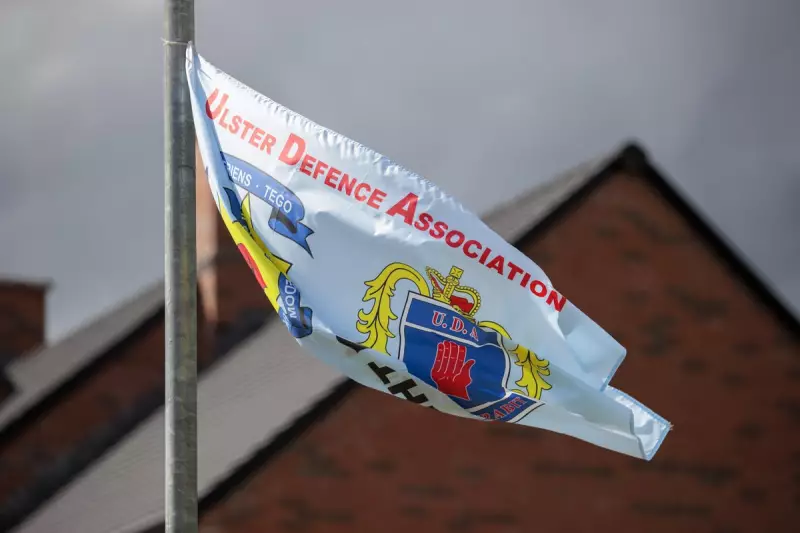
Newly released official documents have exposed high-level discussions from 2004 about employing anti-terrorism legislation to address the contentious display of paramilitary flags and murals in Northern Ireland.
Stormont Meeting Debates Legal Boundaries
The declassified file, held at the Public Record Office in Belfast, contains minutes from a meeting at Stormont House on 2 March 2004. Attendees included senior officers from the Police Service of Northern Ireland (PSNI), civil servants, and representatives from the Community Relations Unit (CRU) and the Community Relations Council (CRC).
The talks built on a prior conclusion that a community-focused approach was preferable to a purely police-led response. However, the conversation took a significant turn when the potential use of the Terrorism Act 2000 was raised.

Developing 'Comprehensive Caselaw' in the Courts
According to the minutes, senior PSNI officer Gary White informed the group he had consulted the Department of Public Prosecutions (DPP) on applying the terrorism laws. He reported that the DPP was generally in favour of using the provisions, particularly when a flag or mural explicitly showed support for a paramilitary organisation.
"GW suggested that this should be a matter for the Courts and that a comprehensive caselaw could be developed to provide a clear line between what is acceptable and what is not," the record states.
White also noted there was "a great deal of sympathy" for the view that behaviour tolerated during the worst of the Troubles might no longer be acceptable.
Test Case and Community Sanctions
The meeting was reminded of a successful test case in Holywood, where four individuals were convicted under Section 13 of the Terrorism Act for displaying paramilitary flags. This demonstrated the law's existing applicability.
Meanwhile, Billy Gamble of the CRU expressed a preference for communities to resolve such matters independently but stressed the necessity of an ultimate sanction. The CRU had also commissioned research on flags and emblems from Queen's University's Institute of Irish Studies.
The minutes concluded that while impressed by community relations approaches, the group acknowledged communities could not always prevent such displays. In those circumstances, the PSNI was confident it had the necessary powers under the Terrorism Act. The final assessment was clear: "there is no one size fits all policy that can resolve the flags issue."