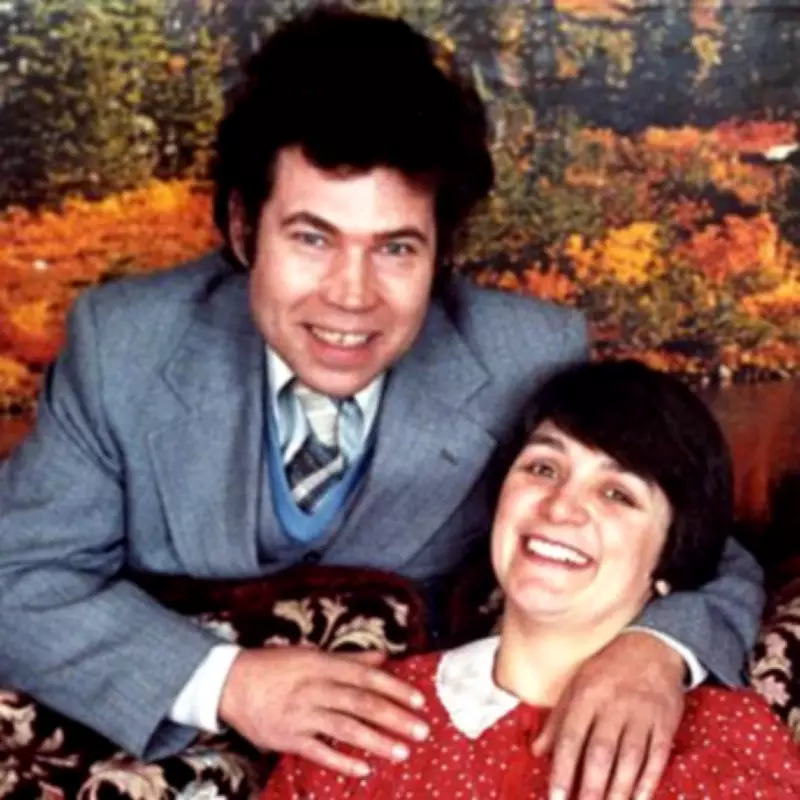
Vanessa Farke-Harris, a former prison governor who oversaw Rosemary West during her incarceration, has provided a chilling account of the convicted serial killer's behavior behind bars. In a recent interview on the Daily Heretic podcast, Farke-Harris labeled West as a "manipulative psychopath" and detailed her eerily emotionless response upon being informed of her husband Fred West's suicide.
The Segregation Unit at HM Prison Holloway
Farke-Harris was in charge of the segregation unit at HM Prison Holloway, where Rose West was held for approximately three to four months while awaiting trial. The segregation unit, often referred to as the SEG, housed prisoners who required protection or were under punishment. During this period, West presented a deceptively ordinary appearance, earning her the nickname "Auntie Rose" among staff due to her unassuming demeanor.
"We used to call her Auntie Rose because she just looked like somebody's auntie," Farke-Harris recalled. "It was very hard to look at her and think of all the dreadful things that she'd done. She had thick milk bottle glasses. She knitted all the time. And we never knew quite what she was knitting. She was very quiet."
A Mask of Normality Hiding Darkness
Beneath that quiet exterior, however, lay a profoundly disturbing character. Farke-Harris emphasized that West's behavior was consistent with that of a psychopath, marked by a complete absence of genuine emotion. This assessment was starkly confirmed on New Year's Day when Farke-Harris and a duty governor received notification that Fred West had taken his own life at HM Prison Birmingham, formerly known as Winston Green.
The two officers entered West's cell together to deliver the news. "We opened the door and the governor said, 'I'm really sorry, Rose, to tell you that your husband Fred has taken his own life,'" Farke-Harris recounted. "Not a flicker. Not a flicker of emotion. In fact, to me, there was almost a glint in her eye like, 'Huh, well, they can't pin it all on me now, can they?'"
Farke-Harris offered a single-word verdict on that perceived thought: "Wrong." She noted that there was no visible grief, shock, or distress from West, who responded with brief, controlled words: "No. No, I'm fine. Thank you." Farke-Harris concluded, "That was it. Typical psychopath."
The Horrific Crimes of the Wests
Rose West was later sentenced to life imprisonment at Winchester Crown Court for the murder of 10 young women and girls, including her daughter Heather and stepdaughter Charmaine. During sentencing, Mr Justice Mantell stated, "If attention is paid to what I think, you will never be released." Her husband, Fred West, had also been charged with multiple murders but killed himself in his prison cell in January 1995 before standing trial.
The couple's crimes, which horrified the nation, involved the rape, torture, and murder of an unknown number of victims over more than two decades. Police searching their address at 25 Cromwell Street in Gloucester—later dubbed the "house of horror"—uncovered the bodies of nine girls buried at the property, with three additional bodies found elsewhere. Graphic evidence presented in court detailed sustained sexual abuse, torture, and dismemberment.
Fred West has been described as the "epitome of evil," targeting vulnerable girls and women to fulfill sadistic fantasies. Together, prosecutors asserted, the pair committed atrocities that left a lasting scar on British criminal history. Farke-Harris's insights shed light on the cold, calculating nature of Rose West, reinforcing her reputation as one of Britain's most notorious murderers.