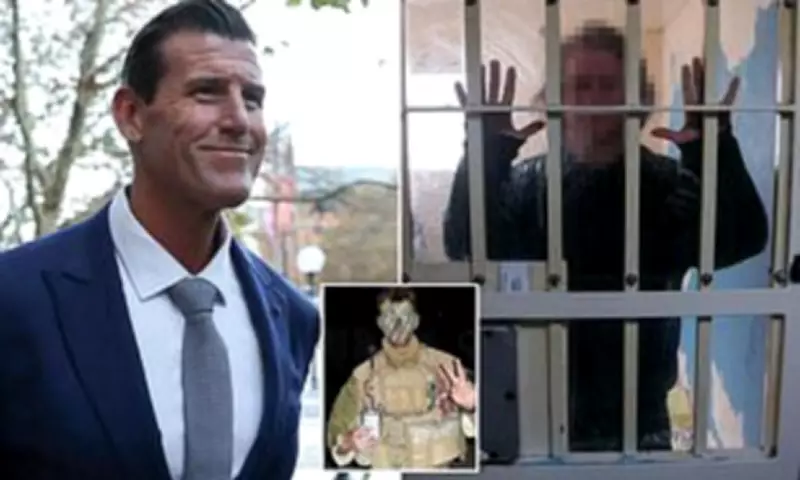
Ben Roberts-Smith's Prison Environment: Surrounded by Former Military Personnel
Ben Roberts-Smith, potentially the sole accused war criminal currently incarcerated in Australia, is far from isolated behind bars. The former soldier finds himself in the company of numerous ex-servicemen, comprising both fellow inmates and prison officers, within the confines of his detention facility.
Arrival and Initial Custody at Silverwater
Roberts-Smith has been detained at the Metropolitan Remand and Reception Centre, located within the Silverwater Correctional Centre in Sydney's western suburbs, since his arrest eight days prior. Upon his arrival at the maximum security prison, one of the first individuals to greet the Victoria Cross recipient was governor Pat Aboud, who served as a soldier before joining Corrective Services nearly four decades ago.
Mr Aboud personally met Roberts-Smith as he disembarked from the transport vehicle from Mascot police station on April 7, accompanying him throughout the reception process until his placement in a cell. The prison governor makes a point of introducing himself to new high-profile inmates to ensure no incidents occur without his knowledge and to emphasize that special treatment will not be granted within his institution.

Composure and Respect in Custody
A prison source described Roberts-Smith as having been 'cool, calm and collected' upon arrival at the MRRC, spending his initial week in solitary confinement. 'I would think he'd be afforded quite a bit of respect from staff,' the source revealed. 'There's an element of both inmates and staff that are former service people.'
The source further explained that inmate reactions would likely be divided: 'Inmates would be split. Some of them will respect him and there'll be other pockets who probably won't. There's also obviously an element of Muslim inmates who might not care for him much. But is it big enough to give him a target on his back? Maybe not.'
Mutual Recognition Among Military Veterans
Retired jail governor John Heffernan suggested that if Roberts-Smith's wartime service is acknowledged by military veterans among his custodians, that recognition would likely be reciprocal. 'I would imagine both BRS and ex-service personnel would have the utmost respect for each other,' Mr Heffernan stated. 'I would see a few salutes happening.'
Roberts-Smith is currently housed in an older section of the prison known as the Darcy pods. Although designated as a protection inmate, he is permitted to interact with other prisoners in communal areas. 'Protection doesn't mean what people think of as segregation or solitary confinement or anything along those lines,' the prison source clarified.
Physical Presence and Potential Threats
Standing at an imposing 202cm tall, the 47-year-old has reportedly not encountered any inmates attempting to confront him thus far. 'Even if you weren't keen on him I don't know that anyone would have the balls to jump in,' the prison source commented. 'Given that he's probably quite decent in terms of what he can do as well. He's such a big dude I think people would be giving him a wide berth no matter where you put him, let's be honest.'
A Corrective Services NSW spokeswoman declined to comment on individual circumstances in custody, maintaining standard departmental policy.
The Serious Charges and Investigation Background
War Crime Allegations from Afghanistan
Roberts-Smith faces five counts of 'war crime - murder' allegedly committed between 2009 and 2012 during his service with the Special Air Service in Afghanistan. His arrest followed an extensive five-year joint investigation conducted by the Australian Federal Police and the Office of the Special Investigator.
The specific accusations include shooting an unarmed Afghan, murdering another alongside an SAS comrade, and ordering the execution of three additional individuals. All charges carry a maximum penalty of life imprisonment, though Roberts-Smith has consistently denied any unlawful killings.

Arrest Circumstances and Legal History
Despite having offered to present himself to police if charges were imminent, Roberts-Smith was apprehended in front of his twin 15-year-old daughters and partner Sarah Matulin upon arriving on a Qantas flight from Brisbane at Sydney Airport. This arrest occurred nearly three years after he lost a defamation action against Nine newspapers, which had published reports in 2018 accusing him of war crimes.
Unidentified Victims and Investigative Challenges
Two of the five alleged victims have never been formally identified by war crimes investigators. Court documents describe one only as 'Person Under Control 1' or alternatively 'Enemy Killed in Action 3', allegedly murdered alongside another SAS soldier at Syahchow in Uruzgan Province on October 20, 2012.
Another victim, known only as 'Person Under Control 2' or 'Enemy Killed in Action 4', was allegedly killed the same day in the same location. Roberts-Smith is accused of aiding, abetting, counselling or procuring an SAS rookie to commit this murder.
A legal source close to the civil case confirmed that investigators still lack identification for these individuals: 'They have never been identified. All they have are photos of dead male Afghans taken by our guys at the end of a mission. They are not crime scene evidence but are now being repurposed in a criminal case.'
Named Victims and Specific Allegations
Three alleged victims are named in court documents: Mohammed Essa (allegedly killed April 12, 2009), his son Ahmadullah (killed the same day, whose prosthetic leg was reportedly taken as a trophy), and Ali Jan (allegedly killed September 11, 2012). Each is described in charge sheets as 'not taking an active part in hostilities' at the time of death.
Investigative Complexities in War Zone Prosecutions
OSI director of investigations Ross Barnett emphasized the extraordinary challenges in prosecuting alleged war crimes from Afghanistan: 'Incredibly complex... literally dozens of murders alleged to have been committed in the middle of a warzone, in a country 9,000km from Australia that we can no longer access.'
Barnett detailed the investigative limitations: 'We don't have access to the crime scene... no photographs, site plans, measurements, recovery of projectiles, blood-spatter analysis. We don't have access to the deceased - there's no post-mortem, therefore no official cause of death, no recovery of projectiles to link to weapons.'
Roberts-Smith, who earned both the Victoria Cross and Medal for Gallantry during his military service, is scheduled to apply for bail at the Downing Centre Local Court on Friday.