Terror, Tension and Unity in Minnesota Amid Trump's ICE Surge: 'I've Never Seen Anything Like This'
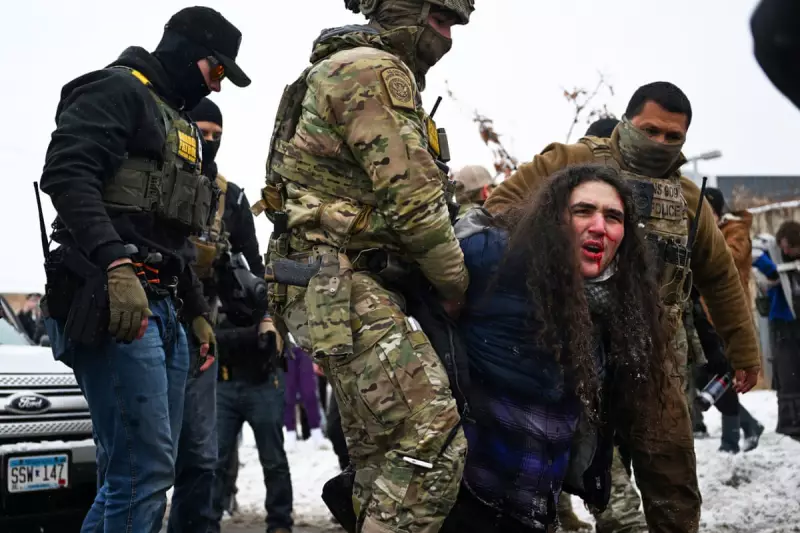
Minnesota residents are sharing the fundamental ways their lives have changed since federal troops arrived in their state, with over 3,000 Immigration and Customs Enforcement (ICE) officers deployed to the Twin Cities. The operation, which began in December and escalated in January, has created an atmosphere of fear and tension, while also fostering a deep sense of community unity.
Daily Life Transformed by Federal Presence
The deployment has led to residents witnessing clashes between civilians and agents, carrying passports and ID cards at all times for fear of being stopped, and staying home as much as possible. Many worry for the safety of their children in public spaces. Dan O'Kane, 69, expressed shock after seeing ICE officers fight with students and throw a teacher to the ground at Roosevelt High School, stating, 'I've never witnessed anything like this in the US.'
Over the past week, more than 150 Minnesota residents spoke about these changes, with an overwhelming majority describing the situation as 'tense'. Many feel their cities are 'occupied' or 'under siege', and some agreed to speak only anonymously due to fears of government retribution.

Racial Profiling and Safety Precautions
Instances of racial profiling have been reported, with Marcus Kessler noting that his wife now carries her tribal identification card everywhere, following guidance from the White Earth Ojibwe Nation. A 57-year-old Latina resident of St Paul, who requested anonymity, said, 'Me and other brown friends are taking precautions: carrying our passports, having phone lines open while we drive, telling people where we're going, when we expect to arrive, and checking in upon arrival so they don't worry.'
Parents are navigating heightened risks, such as a 38-year-old pregnant mother who discussed with her OB what to do if exposed to teargas or pepper spray. She said, 'I'm avoiding protests to be safe and instead focusing my efforts on supply runs. I want to defend my neighbors, but find myself needing to keep my baby safe.'
Impact on Education and Healthcare
Schools have seen lower attendance, with some offering online instruction similar to during the Covid-19 pandemic. A fifth-grade St Paul public schools teacher reported, 'I haven't seen some of my students for two weeks. Every day my class gets smaller and smaller. It's hard for 10-year-olds to wrap their head around. They were trying to work out how long Trump had left in office, so they know when they can go back outside for recess.'
Hospitals are also affected, with one physician noting that emergency departments and children's hospitals are empty despite cold and flu season, as families are too scared to bring in ill children. Gerard James, a therapist, summarised the public mood: 'People are scared to go out. People are enraged, sad, scared.'
Community Solidarity and Resilience
Despite the fear, many residents feel a deep sense of pride in their home, bolstered by strong organizing networks that date back to protests after the killing of George Floyd. Jason C, a 50-year-old resident of south Minneapolis, said, 'Living in Minneapolis right now feels a lot like it did during the George Floyd uprising. It is definitely a retriggering of those traumas but at the same time the communities and systems that were put in place as a result of George Floyd were immediately brought back online to help marginalized communities in our area.'
New strategies for protection have emerged, such as a 72-year-old Minnetonka resident learning to record ICE interactions on her phone. Others carry whistles to alert neighbors, volunteer for school drop-off supervision, or purchase protective gear for protests.

Concerns for the Future
As the operation continues, some residents no longer recognize their home. Mike, from St Paul, remarked, 'Federal agents are assaulting and kidnapping American citizens and non-citizens in broad daylight, in our neighborhoods. I thought this only happened in Iran or the USSR.' Many fear the Twin Cities are a test bed for broader national policies, with one anonymous Minneapolis resident stating, 'We're very clearly a test bed to explore what the people of this country will tolerate as long as it doesn't affect them directly, and the answer appears to be Literally. Fucking. Anything.'
The situation has led some families to consider leaving Minnesota, like Seth, a 33-year-old Minneapolis resident who sent his wife and baby daughter to stay with parents in another state, saying, 'I couldn't stand to have them around this violence.' Yet, the community's resilience shines through, as noted by Dan, a 30-year-old resident who moved to escape LGBTQ discrimination: 'There is a sense of belonging here. That is why I think Trump wants to crush it so badly, the way Somalian people, and other immigrant groups have enriched this city is a threat to them.'