
Minneapolis Newsroom's Digital Pivot Proves Vital During Immigration Crisis
In Minneapolis, a comprehensive immigration enforcement story has rigorously tested a local newsroom during its digital transition. With national attention fixed on the unrest, local journalists have risen to the challenge, demonstrating resilience and adaptability.
A Newsroom Prepared for the Moment
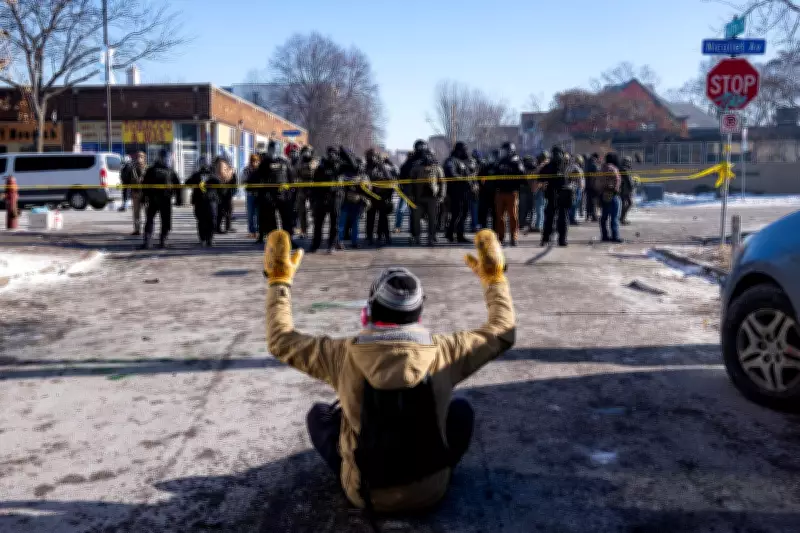
Over the past month, the Minnesota Star Tribune has broken significant stories, including revealing the identity of the immigration enforcement officer involved in the shooting of Renee Good. The outlet has produced a variety of informative pieces, with Richard Tsong-Taatarii's photograph of a prone demonstrator being sprayed point-blank with a chemical irritant becoming a defining image. These ICE actions have fundamentally altered how the newsroom presents its coverage.
At a time when many regional newspapers have become hollowed-out shells due to the decline of journalism as a business, the Star Tribune has maintained relatively steady staffing under billionaire owner Glen Taylor, who acquired it in 2014. The paper rebranded from the Minneapolis Star Tribune and committed to a digital transformation, positioning itself to respond effectively to major stories.
"If you hadn't invested in the newsroom, you wouldn't be able to react in that way," said Steve Grove, publisher and chief executive.
Minnesota's Robust Journalism Ecosystem
The Star Tribune has not operated in a vacuum. Minneapolis benefits from a robust journalism tradition, particularly within public radio and television. Sahan Journal, a digital newsroom focusing on immigrants and diverse communities, has also distinguished itself by covering President Donald Trump's immigration efforts and the public response.
"The whole ecosystem is pretty darn good," said Kathleen Hennessey, senior vice president and editor of the Star Tribune, "and I think people are seeing that now."
While national outlets have made their presence felt, strong local teams offer distinct advantages. Star Tribune journalist Josie Albertson-Grove was among the first on the scene after ICU nurse Alex Pretti was shot dead on January 24th. Living nearby, her deep knowledge of the neighbourhood and its people proved invaluable in reconstructing events.
Deep Local Knowledge and Sources
Journalists with children in local schools learned about ICE efforts to target areas where children gather through community chatter. Reporter Liz Sawyer developed sources that enabled her, alongside colleagues Andy Mannix and Sarah Nelson, to report on who shot Renee Good.
"This is a place with a really, really long and entrenched tradition of activism, and a place with really deep social networks and neighbourhood networks," Hennessey explained. "People mobilize quickly and passionately, and they're noisy about it. That's definitely been part of the story."
A Signal chat alerted photographer Richard Tsong-Taatarii to a demonstration growing raucous on January 21st. Upon arrival, he focused his lens on one protester knocked to the ground, capturing a detailed image of two officers holding the man face-down while a third unleashed a chemical irritant inches from his face.
Enterprise Reporting and Community Impact
In one enterprising story, journalists Christopher Magan and Jeff Hargarten identified 240 of an estimated 3,000 immigrants rounded up in Minnesota, finding 80% had felony convictions but nearly all had been through the court system and were no longer sought by police. Columnist Laura Yuen wrote about her 80-year-old parents carrying passports due to a "quiet, pervasive fear" in the Twin Cities, noting her own passport had become "a badge to prove I belong."
A piece by Kim Hyatt and Louis Krauss detailed the health consequences of chemical irritants used by law enforcement. Veteran television newsman and journalism professor Scott Libin praised the Star Tribune's work as "commendable" and "thorough and dispassionate."
Fundamental Operational Shifts
The news has compelled fundamental shifts in the Star Tribune's operations. The outlet has rearranged staff to cover the story aggressively through a continuously updated live blog on its website, offered free to readers. There is a greater emphasis on video, with forensic studies conducted on footage from the Pretti and Good shootings.
Website traffic has increased by 50 percent, paid subscriptions have risen, and the company is receiving thousands of dollars in donations from across the country. "People have changed the way that they consume news," Hennessey observed. "We see that readers are coming back... They're coming back a couple of times a day to check in on what's new."
Most people in the newsroom are contributing to the story, including the food and culture team and outdoor reporters. "There are no normal beats anymore," Albertson-Grove said.
A Rapid Digital-First Transformation
Under Grove, a former Google executive, the Star Tribune has pursued a digital-first transition, turning over about 20% of its staff in two years. The paper closed its Minneapolis printing plant in December, laying off 125 people and moving print operations to Iowa.
"We face every single headwind that every local news organization in the country does," Grove stated. "But we do feel fortunate that we're the largest newsroom in the Midwest and it's part of the reason we're able to do this now."
Reporter Liz Sawyer says the public response to the outlet's work has lifted her spirits, with readers viewing it as public service journalism. However, the toll is evident. "I think both residents and journalists in this town are running on fumes," she admitted. "We're tired of being in the international spotlight and it's never for something positive. People are trying their best to get through this moment with grace."