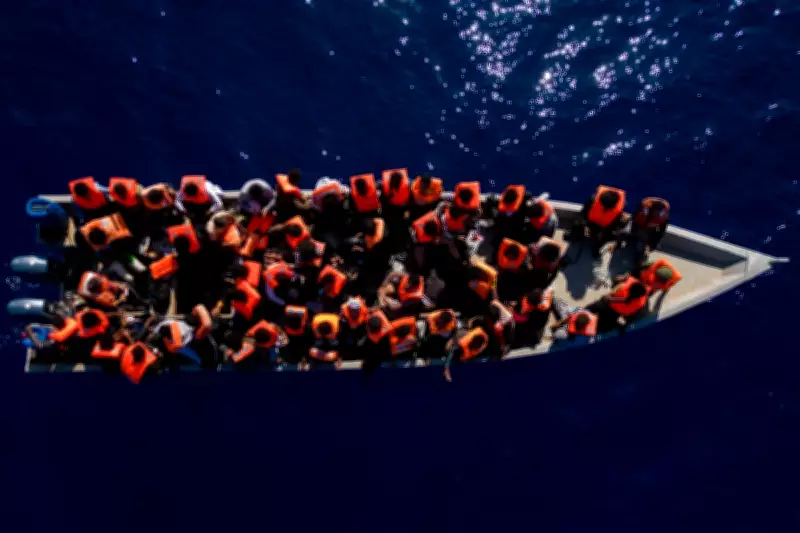
The Deadly Silence of the Mediterranean: 'Invisible Shipwrecks' Claim Hundreds
A harrowing and largely unseen humanitarian crisis is unfolding across the Mediterranean Sea. Migrants attempting the perilous journey to Europe are vanishing in what human rights groups term 'invisible shipwrecks', as key governments withhold vital information on search and rescue operations. The beginning of 2026 has already become the deadliest start to any year for those crossing these waters.
A Strategy of Silence and Unverified Deaths
The United Nations' International Organization for Migration (IOM) has confirmed that 682 people were reported missing by March 16, 2026. However, the true death toll is believed to be significantly higher. Human rights organizations are facing immense challenges in verifying these figures due to a deliberate lack of transparency from Italy, Tunisia, and Malta regarding migrant rescues and shipwrecks along this treacherous route.
'It's a strategy of silence,' stated Matteo Villa, a migration and data researcher at the Italian Institute for International Political Studies. This opacity prevents journalists from confirming reports, ensuring these tragedies remain largely out of the public eye.

Since late January, groups like Refugees in Libya have reported over 1,000 people missing following Cyclone Harry, which brought heavy rainfall, winds of 100 kph, and 9-meter-tall waves to the region. Authorities have neither confirmed nor denied these alarming reports.
Decomposing Bodies and Unanswered Pleas
In the weeks after the cyclone, more than twenty decomposing bodies washed ashore in Italy and Libya, with other human remains spotted floating at sea. For the families left behind, the uncertainty is agonizing.
'Europe should know that these people who got drowned in the sea have family members, have dreams, have passions,' said Josephus Thomas, a migrant from Sierra Leone and community leader in Tunisia's coastal town of El Amra.
Even the IOM's Missing Migrants Project is increasingly unable to verify cases. Julia Black, who leads the project, revealed that last year at least 1,500 reported missing migrants could not be confirmed. For 2026, they already have a secondary dataset of over 400 unverifiable cases.
'We started a new secondary data set of what we are calling unverifiable cases because it's just become so many,' Black explained.
Restricted Access and Withheld Information
Many humanitarian organizations that once helped fill information gaps can no longer do so, facing global funding cuts and government-imposed restrictions across the Mediterranean region.
'We've seen the restriction of access for humanitarian actors, which is not right. And now we're seeing even the restriction of information,' Black added.
The Associated Press made repeated requests to authorities in Tunisia, Italy, and Malta, asking why they are not sharing information related to migrant rescues and what their policies entail. Not a single entity responded.
This silence became particularly pronounced after Cyclone Harry. According to information gathered by Refugees in Libya from migrants in Tunisia and their relatives abroad, hundreds who departed from Tunisia's Sfax region simply disappeared.
'We are looking at boats that never counted how many kids are inside,' said Refugees in Libya founder David Yambio, who acknowledged the difficulty of precision due to the lack of a central recording system for departures, losses, or recoveries.
Authoritative Evasion and a Single Survivor
The AP sent five email requests to the Italian coast guard seeking information on missing boats and search efforts, receiving no response. An officer stated the coast guard had no 'further verified and confirmed information regarding the circumstances.' A Freedom of Information request remains pending. The coast guard also declined to comment on a January 24 alert it issued, made public by journalist Sergio Scandura, regarding eight small boats in distress carrying some 380 people.

There is only one known survivor from the boats reported missing during Cyclone Harry. Rescued by a merchant vessel on January 22 while floating in the water, the man testified he had been traveling with another 50 people, some of whose bodies were visible in rescue footage. Thanks to his account, these deaths were included in IOM's tally. The survivor was reportedly evacuated to Malta, but the Maltese Armed Forces did not respond to multiple requests for confirmation.
Similarly, the Tunisian Foreign Ministry and National Guard have not responded to repeated inquiries. Frontex, the EU border surveillance agency, told AP it spotted eight boats carrying about 160 migrants between January 14 and 24. While six were rescued by Italian authorities, the fate of the other two remains unknown.
A Political Motive Behind the Data Blackout
Until mid-2024, Tunisian authorities regularly shared interception numbers, eager to show compliance with a 2023 deal with Europe to curb migration in exchange for financial aid. This deal was followed by a brutal crackdown on migrants on land, resulting in thousands being detained or abandoned in the desert.
NGOs like the Tunisian Forum for Economic and Social Rights (FTDES), which used to compile and share reports, were also caught in this crackdown. In June 2024, Tunisia's Ministry of Interior ceased releasing any migrant information, citing security reasons.
'The numbers were incompatible with the narrative that Tunisia was not Europe's border guard,' said Romdhane Ben Amor, FTDES spokesperson, suggesting the motives were political.
Italy's erosion of information is even older. The Italian coast guard once provided detailed monthly rescue data. These reports became quarterly before stopping completely in 2020, with previous reports removed from its website in 2022. Despite nearly 5,000 migrants disembarking on Italian shores in 2026 according to Interior Ministry statistics, the coast guard has issued no migration-related press releases.
'It is very clearly a political strategy to repress as much information as possible from the public,' concluded researcher Matteo Villa, highlighting a deliberate campaign of obscurity that leaves hundreds of missing migrants and their grieving families in the dark.