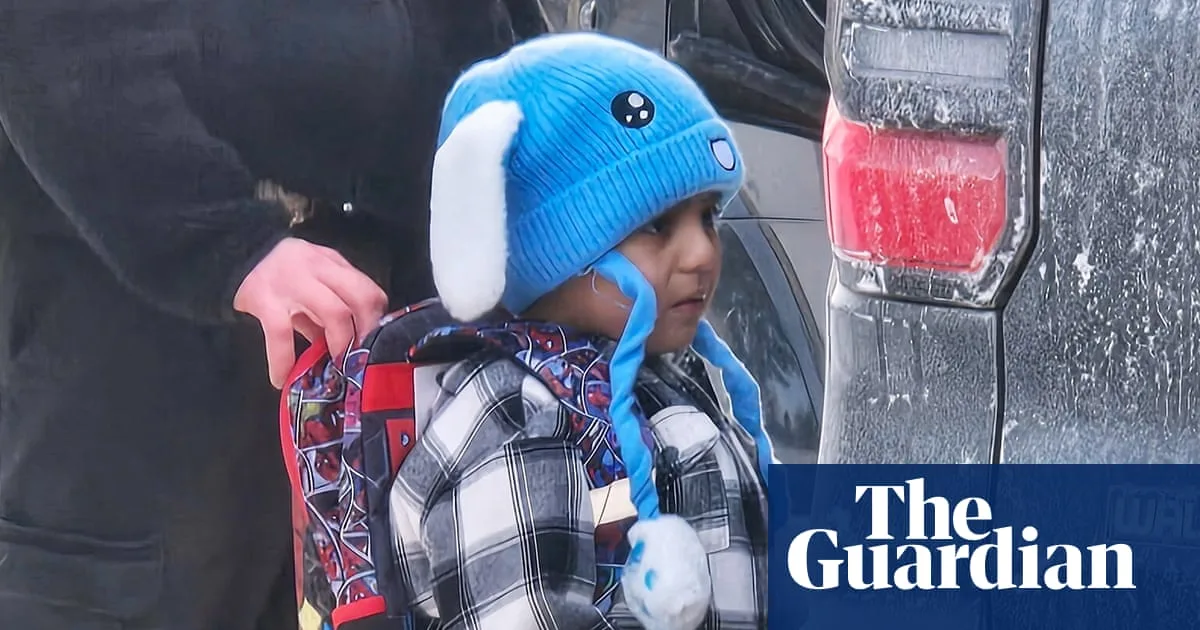
The harrowing detention of five-year-old Liam Conejo Ramos, seized by Immigration and Customs Enforcement (ICE) agents in Minnesota, has been declared unconstitutional by a federal judge, who condemned the action as cruel and lacking basic humanity. The case has ignited a fierce debate about the treatment of migrant children and the implementation of US immigration policy under the current administration.
A Child's World Shattered
On January 20, 2026, Liam Ramos, a pre-K student, was on his way home from school in Columbia Heights, Minnesota, with his father when ICE agents apprehended them. The family, who had emigrated from Ecuador in 2024 and applied for political asylum, had not been issued a deportation order, nor had any member, including young Liam, been accused of a crime. Despite this, they were transported to a detention facility in Dilley, Texas, near San Antonio, a site known for housing numerous child detainees.
Liam, whose middle name 'Conejo' means 'rabbit', was pictured in his distinctive bright blue hat with floppy bunny ears and a beloved Spider-Man backpack—items emblematic of his innocent childhood. Visitors to the Dilley facility reported the child appeared pale, lethargic, and deeply depressed. He struggled to eat the prison food, slept excessively, and repeatedly asked about his confiscated hat and backpack. He missed his mother, classmates, and the routine of school life profoundly.
Public Outcry and Political Intervention
The plight of Liam Ramos did not go unnoticed. A moving video from his classroom, where fellow students sent messages of love and blew kisses, circulated widely. His teachers kept his cubby intact, hopeful for his return. The case attracted significant public attention, leading to demonstrations at the Dilley facility during a visit by Democratic US congressional representatives Joaquin Castro and Jasmine Crockett of Texas, who expressed grave concern over the conditions faced by Liam and other imprisoned children.
This public and political pressure culminated in the case being heard by Federal Judge Fred Biery. In a scathing ruling, Judge Biery ordered the release of Liam and his father, stating their detention was unconstitutional. He criticised the government's actions as stemming from 'ill-conceived and incompetently implemented daily deportation quotas' that traumatise children. The judge accused authorities of ignoring foundational principles, referencing the Declaration of Independence and the Fourth Amendment, which protects against unreasonable seizures. He concluded his ruling with the poignant words 'Jesus wept' alongside Liam's photo.
A Broader Crisis of Compassion
The detention of Liam Ramos is not an isolated incident but part of a wider pattern under the current US immigration framework. Judge Biery's remarks highlight a systemic issue where policies appear to prioritise enforcement over human dignity, particularly affecting vulnerable children. The case raises urgent questions about the moral compass of those implementing such measures: Do they possess no decency, compassion, or recollection of their own childhood?
Some commentators draw parallels to historical atrocities, suggesting that dehumanising rituals can make cruelty easier for perpetrators. The treatment of Liam—stripped of his personal belongings and confined—echoes concerns about how detainees are perceived by officials. His story has become a rallying point, akin to other high-profile cases involving ICE, prompting calls for the release of all children in similar detention situations.
Hopes for Reform and Accountability
In the aftermath of this ordeal, there are growing demands for substantial reform. Firstly, advocates hope Liam's case will inspire a comprehensive overhaul of how the US treats asylum seekers fleeing persecution. Secondly, there is a push for every government official to advocate for the children remaining in detention centres like Dilley. Lastly, there is a visceral desire for accountability, with some hoping that architects of harsh immigration policies are haunted by the innocent faces of those like Liam Ramos.
While Liam has now been released, the trauma inflicted may have lasting effects. The nation cannot fully atone for his suffering, but his story underscores a critical need for policy change. As debates continue, the image of a five-year-old in a bunny-eared hat serves as a powerful reminder of the human cost of immigration enforcement when compassion is sidelined.




