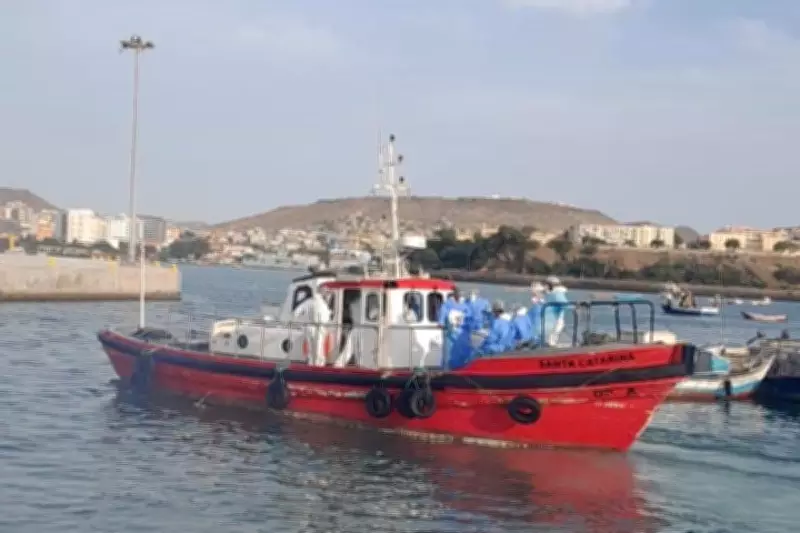
Two individuals who returned to the United Kingdom from a cruise ship affected by a hantavirus outbreak have been instructed to self-isolate, according to the UK Health Security Agency (UKHSA). The agency emphasised that the risk to the broader public remains minimal following their arrival from the MV Hondius.
Source of the Outbreak
It is now suspected that a Dutch couple who visited a landfill during a bird-watching excursion in Argentina may be the origin of the outbreak. Two Argentine officials confirmed that the government's primary hypothesis is that the couple could have encountered rodents during their trip in Ushuaia.
The World Health Organisation (WHO) has reported eight suspected cases of hantavirus linked to the vessel, with five of these cases confirmed. On Wednesday, three patients were medically evacuated from the ship to receive treatment in the Netherlands.

British Doctor's Condition Improves
Spain's health minister announced that a British doctor evacuated from the ship is no longer in critical condition. Despite the Canary Islands' president blocking the vessel from docking in Tenerife, Oceanwide, the cruise operator, stated that the planned destination remains the Canary Islands.
All Passengers Considered Close Contacts
The European Centre for Disease Prevention and Control (ECDC) has determined that everyone on board the cruise ship heading to the Canary Islands should be regarded as a close contact. In a threat assessment, the European health agency explained that this classification is due to the closed environment and shared social areas and activities, in line with the precautionary principle.
However, the ECDC noted that the specific strain of the virus does not transmit easily, making a widespread outbreak unlikely if infection prevention and control measures are implemented. Individuals displaying symptoms should be medically evacuated, while asymptomatic passengers should undergo testing upon disembarkation. The agency also cautioned that a negative test may not entirely rule out infection, and disembarking passengers should receive clear instructions until their diagnosis is confirmed or excluded.
MV Hondius Heads to Canary Islands
The MV Hondius is currently en route to the Canary Islands from Cape Verde, following the evacuation of three individuals with suspected hantavirus infections on Wednesday. The evacuated passengers are from Britain, the Netherlands, and Germany. Earlier reports suggesting the British individual was a doctor appear to be incorrect.
Two other British passengers who left the ship earlier are self-isolating at home after potential exposure. The vessel continues towards the Canary Islands with 145 people on board, all reportedly symptom-free, according to operator Oceanwide Expeditions. Spanish authorities have stated there is no risk to local residents, but the Canary Islands' president expressed concern and claimed he was not adequately consulted.
Atmosphere on Board
A passenger stranded on the ship described the atmosphere as relatively good, despite the ongoing situation.
Understanding Hantavirus
Hantaviruses have been present for centuries and have caused outbreaks across Asia and Europe. In the Eastern Hemisphere, these viruses are associated with severe conditions such as haemorrhagic fever and kidney failure. A distinct group emerged in the early 1990s in the southwestern United States, leading to hantavirus pulmonary syndrome.
The disease gained significant attention in 2025 following the death of Betsy Arakawa, wife of actor Gene Hackman, from a hantavirus infection in New Mexico. The virus is primarily spread through contact with rodents or their urine, saliva, or droppings, particularly when these materials become airborne and are inhaled. People are typically exposed in homes, cabins, or sheds, especially when cleaning enclosed spaces with poor ventilation.
While rare, the WHO notes that hantaviruses can spread between people. The US Centers for Disease Control and Prevention began tracking the virus after a 1993 outbreak in the Four Corners region, where Arizona, Colorado, New Mexico, and Utah meet. Most US cases occur in western states, with New Mexico and Arizona being hotspots due to higher chances of mouse-human encounters in rural areas.

KLM Incident
Dutch airline KLM confirmed that a Dutch passenger who died from hantavirus briefly boarded one of its aircraft in Johannesburg. The crew decided not to allow the passenger to travel due to their medical condition. The flight, KL592, departed Johannesburg for Amsterdam on 25 April. KLM expressed condolences to the next of kin.
Travel Blogger Defends Ship
American travel blogger Jake Rosmarin, stuck aboard the MV Hondius, defended the vessel's cleanliness, stating it is maintained to a very high standard. He noted that aside from the two confirmed cases, other passengers are doing well and remain in good spirits. Rosmarin emphasised that the MV Hondius is an expedition vessel held to higher cleanliness standards due to its remote and environmentally sensitive destinations.
Andes Virus Concerns
The Andes virus, a member of the hantavirus family, has been confirmed in the current outbreak. Unlike most hantaviruses, the Andes virus can spread from person to person, though transmission requires close and prolonged contact. South African tests first confirmed the Andes virus in two passengers from the ship. The WHO noted that the Andes virus is found primarily in Argentina and Chile.
Isolation Period
The UKHSA has indicated that up to eight weeks of isolation may be necessary after hantavirus exposure. A spokesperson described this as the most cautious scenario and stated that the agency would monitor exposed passengers closely over the coming days and weeks. The isolation period may be adjusted as more data becomes available.
Passenger Reaction
Ruhi Cenet, a passenger who was on the MV Hondius for 24 of the 36-day cruise and left after the first death, expressed shock at learning about the outbreak. He told Sky News that he had formed relationships with others on board and felt sad about the crisis. He noted that passengers were initially told the death was due to natural causes, which turned out to be incorrect. With WHO involvement, he remains hopeful for those still on board.