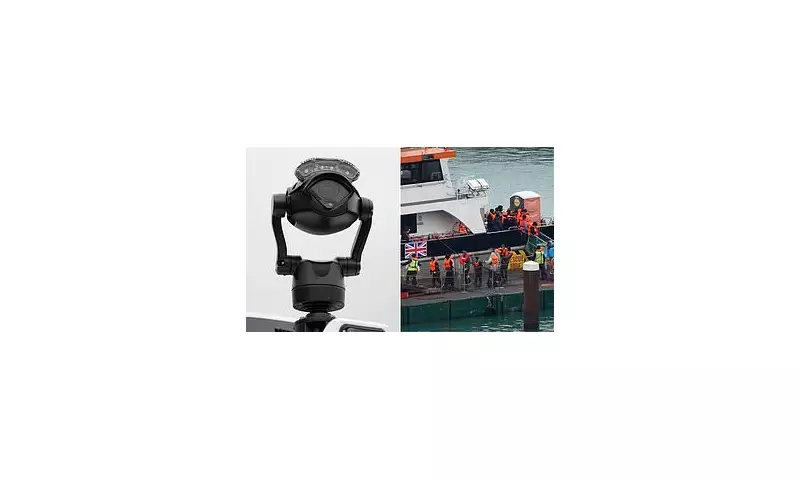
The UK government has begun deploying live facial recognition (LFR) cameras at key ports in a major new push to identify and detain illegal migrants and wanted criminals. The specialist surveillance technology, which scans the faces of passersby in real-time and checks them against watchlists, has already been trialled with success at Holyhead port in Wales.
Holyhead Trial: Scanning Thousands, Securing One Arrest
The initial pilot scheme took place at the end of last year at Holyhead, the UK's second busiest passenger ferry port and a crucial entry point from the Republic of Ireland. More than 400,000 lorries and 400,000 cars pass through the port annually, making it a significant focus for border security.
During the trial, Immigration Enforcement and Border Force staff used a total of 15 cameras. The system cross-checked the faces of individuals against a watchlist containing almost 5,000 wanted immigration offenders. Out of 7,512 faces scanned, the technology triggered two alerts. This led to the arrest of one individual, with no false alarms reported.
This marked the first time Immigration Enforcement officers have utilised live facial recognition. The Home Office stated the overall aim was to 'ensure border integrity and protect the public from harm' by pinpointing those on agreed watchlists.
National Rollout and Policing's 'Biggest Breakthrough'
Following the Holyhead trial, the technology is now expected to be rolled out to other major ports across the United Kingdom. It has already seen use at airports like Manchester, where it created a 'contactless' entry system that considerably reduced waiting times, according to Border Force Director General Phil Douglas.
Plans are also advancing for all police forces in the country to adopt the scanners. The Home Office claims they have already been instrumental in catching rapists, domestic abusers, and other violent offenders. Policing Minister Sarah Jones hailed LFR as the 'biggest breakthrough for catching criminals since DNA matching'.
'We will expand its use so that forces can put more criminals behind bars and tackle crime in their communities,' Jones added. A new national face-matching system is also on trial, allowing police to search millions of custody images in seconds.
Mounting Pressure Amid Record Migration Figures
The expansion of high-tech border controls comes against a backdrop of sustained pressure on UK immigration routes. Last year saw the second highest annual number of illegal migrant arrivals on record, with 41,472 people entering the UK. This figure was 13% higher than 2024 and 41% higher than 2023.
The small boats crisis continues, with migrants packing into vessels at increasing density. An average of 62 people arrived per boat in 2025, up from 53 in 2024 and 49 in 2022.
Prime Minister Keir Starmer faces intense political scrutiny, as he is now less than 1,000 migrants short of the record for the most Channel crossings during a premiership—a record currently held by Boris Johnson. The Conservative and Reform parties have criticised Labour's approach, blaming a reluctance to withdraw from the European Convention on Human Rights (ECHR) for the failure to stem the flow.
Shadow Home Secretary Chris Philp argued that 'small boat crossings are the inevitable product of a system that guarantees entry and obstructs removal', while Reform UK leader Nigel Farage called the government's plan to 'smash the gangs' a 'complete disaster'.
As the political debate rages, the deployment of live facial recognition at Britain's borders represents a tangible technological step being taken to assert control, with the Holyhead trial serving as a proof of concept for a wider national security strategy.