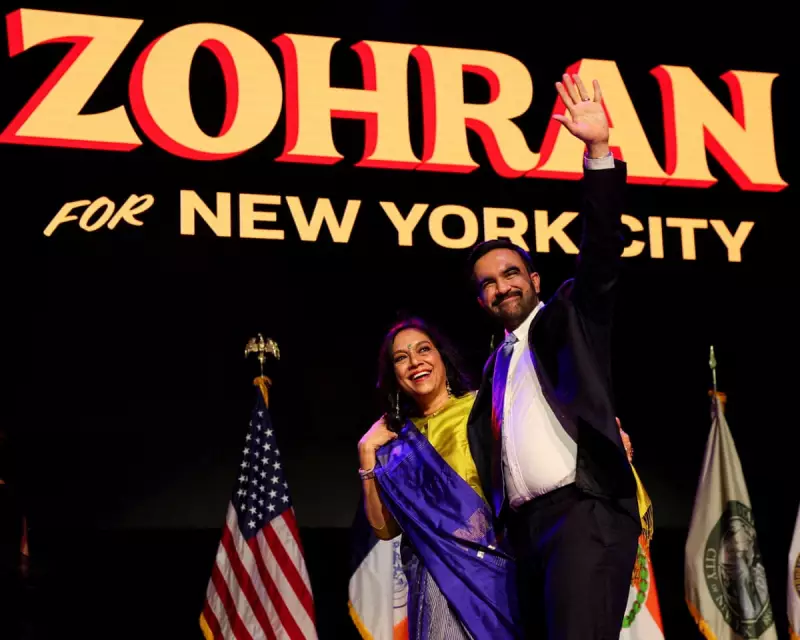
In a historic political moment that captured global attention, Zohran Mamdani has been elected as New York City's first Muslim mayor, becoming the youngest person to hold the office since 1892. The newly-elected leader took to the stage with his mother, acclaimed film director Mira Nair, in a celebration that highlighted the profound cultural influences shaping his groundbreaking political vision.
The Cinematic Foundation of a Political Movement
While headlines naturally focused on Mamdani's unprecedented political rise, campaign directors revealed that his passionately inclusive politics owe significant debt to the boundary-breaking films of his mother. Mira Nair, a pioneering film-maker with a career spanning more than three decades, has continually reshaped how south Asian identity is portrayed on screen through works like Salaam Bombay! and Monsoon Wedding.
Born in India and educated in Delhi and at Harvard, Nair has always straddled multiple worlds. This unique perspective of navigating different cultures, geographies and emotional landscapes sits at the heart of her storytelling approach - and now appears to fundamentally inform her son's political philosophy.
From Silver Screen to City Hall: A Legacy of Inclusion
Nair's debut feature, Salaam Bombay! (1988), described by critics as fiercely unsentimental and throbbing with energy, provided a visceral portrait of life on the streets for India's abandoned children. The film earned an Oscar nomination for best foreign language film - making it only the second Indian film to ever receive this honour - and won the Caméra d'Or for debut directors at Cannes.
More significantly, Nair used the film's proceeds to establish the Salaam Baalak Trust, a nonprofit that continues providing support for street children in Delhi and Mumbai today. This commitment to transforming artistic success into tangible social change demonstrates the ethical foundation that would later influence her son's approach to public service.
Her 1991 follow-up, Mississippi Masala, starring Denzel Washington and Sarita Choudhury, broke new ground as one of the earliest films to explore racial complexities faced by Indian immigrants in America's deep south. Through its interracial love story, the film tackled themes of identity, displacement and belonging with rare sensitivity, winning the prize for best screenplay at the Venice Film Festival.
Mainstream Success and Cultural Impact
It was Monsoon Wedding (2001) that cemented Nair's mainstream success while maintaining her distinctive voice. The vibrant family dramedy, set during a chaotic Delhi wedding, captured the tension between tradition and modernity with joyous, unsentimental tone. The film won the Golden Lion at Venice and became a global hit, particularly resonating with British south Asians who connected deeply with its exploration of diaspora identity, arranged marriage and familial dysfunction.
Nair continued exploring cultural duality with 2006's adaptation of Jhumpa Lahiri's The Namesake, creating one of the most emotional explorations of living between two worlds ever put on screen. Her 2012 adaptation of Mohsin Hamid's The Reluctant Fundamentalist, featuring Riz Ahmed as a Pakistani man imperilled in post-9/11 America, demonstrated her continued commitment to provocative storytelling.
Throughout her career, Nair's work has consistently disrupted stereotypes imposed on south Asians in cinema. Her characters are complex, her narratives expansive, defined by contradiction, intimacy and emotional truth. Though unapologetically political, her films avoid didacticism, allowing themes to unfold through the language of family and memory.
The Political Inheritance
This same nuanced vision appears to have fundamentally shaped her son's political outlook. Mamdani, a former housing rights activist and state assemblyman, has frequently spoken about the influence of his parents, particularly his mother's emphasis on cultural rootedness and justice.
Nair's influence extends beyond cinematic achievement into what might be described as cultural activism - bringing dignity and humanity to marginalised lives through storytelling. From street children and undocumented migrants to queer lovers and second-generation immigrants, her protagonists are never peripheral figures. They occupy the centre of the narrative, their experiences rendered with depth and respect.
Even as Nair expanded into new creative forms - directing opera, teaching, and founding a film school in Kampala - her commitment to storytelling as empowerment has remained unwavering. Her most recent work, the series A Suitable Boy (2020) adapted from Vikram Seth's novel, made history as the first BBC series to feature an all-Indian cast.
As New York City welcomes a mayor who represents a new kind of American leadership - young, brown, Muslim - the through-line becomes unmistakable. Long before her son ever canvassed a street in Queens, Mira Nair was laying the groundwork for a more inclusive cultural landscape, one film at a time.
Mamdani paid direct tribute to this legacy in his victory speech, stating: To my parents, mama and baba: You have made me into the man I am today. I am so proud to be your son. The statement serves as powerful acknowledgement that the values driving his historic mayoralty were cultivated through a lifetime of artistic and cultural engagement with the very issues now central to his political mission.