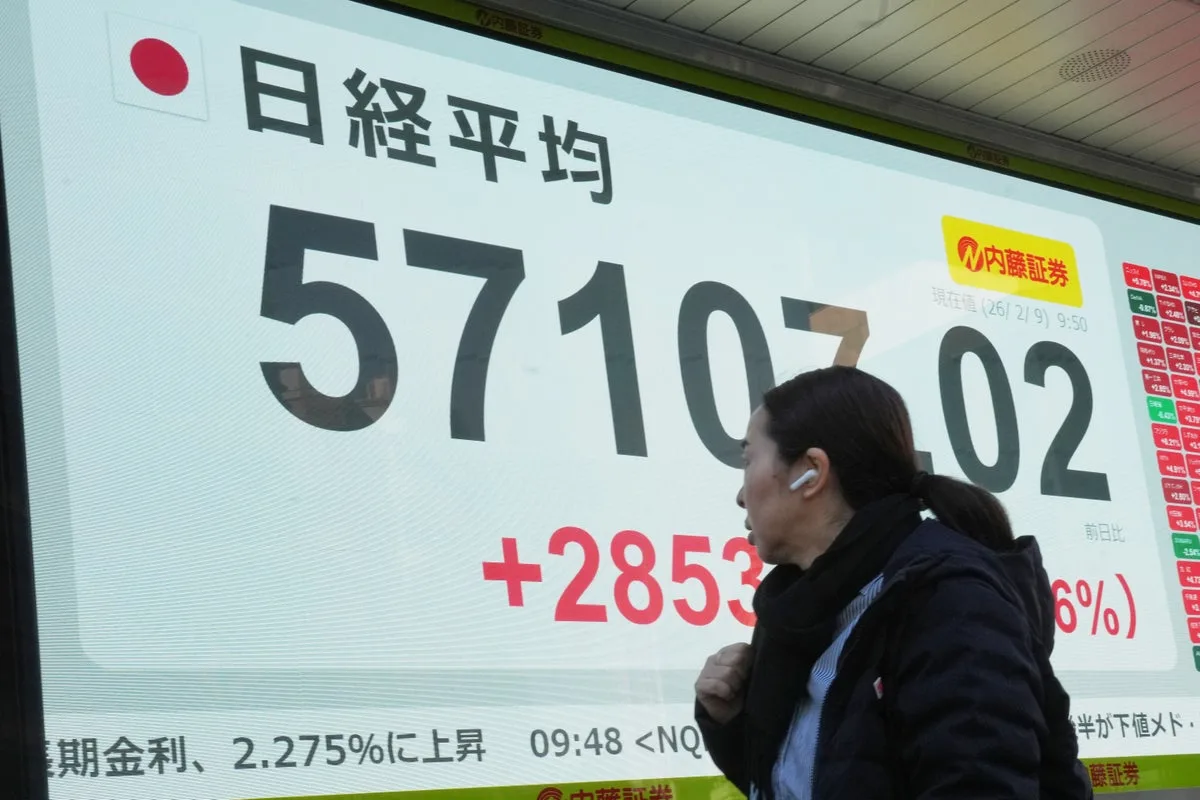
Tokyo's benchmark Nikkei 225 share index has experienced a significant surge, jumping 4.7% on Monday. This dramatic rise follows the decisive victory of Japanese Prime Minister Sanae Takaichi's governing party, which secured a commanding two-thirds supermajority in a recent parliamentary election. The political outcome has injected considerable optimism into financial markets, with investors anticipating a period of stable, market-friendly governance under Takaichi's leadership.
Historic Election Victory for the LDP
According to results from public broadcaster NHK, Prime Minister Takaichi's Liberal Democratic Party (LDP) alone secured an impressive 316 seats by early Monday. This comfortably surpasses the 261-seat absolute majority required in the 465-member lower house, which is the more powerful chamber of Japan's two-chamber parliament. This achievement marks a historic record for the party since its foundation in 1955, exceeding the previous record of 300 seats won in 1986 under the late Prime Minister Yasuhiro Nakasone.
In a statement to NHK, Prime Minister Takaichi affirmed her commitment to pursuing policies aimed at making Japan strong and prosperous. Her first major legislative task, when the lower house reconvenes in mid-February, will be to work on a delayed budget bill. This funding is crucial for implementing economic measures designed to address pressing issues such as rising costs and sluggish wages, which have been a concern for many Japanese citizens.
Asian Markets Rally in Unison
The positive sentiment emanating from Tokyo spread rapidly across the Asian region, lifting other major indices. South Korea's Kospi surged 4.3%, while Hong Kong's Hang Seng index climbed 1.5% and the Shanghai Composite rose 1%. Taiwan's Taiex gained 2.4%, and Australia's S&P/ASX 200 surged 1.9%. This widespread advance was bolstered by a robust rally on Wall Street the previous Friday, where technology stocks recovered significant losses from earlier in the week.
By late morning trading in Tokyo, the Nikkei 225 was up 4.7% at 56,788.85, having briefly topped the 57,000 level earlier in the session to set a new all-time record. The Kospi followed closely, gaining 4.3% to reach 5,308.84. The combination of a rebound in tech shares, Wall Street's strong performance, and the upbeat political news from Japan created a perfect storm of bullish momentum across Asian financial markets.
Wall Street's Influence and Tech Sector Recovery
On Friday, the U.S. stock market roared back with impressive gains. The S&P 500 rallied 2% for its best single-day performance since May. The Dow Jones Industrial Average soared 1,206 points, or 2.5%, surpassing the 50,000 level for the first time in its history. The Nasdaq composite leaped 2.2%, driven largely by a recovery in technology stocks.
Computer chip companies were at the forefront of this widespread rally. Nvidia jumped 7.8%, significantly trimming its loss for the week, while Broadcom climbed 7.1%, completely erasing its weekly decline. However, despite Friday's surge, the S&P 500 still recorded its third losing week in the last four. Market concerns persisted regarding spending by Big Tech companies and fears that artificial intelligence might disrupt traditional software firms, particularly after AI company Anthropic released free tools to automate services like legal work.
Cryptocurrency and Commodities Stabilise
In parallel developments, Bitcoin steadied following a weekslong plunge that had sent it more than halfway below its record price set in October. The cryptocurrency climbed back above the $70,000 mark after briefly dropping close to $60,000 late Thursday. Meanwhile, prices in the metals market also calmed following their own recent volatility. Gold rose 1.8% to settle at $4,979.80 per ounce, while silver added a modest 0.2%.
The overall financial landscape reflects a complex interplay of political stability, technological innovation, and global market dynamics. Prime Minister Takaichi's historic supermajority victory has provided a clear catalyst for renewed investor confidence in Japan, with ripple effects felt across Asia and beyond.






