

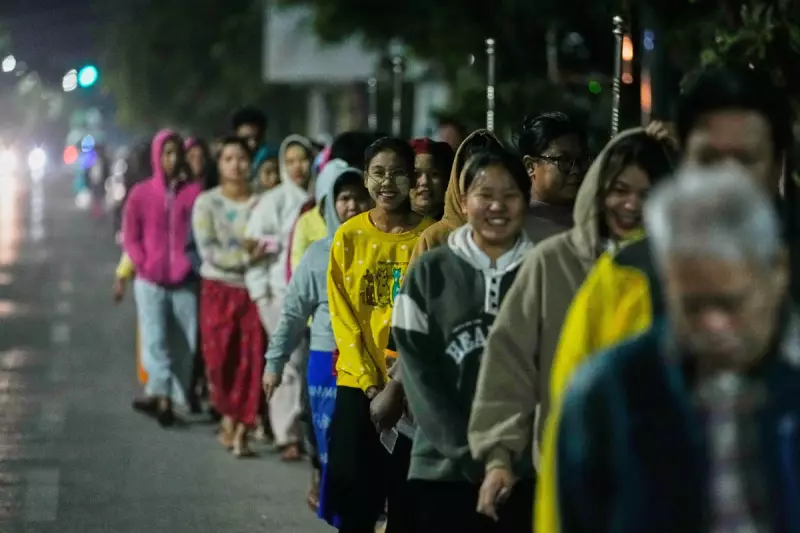
Myanmar's military government has proceeded with the second phase of its first general election in five years, extending polling to additional townships despite ongoing civil war and widespread international condemnation.
Voting Expands into Conflict Zones
On Sunday, 11 January 2026, polling stations opened at 6 a.m. local time across 100 townships. This included areas in the Sagaing, Magway, Mandalay, Bago and Tanintharyi regions, as well as Mon, Shan, Kachin, Kayah and Kayin states. Many of these locations have experienced recent clashes or remain under tight security, highlighting the volatile environment surrounding the vote.
The election is being conducted in three phases due to armed conflicts. The first round was held on 28 December in 102 townships. A final round is scheduled for 25 January, although 65 townships will be excluded entirely because of active fighting.

Mixed Turnout and Government Claims
Initial observations from Associated Press journalists in Yangon and Mandalay indicated subdued participation. Voter numbers at over ten polling stations ranged from roughly 150 at the busiest to just a handful at others, appearing significantly lower than during the 2020 election.
The military government stated there were over 24 million eligible voters for this election, a figure about 35% lower than in 2020. Authorities claimed the first phase was a success, with ballots cast by more than 6 million people, representing about 52% of eligible voters in that round. Mandalay's chief minister, Myo Aung, asserted that turnout on Sunday was higher than in December.
Some voters, like Maung Maung Naing in Mandalay, expressed hope for a government that would improve livelihoods. Independent candidate Sandar Min from Yangon stated she was participating to work for change and reduce suffering, despite criticism of the process.
Widespread Criticism and a Dominant Military-Backed Party
Critics, including the United Nations, have dismissed the election as a sham designed to legitimise military rule following the February 2021 coup that ousted Aung San Suu Kyi's elected government. Tom Andrews, a UN special rapporteur, cited coercion, violence, and political exclusion.
The political landscape is heavily constrained. Aung San Suu Kyi, 80, is serving a 27-year prison sentence, and her National League for Democracy party was dissolved in 2023. Many parties boycotted the polls, while opposition groups called for a voter boycott.
Under a new Election Protection Law, authorities have charged more than 330 people for leafleting or online criticism. According to the Assistance Association for Political Prisoners, over 22,000 people are detained for political offences, and more than 7,600 civilians have been killed by security forces since 2021.
Despite over 4,800 candidates from 57 parties competing, the military-backed Union Solidarity and Development Party (USDP) is in a dominant position. It won nearly 90% of contested seats in the lower house during the first phase and a majority in regional legislatures.
Myanmar's parliament has 664 seats across two houses, with the military constitutionally allocated 25% of the seats in each. The party securing a combined parliamentary majority will select the next president and form a government.






