Early Voting Commences for Iraq's Crucial Parliamentary Election
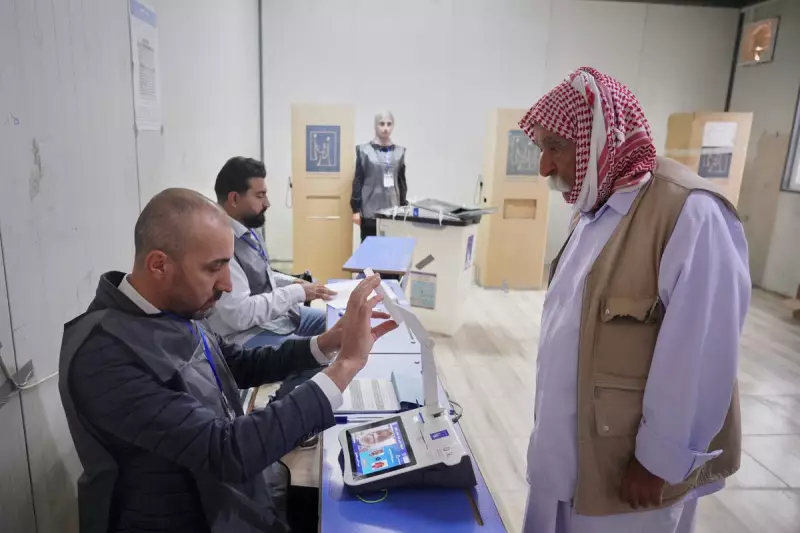
Members of the Iraqi security forces and displaced individuals, including those from the minority Yazidi community, began casting their ballots on Sunday in a significant early voting process ahead of the country's parliamentary election. This pivotal vote will help determine whether Prime Minister Mohammed Shia al-Sudani secures a second term, unfolding against a backdrop of regional instability and Iraq's delicate diplomatic balancing act between Tehran and Washington.
A Polling Station in Dohuk: Yazidis Seek a Voice
In the semi-autonomous northern Iraqi Kurdish region, a polling station set up in a small school near Dohuk saw a slow start, with voters trickling in after 9 a.m. Many of these voters were Yazidis, who fled their homes over a decade ago following brutal attacks by the Islamic State group. They arrived clutching worn identification cards, some guiding elderly relatives to the entrance. Inside the classrooms, the scene was crowded with dozens of monitors representing rival parties and candidates.
The Yazidi community suffered immensely during the IS terror campaign, when militants rampaged through Iraq’s Sinjar district in Nineveh province, killing and enslaving thousands whom the extremist group considered heretics. Despite the defeat of IS in Iraq and Syria, many Yazidis see an uncertain future in Sinjar. Political disputes and a stark lack of infrastructure have prevented a full return, with the area remaining carved up by multiple armed groups.
"Eleven years passed and the situation is the same," said Khedhir Qassim, a displaced Yazidi from Sinjar who voted at the camp in Dohuk. He expressed little faith that new leaders would bring meaningful change. "We want them to support us and rebuild our areas that are ruined due to their political dispute and where everyone works for their own benefit."
Another voter, Edris Zozani, explained his strategic choice to support the Kurdish Democratic Party (KDP), one of the country's two main Kurdish parties. "If we have independent Yazidi candidates, they wouldn’t be able to represent us effectively," he said. "But if they go to parliament as part of strong lists, like the KDP, they would be in a better position to support the Yazidi community."
Security Personnel and Militias Vote in Baghdad
Meanwhile, in the Iraqi capital of Baghdad, a different segment of the electorate was making its voice heard. Iraqi soldiers, police, and members of the Popular Mobilization Forces (PMF)—a coalition of primarily Shiite, Iran-backed militias that united to fight IS—participated in the early voting. An estimated 1.3 million army and security personnel were eligible to cast their ballots in this early phase.
The fate of the PMF is set to be a contentious issue for the next parliament. Although formally placed under military control in 2016, the coalition still operates with significant autonomy. Tensions between Baghdad and Washington over the presence of Iran-backed militias in Iraq add to the complexity. Parliament has been considering legislation to solidify the relationship between the military and the PMF, a move that has drawn objections from the United States.
One militiaman in Baghdad, who spoke on condition of anonymity, stated, "I voted for the list that defends the PMF." He did not specify which list he supported. Several of the armed groups within the PMF have associated political parties participating in the election.
The Stakes of the Election
With 7,744 candidates competing, most aligned with largely sectarian parties, the election's outcome is highly anticipated. The main election day is set for Tuesday. Alongside the 1.3 million security personnel, around 26,000 displaced people were eligible for the early vote, highlighting the challenges of inclusive participation in a nation still grappling with the aftermath of conflict and displacement.