
France has begun voting in the first round of municipal elections, widely regarded as a crucial test of the political climate ahead of next year’s presidential election. The vote for mayors and councillors in 35,000 villages, towns and cities across the country is focused on local issues such as security, housing and refuse collection, but the results—particularly in larger towns and cities—will be closely scrutinised for what they reveal about party strategies and alliances in France’s increasingly fragmented political landscape.
With President Emmanuel Macron’s two terms ending next year, uncertainty surrounds which candidates will contest the presidency of the EU’s second-largest economy. Parliament remains divided after Macron called a snap election in 2024, with no absolute majority among the left, far right and centrists. The far-right, anti-immigration National Rally (RN) is seen as a key contender in the presidential race, but has historically struggled at the local level and lost councillors in the last municipal elections in 2020.
Voter turnout at 5pm on Sunday stood at 48.9%, higher than at the same point in the 2020 local elections, when the Covid pandemic kept many voters at home, but lower than the 2014 municipal elections. The RN is seeking to hold on to Perpignan, the largest city it runs (population 121,000), and hopes to win other cities including Toulon and Nîmes. A significant victory in a large city would allow the party to claim it is building momentum. The RN is also the main opposition challenger in Marseille, France’s second-largest city, run by a leftwing coalition since 2020.
In Nice, Éric Ciotti—who quit as leader of the traditional right party Les Républicains (LR) to join forces with the RN in 2024—is hoping to win the city from his bitter rival, Christian Estrosi. How the RN fares in some cities will depend on whether parties on the left form alliances or agreements to block the far right between the first and second rounds. Historically, France’s major cities have been governed by centre-left groupings or Les Républicains. Green-led coalitions, which won significant cities in 2020 including Lyon, are under pressure as they try to hold on to their gains. The radical left La France Insoumise (LFI) is also seeking a local foothold, targeting mayoral posts in towns such as Roubaix.
Any local deals that bring the traditional right and the far right closer together, breaking a historical division, are being carefully watched. Similarly, it remains to be seen whether leftwing coalitions led by Socialists can form deals with LFI to hold back potential RN gains, for example in Marseille. François Kraus, head of political studies at the IFOP polling institute, said the municipal vote should not be seen as a “primary for the presidential election” but would nonetheless reveal key trends and dynamics, providing “a useful barometer of the political climate”.
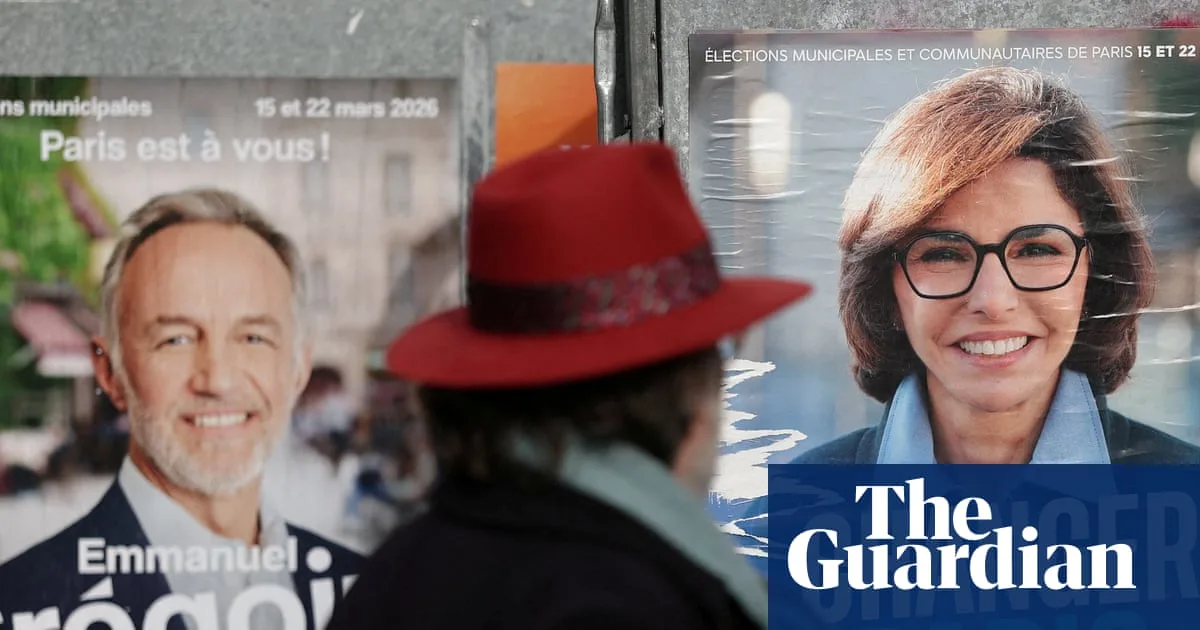
A key focus will be the battle for mayor of Paris. The right’s Rachida Dati, who served as culture minister under Macron and justice minister under Nicolas Sarkozy, is seeking to take the capital from the left, which has held power for 25 years. Dati, the first woman of North African and Muslim heritage to hold a major French government post, is one of the best-known candidates. In September, she will go on trial in Paris for alleged corruption and abuse of power, accused of lobbying for the Renault-Nissan carmaking group while she sat in the European Parliament.




