

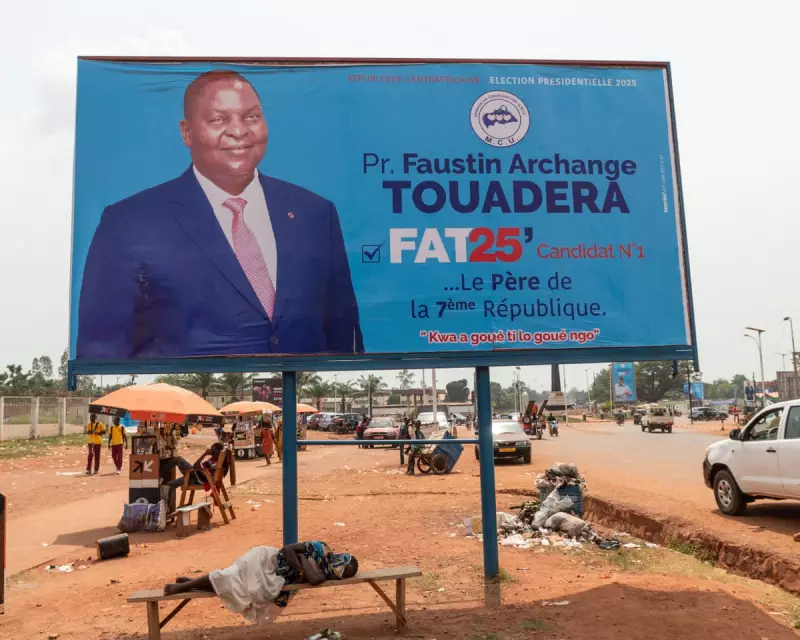
Voters in the Central African Republic (CAR) are heading to the polls this Sunday in a critical electoral test, with President Faustin-Archange Touadéra seeking to extend his rule amidst a fragile security landscape and significant political controversy.
A Nation at a Crossroads
This Sunday's vote is being described by observers as a "quadruple election", with citizens casting ballots not only for the presidency but also for parliamentary, local, and municipal offices. Approximately 2.3 million registered voters are eligible to participate in this complex electoral process.
President Touadéra, a former mathematics professor who has held power since 2016, is widely anticipated to win another term. His path was cleared by a 2023 constitutional referendum that abolished presidential term limits and extended the length of a single term from five to seven years.

Opposition Hopes and Electoral Hurdles
Seven candidates are competing for the presidency. Key challengers include former prime ministers Anicet Georges Dologuélé – the runner-up in both the 2015 and 2020 elections – and Henri-Marie Dondra, who briefly served under Touadéra. Both were permitted to stand by the constitutional court after initial bans.
The opposition aims to channel widespread public frustration in a nation where conflict remains a daily reality. Over half a million people are internally displaced within CAR, with a similar number living as refugees in neighbouring countries.
However, significant concerns cloud the electoral process. Critics point to irregularities, such as the voter list being published only online in a country with scarce internet access and electricity, potentially disenfranchising large segments of the population. These issues have prompted a faction of opposition politicians to announce a boycott.
Security, Foreign Influence, and a Fragile Peace
The vote occurs against a backdrop of persistent insecurity. The UN peacekeeping mission, Minusca, whose mandate was recently renewed, is providing crucial security and logistical support for the elections, compensating for the state's crumbling infrastructure.
President Touadéra's reliance on foreign security partners is a defining feature of his tenure. He has notably placed faith in the Russian mercenary firm Wagner, which provides part of his personal security detail. Despite the death of Wagner's founder, Yevgeny Prigozhin, Touadéra has resisted Moscow's calls to integrate the fighters into its successor entity, the Africa Corps.
In contrast, Rwandan troops, operating under a different model, have helped secure the countryside. The government's partnerships have sparked accusations of selling national assets, highlighted by a recent pro-opposition media claim that soldiers were evicted from a World Bank-funded youth centre to make way for a Rwandan livestock operation.
Yet, there are glimmers of hope. A peace accord signed in April with two main rebel groups and what Human Rights Watch's central Africa director, Lewis Mudge, called "tangible progress to establish peace" suggest the country might be slowly stabilising. UN official Abdou Abarry also commended the country's "remarkable recovery," while acknowledging ongoing challenges.
As polls open, the people of the Central African Republic are weighing hopes for stability against fears of deepened foreign influence and democratic backsliding, making this one of the most consequential votes in the nation's recent history.






