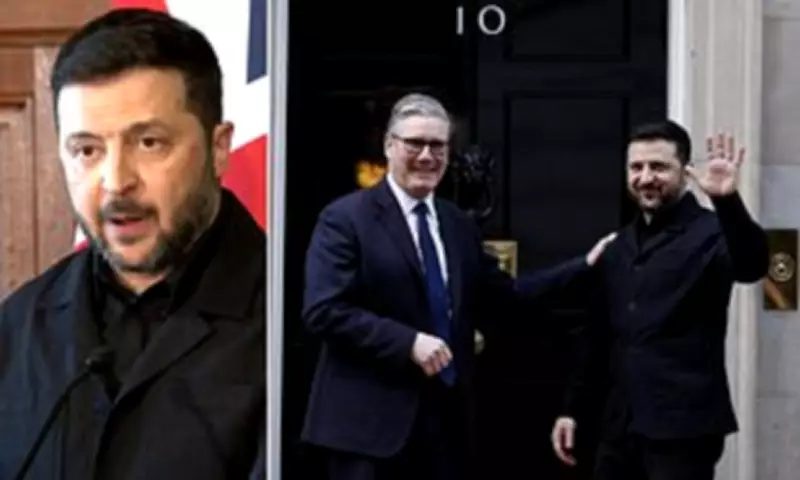
Ukrainian President Volodymyr Zelensky delivered a powerful and emotionally charged address to British parliamentarians at Westminster this afternoon, his raw urgency and dynamic delivery serving as a stark contrast to what he characterised as a complacent political establishment. The wartime leader from Kyiv directly confronted MPs and peers with a message that shamed what he portrayed as Britain's conniving political class.
A Direct Confrontation with Western Complacency
Zelensky, speaking with a rasping, guttural voice that sometimes challenged comprehension but never obscured his meaning, stood before parliament in a dark tunic and delivered what observers described as an arresting, fervent performance. For four years, he reminded the chamber, Ukraine has been fighting a murderous invasion orchestrated by what he called the "sly psychopath in the Kremlin." His people live in bomb shelters, under air shelter nets, exhausted and damaged, with death haunting their dreams.
Technological Innovation Born of Necessity
Yet remarkably, it was Zelensky who offered assistance to Britain. He detailed the technological leaps Ukraine has been forced to make to survive attacks from Moscow and Tehran, announcing an offer to export 1,000 Ukrainian drones daily to the Persian Gulf region. "We focus on speed," he told what he implicitly characterised as a room of ineffectual dawdlers. "Our strength is not by chance. This is the result of work. We can do it. Our solutions work."
The Ukrainian president delivered a scathing assessment of the geopolitical landscape, describing Vladimir Putin and Iran's leadership as "brothers in hatred." This formulation stood in sharp contrast to recent parliamentary debates where some left-wing MPs have placed those same actors on what they suggest is a comparable moral level to the United States.
Westminster's Contrasting Priorities
As Zelensky spoke, the contrast with Westminster's ordinary business could not have been more pronounced. While he addressed the urgent threats at Europe's eastern gates, the Commons chamber occupied itself with rubber-stamping the creation of eleven additional salaried ministerial positions. Observers noted the symbolic disconnect between Ukraine's existential struggle and Britain's bureaucratic expansion.
An Unseen Audience of Power
The event's impact on Britain's ruling caste remains partially obscured due to restrictions placed on journalists. Sketch writers were forbidden from attending in person, forced instead to watch proceedings on a one-dimensional screen. This made it impossible to determine which Cabinet members, if any, were present in Committee Room 14 to hear Zelensky's remarkable call to strengthen defences.
Labour leader Sir Keir Starmer attended but remained out of camera shot for much of the event. NATO Secretary General Mark Rutte and Business Secretary Kemi Badenoch were also confirmed present, but the official prohibition on journalist attendance limited detailed reporting about the audience's composition and reactions.
Parliamentary Responses and Parallel Events
Lord Forsyth, Speaker of the House of Lords, acknowledged the address as "inspiring" and quoted from W.E. Henley's poem Invictus, which praises an "unconquerable soul" and concludes with the declaration "I am the captain of my soul." Forsyth suggested Zelensky embodied this spirit, while implicitly questioning whether Britain could claim the same.
Earlier the same day, the word "inspiring" had been applied with considerably less justification to Chancellor Rachel Reeves's Mais Lecture, which signalled potential regulatory surrender to Brussels according to critics. A moderator described Reeves's effort as "inspiring" and added, "I have really enjoyed the enthusiasm," prompting scepticism about the term's dilution.
Defence Questions Loom Large
Elsewhere in Westminster, a select committee heard from the new permanent secretary at the Ministry of Defence, whose presence failed to reassure observers. Sitting alongside an air marshal repeatedly addressed by his first name "Tim" rather than his surname, the committee learned that the MoD employs 55,000 civil servants—a bureaucratic apparatus that stood in ironic contrast to Zelensky's emphasis on agility and decisive action.
Zelensky's central question hung in the air long after his departure: "Why does our Prime Minister never speak with such limpid instancy? Why are our leaders not able to join the hostile dots and communicate the threat?" In a parliament often accused of mediocrity, his visit served as a potent reminder of what genuine statesmanship looks like—even as institutional barriers prevented full witness to its impact.