Zelensky's Passionate Davos Address Challenges European Complacency
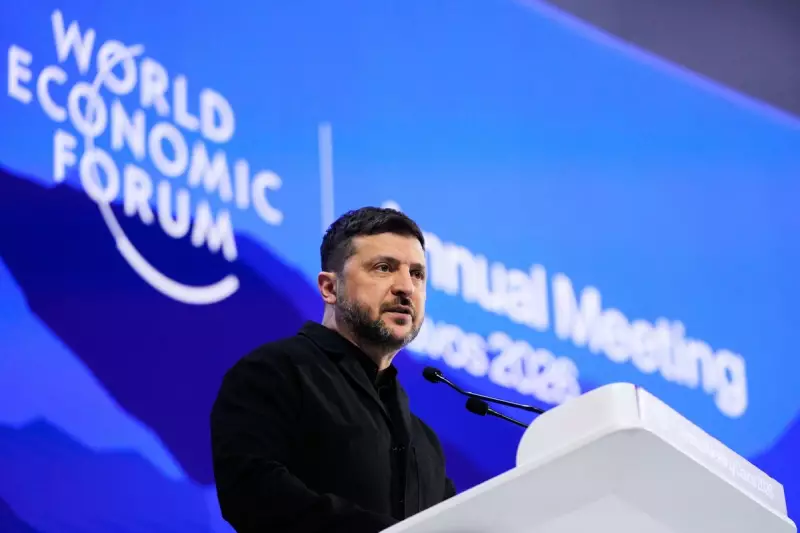
In a powerful and emotionally charged speech at the World Economic Forum in Davos, Ukrainian President Volodymyr Zelensky delivered a stark wake-up call to European leaders, accusing them of failing to live up to their global responsibilities while his nation continues to defend itself against Russian aggression.
The wartime leader, whose country approaches the fifth anniversary of Russia's full-scale invasion, pulled no punches in his assessment of European political fragmentation and lack of decisive action.
"Europe is Just a Salad" - A Stinging Critique of Continental Division
"We should not accept that Europe is just a salad of small and middle powers, seasoned with enemies of Europe," Zelensky declared to a silent audience of global leaders, business titans, and European bureaucrats.

His vivid metaphor highlighted what he sees as Europe's fundamental weakness: a collection of nations more focused on internal disagreements than presenting a united front against common threats. The Ukrainian president argued that this fragmentation prevents Europe from becoming the "great power" it has the potential to be on the world stage.
Contrasting Global Responses to Authoritarian Regimes
Zelensky drew pointed comparisons between different international approaches to dealing with authoritarian leaders, noting that while former US President Donald Trump had taken decisive action against Venezuela's Nicolás Maduro, "Putin is not on trial" despite leading Europe's largest conflict since World War II into its fourth year.
This comparison served to underscore his central argument: that Europe has consistently failed to match its rhetoric about defending democratic values with concrete action when faced with genuine threats to those values.
The "Groundhog Day" of European Inaction
The Ukrainian leader described European foreign policy as being stuck in a repetitive cycle, telling the Davos audience: "We are living in Groundhog Day." He cited multiple examples where European nations had failed to coordinate effective responses:
- Inadequate support during what he called the "bloodbath" in Iran
- Failure to establish a united position on Greenland
- General reluctance to take leadership when American focus shifts elsewhere
Zelensky argued that this pattern reveals a deeper problem in European political culture: "Some European leaders are from Europe, but not always for Europe."
A Call for Strategic Independence from American Influence
Perhaps his most significant challenge to European leaders was his argument that they must stop looking to Washington for direction. Zelensky noted that when European nations did stand up to Trump over Greenland, the American president backed down - proof that "Europe can be strong when it chooses to be."
He criticized what he sees as a European tendency to "hope someone else will do it for them" when it comes to defending continental interests, suggesting this passive approach fundamentally misunderstands how great powers must operate in the modern world.
Shifting Narratives and Military Realities
Zelensky's address came amid what analysts describe as a marked shift in understanding of the Ukraine conflict. Military experts and Davos delegates increasingly challenge the narrative that Kyiv cannot win against Russian forces, with many now arguing the opposite.
His speech found support from other prominent figures at the forum, including:
- Canadian Prime Minister Mark Carney
- Finnish President Alexander Stubb
- Keith Kellogg, former Trump special envoy to Kyiv
These leaders joined Zelensky in calling for Europe to recognize its collective power and take greater responsibility for regional security, particularly as American attention continues to shift toward other global priorities.

A Vision for Ukraine's European Future
Beyond immediate military needs, Zelensky's address served as a powerful argument for Ukraine's eventual integration into European structures. He presented his nation not just as a country fighting for survival, but as a potential catalyst for European renewal - a nation whose struggle could inspire the continent to finally embrace its potential as a unified global force.
The emotional intensity of his delivery reflected the high stakes: a leader fighting for his country's existence while simultaneously challenging an entire continent to rediscover its purpose and power in an increasingly unstable world order.