Three Palestinians Killed in West Bank Settler Clash, Week's Death Toll Rises to Six
Three Palestinians have been killed in a violent clash with Israeli settlers in the occupied West Bank on Sunday, escalating tensions as regional conflict with Iran dominates attention. This incident brings the number of Palestinian fatalities from recent violence to six, highlighting a surge in hostilities during the ongoing Middle East war.
Details of the Fatal Incident
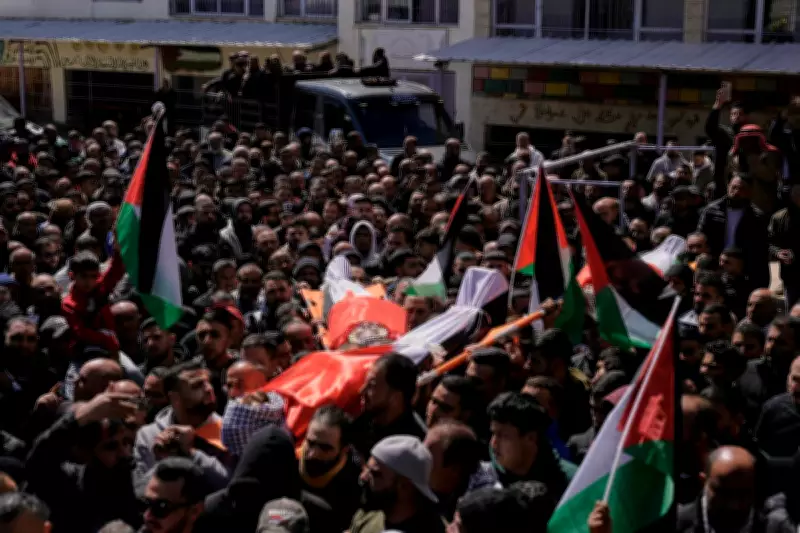
The Israeli military reported responding to attacks by settlers near Khirbet Abu Falah, east of Ramallah. According to official statements, two Palestinians died from gunfire, while a third succumbed to suffocation, likely caused by tear gas. The victims have been identified as cousins Fare' Hamayel and Thaer Hamayel, along with Mohammad Murra, all of whom were buried in a joint funeral ceremony.
Witness Amin Shouman, a resident of Abu Falah, described to The Associated Press how dozens of Israeli settlers approached the village from the north and opened fire when confronted by a local community guard committee. This account underscores the volatile nature of the encounter.

Context of Rising Violence
Sunday's fatalities follow several deadly incidents last week, including the killing of a Palestinian in the South Hebron Hills by an Israeli reservist on Saturday and the shooting deaths of two Palestinian brothers by settlers in the northern West Bank on Monday. Data from the United Nations Office for the Coordination of Humanitarian Affairs reveals that in 2025, 240 Palestinians were killed in the territory, with the majority attributed to Israel's military and nine to settlers. This year, however, a significantly larger proportion of fatalities has been directly linked to armed settlers.
In a rare move, the Israeli military strongly condemned the settler violence and announced a criminal investigation into those involved. Maj. Gen. Avi Bluth, commander of the Central Command overseeing the West Bank, stated, "This is an unacceptable incident. There will be zero tolerance for civilians who take the law into their own hands. Especially at a time when the IDF is striking our bitter enemies, Iran and Hezbollah, with a firm hand—we cannot allow reckless internal violence to undermine the rule of law and the security of the region."
Broader Implications and Challenges
Palestinians and human rights groups have long criticized Israel for failing to hold settlers accountable for violence. The Palestinian Authority's Foreign Ministry accused Israel on Saturday of "exploiting the atmosphere of war" and the lack of international focus on West Bank issues to intensify intimidation, violence, and forced displacement.
Yesh Din, an Israeli rights group, documented over 50 incidents of settler violence against Palestinians in the first four days of the war with Iran, which began on February 28. Additionally, the Palestinian Red Crescent highlighted that checkpoint and gate closures imposed due to the war are creating mounting obstacles for first responders in the West Bank, particularly in cases involving settler violence.
While there is no full lockdown comparable to those following the October 7, 2023, attack or last year's war with Iran, Israel has erected hundreds of new gates across the territory, tightening movement between Palestinian towns and making emergency response significantly more difficult. The Red Crescent noted that there are now around 1,100 gates, up from roughly 800 during last year's conflict.
Doctors and emergency workers report that these movement restrictions severely hamper their ability to respond quickly to violent attacks, especially in communities most vulnerable to settler violence. Many of these areas are under full Israeli military and civil control, far from city-center hospitals, and dependent on roads that can be sealed without notice.