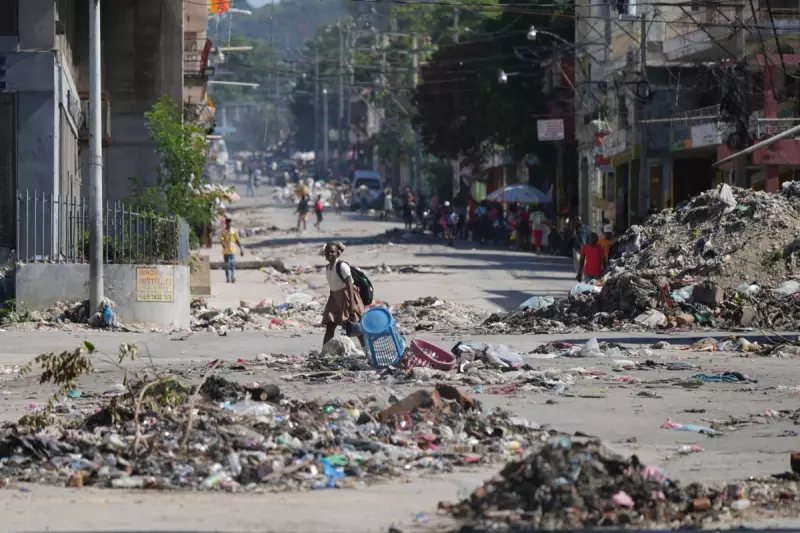
The United States government has delivered a stark warning to Haiti's transitional council, cautioning that it will take decisive action if Haitian politicians pursue moves that could further destabilise the troubled Caribbean nation. This comes as international pressure intensifies on the unelected body to facilitate the country's first elections in over a decade.
US Embassy Issues Direct Warning on Social Media
In a statement posted on the social media platform X, the U.S. Embassy in Haiti explicitly stated that "The United States would consider that any person who supports such a destabilizing initiative, which favors the gangs, would be acting against the interests of the United States, the region, and the Haitian people, and will take appropriate measures accordingly." The embassy emphasised that any political manoeuvring that undermines efforts to establish basic security and stability would be viewed unfavourably.
The warning emerged amidst reported disagreements between some council members and Haitian Prime Minister Alix Didier Fils-Aimé, though specific details remain unclear. The council convened behind closed doors earlier on Wednesday, with representatives from both the prime minister's office and the council's seven voting members declining to comment on the developing situation.

Background of Political Chaos and Transitional Authority
This latest development represents another chapter in Haiti's prolonged political crisis, which escalated dramatically following the assassination of the country's last elected president, Jovenel Moïse, in July 2021. The transitional council was established in April 2024 with assistance from Caribbean leaders after powerful gangs seized control of Haiti's main international airport and targeted critical state infrastructure in unprecedented attacks, ultimately forcing former Prime Minister Ariel Henry to resign.
The council was tasked with selecting Haiti's prime minister to bring some stability to the beleaguered nation. It initially appointed longtime civil servant Garry Conille before dismissing him in November 2025 in favour of Fils-Aimé, a businessman and former head of Haiti's Chamber of Commerce and Industry. The council is theoretically supposed to step down by February 7th, though uncertainty surrounds whether this deadline will be met, with critics alleging some members are attempting to extend their power.
International Concerns and UN Security Council Meeting
Earlier on Wednesday, the U.N. Security Council convened to discuss Haiti's deteriorating situation. Carlos Ruiz-Massieu, special representative of the U.N. Secretary General in Haiti, declared that "Haiti has entered a critical phase in its process of restoring democratic institutions" and emphasised that "the time for political maneuvering is over."
Panamanian Ambassador Eloy Alfaro de Alba highlighted that Haiti stands at a "critical juncture" with only eighteen days remaining before the transitional council's mandate expires. A newly released U.N. report noted that national stakeholders remain divided over the transitional governance architecture meant to lead the country toward elections.
Security Crisis and Humanitarian Toll
The security situation in Haiti remains dire, with gangs estimated to control approximately ninety percent of the capital, Port-au-Prince, and having seized significant territory in the country's central region. According to U.N. figures, more than 8,100 killings were reported across Haiti from January to November last year, with the actual numbers likely higher due to limited access to gang-controlled areas.
Haiti's National Police, assisted by a U.N.-backed mission led by Kenyan police that remains understaffed and underfunded, continues efforts to quell gang violence. This mission is transitioning into a specialised "gang suppression force" with arrest powers targeting suspected gang members. Additionally, the Haitian government has collaborated with a private military contractor to conduct drone strikes against suspected gang members, though these operations have resulted in civilian casualties, including children.

Election Timeline and Future Prospects
The February 7th deadline for the council's departure was established in early 2024 under the assumption that Haiti would have held general elections by that time. Persistent gang violence has prevented officials from conducting elections thus far, though tentative plans currently schedule them for August, with a potential runoff in December. As the deadline approaches, many fear that political instability could trigger renewed violent protests, further complicating Haiti's path toward democratic restoration.