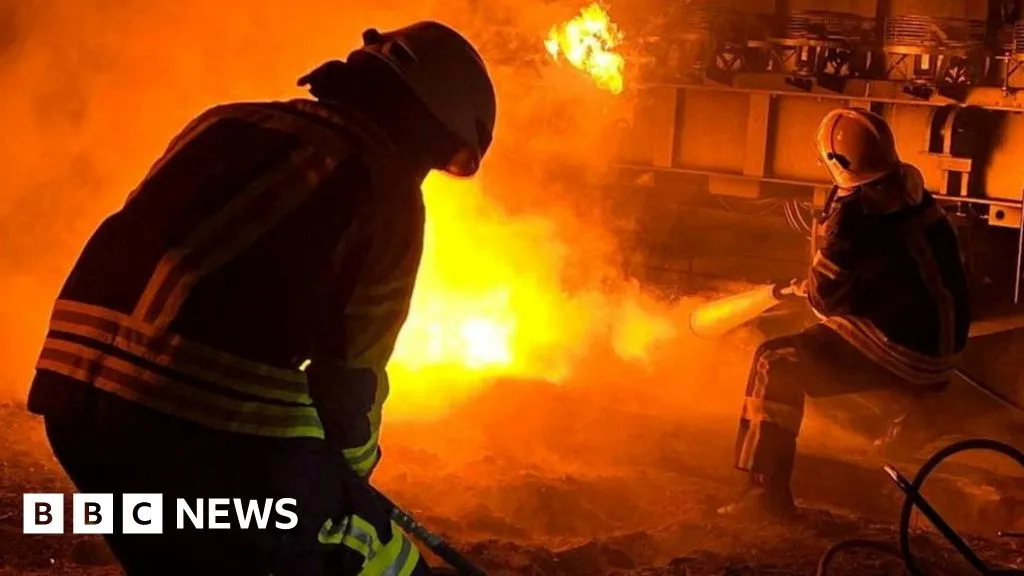
Russian missiles and drones have relentlessly targeted Ukraine's energy infrastructure in recent weeks, creating a humanitarian crisis during one of the country's coldest winters on record. The sustained attacks have plunged millions into darkness and freezing conditions, raising urgent questions about the legality of such military actions under international law.
Ukraine's Accusations of Illegal Targeting
Ukrainian authorities have formally accused Russia of systematically and illegally targeting civilian power infrastructure throughout the ongoing conflict. The stated purpose, according to Kyiv, is to deprive civilians of essential services including lighting, heating, and running water during the harshest winter months.
"Taking advantage of the coldest days of winter to terrorize people is more important to Russia than diplomacy," declared Ukrainian President Volodymyr Zelenskyy on Tuesday. His statement coincided with new diplomatic talks aimed at ending the conflict, while temperatures in the capital Kyiv plummeted to around minus 20 degrees Celsius.
What International Law Says About Energy Infrastructure Attacks
According to international legal experts, combatants may legally target a power grid only under specific conditions. "The attack must directly affect a valid military target," explained David Crane, former chief prosecutor at the United Nations Special Court for Sierra Leone. "Crucially, such attacks cannot cause excessive civilian casualties or suffering."
Crane was unequivocal in his assessment of Russia's campaign: "The indiscriminate and widespread targeting we're witnessing in Ukraine does not come close to what is legal under established international humanitarian law."
The International Committee of the Red Cross provides further clarification, stating that energy systems providing essential services to civilians "are in principle civilian objects, and as such are protected against direct attack and reprisals as well as incidental harm."
International Criminal Court Action
The legal debate has already moved beyond theoretical discussion. In 2024, pretrial judges from the International Criminal Court issued arrest warrants for senior Russian military officials, including former Defense Minister Sergei Shoigu and Chief of the General Staff Valery Gerasimov.
The court found "reasonable grounds to believe that the alleged strikes were directed against civilian objects." Even for installations that might have qualified as military targets, judges determined that "the expected incidental civilian harm and damage would have been clearly excessive to the anticipated military advantage."
Russia, which is not a member of the International Criminal Court, rejects its jurisdiction and refuses to extradite suspects to face justice in The Hague.
Russia's Defense of Its Military Actions
Russian officials have consistently defended their targeting of Ukrainian energy facilities. The military claims it strikes only infrastructure supporting Ukrainian military industries and armed forces, denying any intentional targeting of residential areas despite substantial evidence to the contrary.
Kremlin spokesman Dmitry Peskov reiterated this position recently, stating: "Our military is striking the targets that they believe are associated with the military complex of the Kyiv regime. The operation is continuing."
Ukraine's Assessment of Russian Strategy
Ukrainian authorities interpret Russia's energy infrastructure campaign differently. Kyiv believes Moscow aims to undermine Ukrainian morale and resilience by inflicting severe hardship on civilians forced to endure dark, freezing conditions in their homes.
According to Ukrainian energy officials, Russia has systematically targeted critical components of the electricity network including:
- Substations and transformers
- Power plant turbines and generators
- Transmission infrastructure
DTEK, Ukraine's largest private power company, reported that a recent overnight attack marked the ninth major assault on energy infrastructure since October alone.
The Staggering Economic Damage
The financial toll of Russia's energy infrastructure campaign has been enormous. A joint assessment by the World Bank, European Commission, and United Nations estimates that Ukraine's energy sector has suffered more than $20 billion in direct war damage.
This destruction compounds the humanitarian crisis, as repair and reconstruction efforts struggle to keep pace with ongoing attacks during one of Ukraine's most challenging winters in living memory.






