Major Western Allies Withhold Support for Trump's Controversial Gaza Peace Initiative
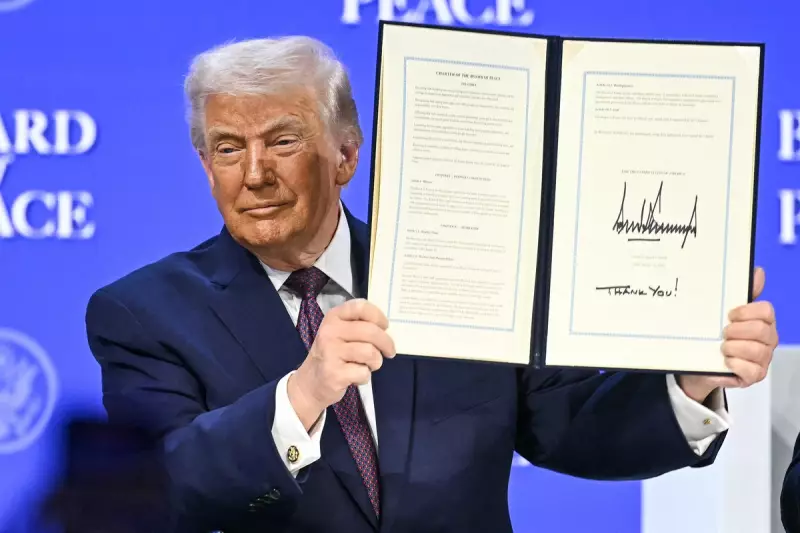
In a significant diplomatic development, Britain has joined a coalition of key Western nations in declining to participate in Donald Trump's newly proposed Gaza Board of Peace. The high-profile signing ceremony at the World Economic Forum in Davos was conspicuously absent of representatives from the United Kingdom, Canada, Italy, and several other traditional US allies. This collective snub comes amid deepening apprehensions regarding the board's composition, its staggering financial demands, and its potential to destabilise existing international institutions.
Diplomatic Concerns and the Putin Problem
The reluctance of allied nations is multifaceted. A primary point of contention, articulated forcefully by UK Foreign Secretary Yvette Cooper, is the inclusion of Russian President Vladimir Putin on the board. Ms Cooper condemned the notion of Putin's participation in a peace-focused body while Russia's war in Ukraine continues unabated. "The idea of the Russian president being part of something which is talking about peace... when we have still not seen any signs from Putin that there will be a commitment to peace in Ukraine is profoundly troubling," she stated.
Beyond the geopolitical friction with Russia, the financial barrier to entry is proving a major deterrent. President Trump has stipulated that each member nation must contribute a colossal $1 billion to join the initiative, a requirement that has alienated numerous potential partners already scrutinising their budgets.

Fears of Undermining the United Nations
Perhaps the most profound concern circulating in diplomatic circles is the suspicion that the Board of Peace is intended to function as a rival or replacement for the United Nations. The UN was established in the aftermath of the Second World War with the core mission of maintaining global peace and security. While President Trump has insisted the new board will operate alongside the UN, his reassurances have fallen on sceptical ears, particularly following his recent threats regarding Greenland, a territory of NATO ally Denmark.
These fears were scarcely allayed by the President's own comments at the board's televised launch in Davos. Trump suggested the group's remit would expand far beyond its initial purpose of cementing a Gaza ceasefire. "Once this board is completely formed, we can do pretty much whatever we want to do," he declared, a statement likely to trigger alarm across European capitals and beyond regarding the board's unchecked potential scope and power.
Trump's Combative Response and a Question of Legitimacy
Faced with this diplomatic resistance, President Trump has adopted a characteristically combative stance. When questioned about France's refusal to attend the signing ceremony, he threatened to impose a "200 per cent tariff" on French wines and champagne, confidently predicting that French President Emmanuel Macron "will join."
Despite the notable Western absences, the US claims 35 countries have agreed to participate, including Israel, Saudi Arabia, the United Arab Emirates, Egypt, Turkey, and Belarus. However, this roster highlights a potential weakness for the initiative: the predominance of non-democratic states among the committed members could severely limit the board's perceived legitimacy and operational effectiveness on the world stage.
The unfolding situation presents a stark diplomatic challenge, pitting a US-led vision for a new peace architecture against the cautious, institutionally-minded approach of many of its oldest allies. The future of the Gaza Board of Peace now hangs in the balance, contingent on whether it can address the substantive concerns over cost, membership, and its relationship with the established global order.