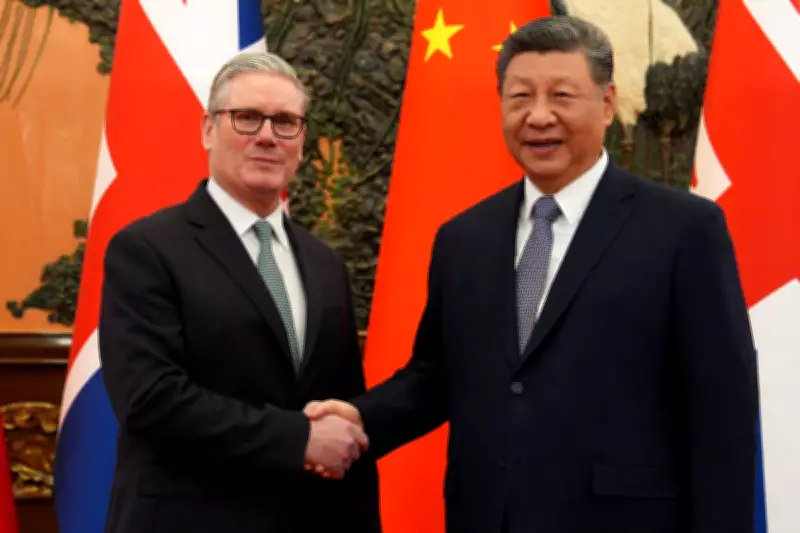
Prime Minister Keir Starmer's diplomatic visit to China has ignited a fierce debate over the UK's strategy in countering Beijing's global influence. While economic rivalry often dominates headlines, a critical battleground lies in Africa, where China is aggressively using media as a soft power tool to shape public opinion. Experts argue that UK aid reductions are inadvertently handing China a significant advantage in this information war.
The Retreat of Western Media in Africa
In recent years, China has methodically increased its soft power across the African continent, targeting the fastest-growing region where a quarter of the world's population will reside by 2050. This push coincides with a British and American retreat from media investments, which Beijing has cleverly exploited. Through a network of correspondents in nearly every African capital, China has seized broadcasting opportunities abandoned by Western outlets, training journalists to disseminate pro-Beijing messages.
The core narrative promoted by Chinese state media portrays the West as an untrustworthy colonial force that has historically impoverished African nations. This message resonates deeply, fuelling anti-American and anti-Western sentiments. A recent study revealed that six in ten Ethiopians and five in ten South Africans blame the United States for potential conflict in Taiwan, highlighting the effectiveness of China's propaganda efforts.

Funding Cuts Threaten BBC World Service
At a time when the BBC World Service should be expanding to challenge China's growing media dominance, its future is uncertain due to reliance on the UK's international development budget. Billions of pounds in aid cuts jeopardise the broadcaster's ability to operate, potentially crippling its presence in Africa. Meanwhile, China marches ahead, reinforcing its position as the continent's largest media player.
China's arsenal includes the English-language channel of the state-run China Global Television Network (CGTN), the Xinhua news agency, and the Communist Party-owned China Daily. Beyond these outlets, Beijing has established a web of partnerships with local organisations, embedding its influence deeply into African media landscapes.
Infrastructure and Digital Expansion
As many African countries transition from analogue to digital television, Chinese companies like StarTimes have secured numerous tenders to operate the necessary infrastructure. This control over TV distribution grants China unparalleled access to African audiences. Additionally, CGTN programmes designed for "non-professional journalists" provide resources that encourage storytelling aligned with Beijing's interests.
On platforms like YouTube and TikTok, where up to 70% of young people in Kenya and Nigeria source their news, Chinese state media thrives. "News influencers" on these platforms present a sanitised, positive image of China, avoiding sensitive topics such as human rights abuses in Xinjiang. CGTN ranks highly among international broadcasters for YouTube viewership, further amplifying its reach.
The Scale of China's Media Influence
The China Index, a civil society project monitoring Beijing's global grip, identifies 76 countries where outlets deliver Chinese state-funded content, including 14 in Africa. Policymakers in European capitals often rely on fact-checking or media literacy campaigns to combat disinformation, but these tactics falter when anti-Western narratives tap into deep-seated historical mistrust.
Despite these challenges, the BBC remains a popular and trusted news source in Africa. A 2024 survey found that 60% of Zambians and over 40% of South Africans rely on the BBC for news, viewing it as a symbol of media freedom. However, this status is at risk if funding cuts force the corporation to scale back its operations.
Case Studies: Lesotho and Nigeria
Lesotho exemplifies the shifting dynamics. The national station there switches off for several hours daily, creating a vacuum that the BBC once filled. Now, it must compete with CGTN for airtime, illustrating how Western retreat opens doors for Chinese media. Similarly, in Nigeria, when Turkey's state channel TRT launched a Hausa language service, many BBC staff defected due to better pay, demonstrating how financial incentives can undermine Western media efforts.

Many may not realise that shrinking aid budgets weaken Britain's global standing and influence, much to the delight of authoritarian rivals like China. As Prime Minister Starmer engages with Chinese leaders this week, experts urge him to consider the long-term consequences of ceding media influence in Africa. The battle for hearts and minds is not merely ideological—it is a strategic imperative with far-reaching implications for UK foreign policy.