President Claudia Sheinbaum of Mexico has issued a firm defence of her nation's sovereignty following controversial remarks from her US counterpart. The diplomatic row erupted after a statement from the White House celebrated a nineteenth-century military conflict between the two neighbours.
A Historical Sore Spot Reopened
The White House message, posted on Monday, described the 1846-1848 US-Mexico war as an event that "reasserted American sovereignty, and expanded the promise of American independence across our majestic continent." President Donald Trump personally lauded the conflict as "a legendary victory" and "a triumphant victory for American sovereignty."
For Mexico, this conflict represents a profound national trauma. The war concluded with the capture of Mexico City by US forces in 1847, leading to the Treaty of Guadalupe Hidalgo. This agreement forced Mexico to cede a staggering 55% of its pre-war territory. The lost lands encompass what are now the US states of California, Nevada, Utah, significant portions of Colorado, New Mexico, and Arizona.

Mexican Leadership Condemns 'Imperialist Tone'
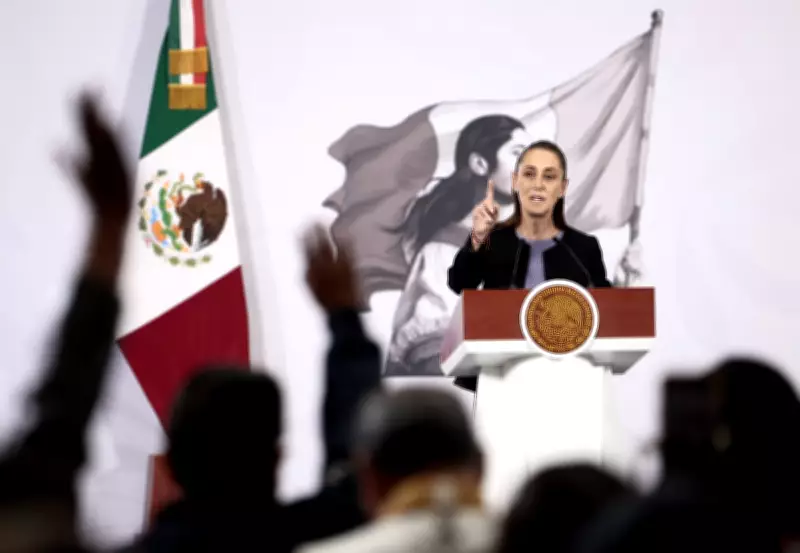
Responding during her morning news conference at the National Palace in Mexico City on Tuesday 29th January 2026, President Sheinbaum stated unequivocally: "We must always defend our sovereignty." Her measured response contrasted with the fury expressed by other prominent Mexican figures.
Former Mexican ambassador to the United States, Arturo Sarukhan, expressed shock on social media platform X. "Never, in the recent annals of Mexico-US relations had we seen anything like this," he wrote. "This is not only spiking the ball in the end zone; it's an in your face F… You."
Political analyst Denise Dresser offered a stark interpretation, suggesting the statement reveals Trump's underlying attitude. "He continues to view Mexico as a territory to be conquered, not as a partner," she wrote. "He will continue to look for ways to intervene."
A Veiled Threat or a Diplomatic Slap?
The contentious message arrives amidst a period of heightened US military activity in Latin America under the Trump administration. Last month, American troops were deployed into Venezuela in an operation targeting President Nicolás Maduro. Similar military threats have been directed towards Colombia and Cuba.
Regarding Mexico specifically, Trump has frequently suggested the possibility of sending US forces across the border to combat powerful drug cartels. He has previously stated, after maritime actions against alleged drug vessels, that "we are going to start now hitting land, with regard to the cartels." President Sheinbaum has consistently rejected any such proposals for foreign troop deployments on Mexican soil.
Some analysts perceive the White House's historical commentary as more than a mere provocation. Tony Payan, a Mexico expert at Rice University in Texas, interpreted it as a deliberate insult to a key ally. "Mexico is a country that has done nothing but cooperate with US interests on all levels," Payan noted. "And here he is rubbing Mexico's nose in what is essentially a very deep wound in Mexico's history … it's seared in Mexico's memory."
A Legacy of Expansionism
According to Payan, the statement provides significant insight into Trump's presidential ambitions and desired legacy. "He wants to go down as a great president who expanded the American Empire," Payan argued. "It's just sheer 19th-century-style imperialism." Trump himself hinted at this connection, suggesting that much of his current policy in Latin America is "guided by our victory on the fields of Mexico 178 years ago," including efforts to defend "our southern border against invasion."
The episode underscores the fragile state of cross-border relations and highlights how historical grievances can be weaponised in modern diplomacy. The celebration of a war that resulted in massive territorial loss for Mexico has been received not as a historical reflection, but as a potent political statement with contemporary implications.