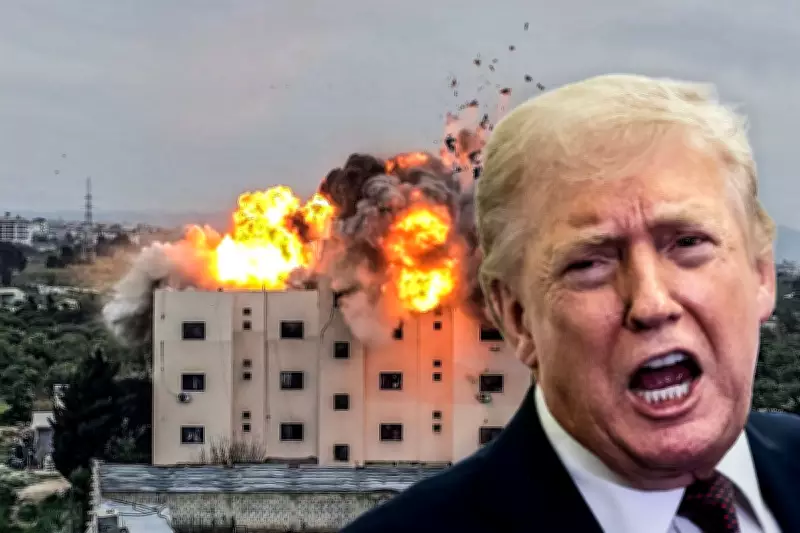
Former Deputy Supreme Allied Commander Europe for NATO, General Sir Richard Shirreff, has issued a stark warning about the dangers of Donald Trump's military campaign in Iran, describing it as staggeringly arrogant and potentially catastrophic. In a detailed analysis, Shirreff argues that the operation, dubbed "Operation Epic Fury," was launched without a clear endgame or strategic foresight, risking global economic meltdown and even nuclear Armageddon.
The Flawed Foundation of Operation Epic Fury
Shirreff questions whether historians will view Trump's war in Iran as a strategic masterstroke to curb China by cutting off its access to cheap Iranian oil, following similar moves against Venezuela. However, based on America's current performance, he deems this unlikely. He criticises Trump for initiating another Middle Eastern conflict with no coherent plan for conclusion, despite having stated objectives.
The former NATO commander highlights Trump's contradictory demands, including calls for "unconditional surrender" from Iran, urging the Iranian people to overthrow their regime, and shifting justifications from destroying nuclear capabilities to targeting military assets. Over the past two weeks, the US and Israel have engaged in systematic industrial destruction of Iran's military, leading to reports of desertions and mounting civilian casualties, such as the tragic loss of over a hundred schoolgirls from an American Tomahawk missile.
Strategic Blunders and Surprise Retaliation
Shirreff points out that Operation Epic Fury was launched with such arrogance that America appeared surprised when Iran retaliated by closing the Strait of Hormuz, a critical chokepoint for 20% of the world's oil flow. This move has caused oil prices to skyrocket, threatening global economic stability. He notes that proper military planning involves war-gaming second and third-order impacts, but this fundamental step was neglected.
The assumption that bombing alone could win the war ignores historical lessons, such as the Luftwaffe's failure in the Blitz, Allied bombing campaigns in WWII, and Putin's recent failures in Ukraine. Shirreff warns that while America may be winning tactically, the strategic disaster of closed oil routes could lead to defeat, echoing Sun Tzu's maxim: "tactics without strategy is the noise before defeat."
Alliance Fractures and Escalation Risks
Faced with this reality, Trump is pressuring allies for support, but his threats against NATO are falling on deaf ears due to prior actions, including threats against Denmark over Greenland and undermining trust at security conferences. Shirreff emphasises that trust in US commitment to NATO's collective defence has been shattered, compounded by Trump's alignment with Putin in Ukraine.
Looking ahead, Shirreff outlines possible scenarios: a quick US victory in neutralizing Iran's capabilities within four to six weeks, which he dismisses as wishful thinking given Iran's refusal to negotiate under fire; or a protracted attritional fight with asymmetric pressure from Iran via drones and proxy networks. He warns against escalation, noting that securing the Strait of Hormuz might require massive amphibious operations, and ground invasions could lead to horrors surpassing Iraq or Vietnam.
Nuclear Nightmare and Global Implications
Most alarmingly, Shirreff speculates about the potential for Israeli deployment of a nuclear device, which could trigger a world-changing Armageddon in Iran. Such talk, he argues, guarantees that Iran and other regimes will pursue nuclear capabilities with renewed vigour if given the opportunity, perpetuating a cycle of aggression and proliferation.
Call to Action for Middle Powers
Shirreff asserts that Britain and European allies have a stake in this conflict, with Gulf allies under attack, forces in Iraq and Cyprus targeted, and NATO sea lines threatened. However, he cautions against being dragged into Trump's war. Instead, he echoes Canadian Prime Minister Mark Carney's call from Davos for "middle powers" to unite, pool ideas and resources, and find ways to reopen the Strait of Hormuz while keeping America at arm's length.
He stresses that Europeans and Canada must "Europeanise" and "Canadianise" NATO, recognising that US leadership in the transatlantic order is gone forever. This transition requires energy, determination, honest leadership, and increased defence investment to reduce dependence on the US.
Critique of UK Leadership
Shirreff questions whether UK Prime Minister Keir Starmer is up to this task, accusing him of lacking a concrete plan and virtue signalling by claiming to increase defence spending while cutting budgets for social welfare. He argues that this is not the honest leadership Britain needs during this critical time, emphasising the urgency for proactive and integrity-driven policies to navigate the escalating crisis.