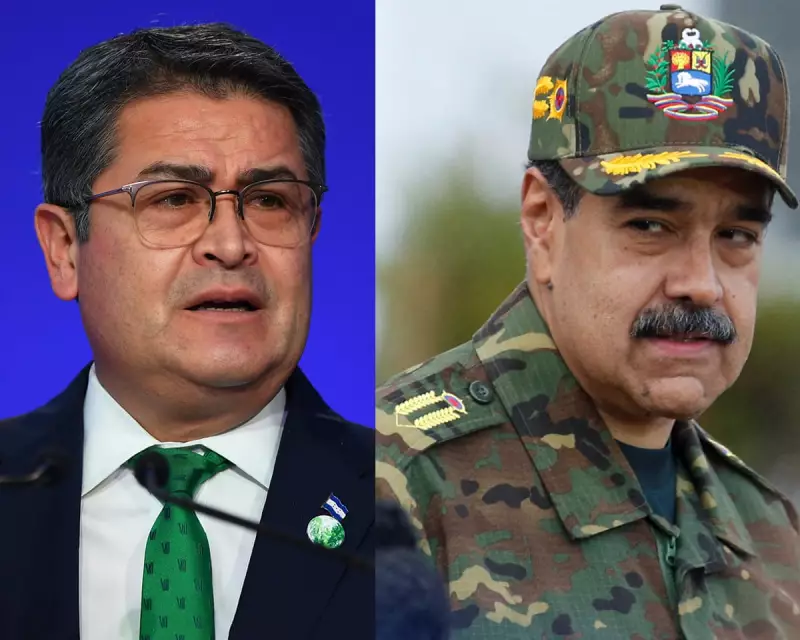
Donald Trump's recent pledge to pardon a former Latin American president convicted of major drug trafficking offences has sparked accusations of profound hypocrisy, as his administration simultaneously escalates a military-led 'war on drugs' against Venezuela.
The Pardon and the Prosecution
Last week, former US President Donald Trump vowed to pardon Juan Orlando Hernández, the ex-leader of Honduras who is currently serving a 45-year prison sentence. Hernández was found guilty in a Manhattan federal court in July 2024 for turning his nation into a 'cocaine superhighway to the United States'.
Prosecutors detailed how he allegedly conspired with notorious cartel bosses, including Joaquín 'El Chapo' Guzmán, accepting a $1m bribe for his presidential campaign. His brother, Juan Antonio 'Tony' Hernández, is serving a life sentence for related crimes.
Contrasting this, Trump's administration has labelled Venezuela's Nicolás Maduro a 'narco-terrorist', placing a $50m bounty on him and initiating a significant military buildup in the Caribbean to pressure his regime.
A 'Charade' of Counter-Drug Efforts
Experts have labelled Trump's dual approach as incoherent and politically motivated. Mike Vigil, former DEA chief for international operations, called the entire counter-drug effort a 'charade based on lies and hypocrisy'.
'He is giving a pardon to Juan Orlando Hernández and then going after Nicolás Maduro… It’s all hypocritical,' Vigil stated. He argued that Hernández, as a sitting president, oversaw the movement of billions of dollars worth of cocaine, a scale far exceeding the impact of Trump's recent 'kinetic strikes' on suspected drug boats.
Those strikes, which began in September, have reportedly killed around 80 people and destroyed 20 boats, but critics say they have had a negligible effect on drug flows and may have targeted impoverished fishermen.
Political Strategy Over Consistent Policy
Analysts suggest the discrepancy stems from political alignment rather than a consistent anti-narcotics strategy. Orlando Pérez, a Latin America scholar, noted that Hernández was a right-wing US ally, while Maduro is a left-wing adversary.
'It’s all ad hoc and based on political considerations,' Pérez said. 'It is ideological. It is political. It is self-interested in terms of advancing an ideological agenda – and it has nothing to do with effective anti-drug policies.'
Trump defended his position on Hernández, claiming the former Honduran leader was 'set up' in a 'Biden set up', a view starkly at odds with the jury's verdict and the evidence presented by US prosecutors.
The move has baffled observers, including author Ioan Grillo, who called it 'jaw-dropping' and said it 'undermines his hard-line ‘war on drugs’ position'. The situation lays bare the complex and often contradictory intersections of US foreign policy, domestic politics, and the decades-long fight against drug trafficking in the Americas.