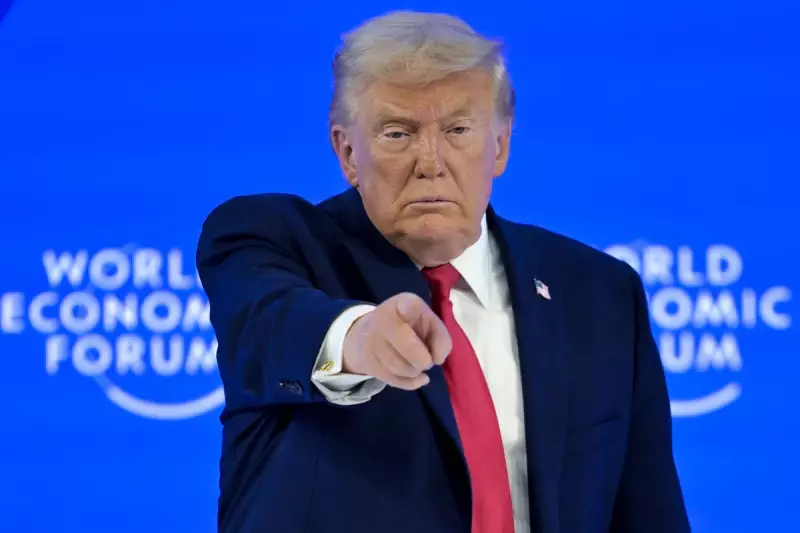
US President Donald Trump has announced the establishment of a "framework" for a future agreement concerning Greenland, following intense discussions with NATO Secretary General Mark Rutte. This development comes after weeks of controversial threats from the Trump administration regarding the Danish territory. The president stated that the arrangement is "a little bit complex" and would require further explanation, but he has notably withdrawn previous tariff threats against European allies, aiming to reduce diplomatic tensions.
The Core Components of the Proposed Framework
According to briefings from officials close to the negotiations, the potential deal draws inspiration from Britain's longstanding overseas territory arrangements. A key element under discussion is granting the United States sovereignty over specific areas of land for military bases, similar to the British Sovereign Base Areas in Cyprus. These zones, such as Akrotiri and Dhekelia, function as UK overseas territories with their own civilian administration, handling matters like law enforcement and immigration.
US Military Expansion and Strategic Interests
The framework could allow the US military greater freedom to build and operate in Greenland without the need for standard planning permissions from Danish authorities. This is particularly significant given Greenland's wealth of critical minerals. A 2023 survey identified that 25 out of 34 minerals classified as "critical raw materials" by the European Commission are present on the island, including graphite, copper, nickel, and rare earth elements essential for modern technology and defence industries.

Trump emphasised the long-term security and mineral benefits, stating, "It's the ultimate long-term deal. It puts everybody in a really good position, especially as it pertains to security and to minerals." The US already maintains a permanent presence at Pituffik Space Base under a 1951 agreement, but the new framework could facilitate expansion into mineral-rich regions.
Reactions from Denmark and Greenland
Denmark has expressed openness to dialogue, provided its territorial integrity is respected. However, the Danish government has not formally endorsed any specific aspects of the agreement as briefed by NATO or discussed publicly. The situation is further complicated by Greenland's semi-autonomous status. The island has its own prime minister, Jens-Frederik Nielsen, who has previously opposed American threats, though he has not yet commented on the recent talks.
Greenlandic MP Aaja Chemnitz Larsen voiced strong concerns, stating on social media, "What we are witnessing these days in statements from Trump is completely insane. NATO has absolutely no mandate to negotiate anything whatsoever without us in Greenland." This highlights the necessity for Greenland's involvement in any final negotiations, as emphasised by Rutte, who confirmed that specific talks would include the US, Denmark, and Greenland.
Significant Gaps and Unanswered Questions
Despite the announced framework, numerous details remain unspecified and informal. If the primary objective is to counter Russian and Chinese influence in the Arctic, it is unclear what additional value this deal provides, given that the US already has rights to build bases in Greenland, and Denmark has previously acted against Chinese investments. NATO allies are already increasing their presence in the region for security purposes.
Challenges in Mineral Extraction and Environmental Concerns
The development of Greenland's mining sector faces substantial hurdles, including bureaucratic red tape and opposition from indigenous communities. Furthermore, the extraction of oil and gas is banned on the island for environmental reasons, raising questions about how rare mineral mining would proceed and how Greenland would be compensated. The framework lacks clarity on these economic and environmental aspects.
Modelling the agreement on the British bases in Cyprus also presents complexities, as that arrangement has evolved significantly since 1960. Negotiators would need to define precise terms for development and independence, even if certain areas become de facto American territory. Additionally, the NATO alliance has been strained by the US's repeated threats, necessitating efforts to rebuild trust and cooperation on Arctic security matters.

Rutte expressed optimism about finalising details quickly, hoping for an agreement by 2026, but with the framework still lacking concrete specifics and facing political and logistical challenges, the path to a finalized deal remains uncertain.