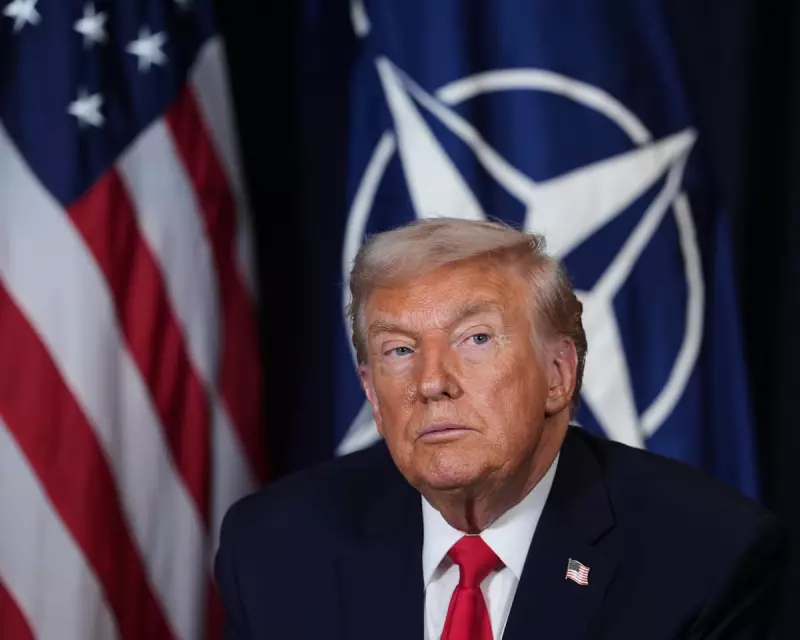
Fragile Arctic Truce: Trump's Greenland Ambitions and NATO's Delicate Deal
A comprehensive public explanation detailing precisely why ownership of Greenland is considered vital for the United States has never been formally provided by the US administration. This omission leaves a significant question mark over the strategic thinking driving recent geopolitical manoeuvres in the high north.
The Davos Agreement and Its Precarious Nature
The outline deal, struck between NATO Secretary General Mark Rutte and US President Donald Trump in Davos, focuses on stepping up the NATO presence in the Arctic. Crucially, this is contingent upon the proviso that it does not undermine the sovereignty of Greenland or Denmark. While the framework for such enhanced monitoring of Russian ship movements has been available to the US for some time, it necessitates new resources dedicated to this central task.
However, the agreement exists in a notoriously fragile state. Over the past year, President Trump has demonstrated a pattern of launching impetuous confrontations with maximalist demands, only to subsequently back down before relaunching the fight weeks later. It is therefore quite plausible that the current truce represents merely a midpoint in this exhausting and volatile diplomatic process.

Unresolved Core Issues: Minerals and the Golden Dome
Two major issues remain conspicuously unresolved, casting doubt on the deal's longevity. Firstly, there is the question of whether the agreement, as President Trump claims, grants the US access to Greenland's critical minerals. This is not a matter a NATO secretary general would typically be authorised to negotiate, yet Trump has insisted he secured this concession during the talks.
The second, and perhaps more significant, demand surrounds the planned $175 billion Golden Dome defence system. This futuristic project is designed to intercept hypersonic, ballistic, and advanced cruise missiles and drones from global or space-based launches. President Trump has repeatedly asserted that full US ownership of Greenland is vital for this project to proceed, imbuing the territory's acquisition with a near-mystical quality within certain White House circles. No contracts have been issued for the Golden Dome, and the bulk of the shield would be satellite-operated, with a primary land-based interceptor site previously considered for New York State.
NATO's Arctic Sentry and Diplomatic Maneuvering
Aware of Trump's volatility, the United Kingdom—which played a key role in brokering the agreement by advocating for a stronger NATO Arctic posture—adopted a cautious tone. UK Foreign Secretary Yvette Cooper explained the rationale behind a proposed NATO-led "Arctic Sentry" mission, modelled on existing sentries in the Baltic and Eastern Europe. This concept, promoted by the UK and German Defence Minister Boris Pistorius, had stalled due to Trump's demand for far more, including the outright ownership of Greenland.
Some NATO states have expressed wariness, questioning the imminence of the Russian shipping threat. A recent reconnaissance mission by eight NATO members, which triggered Trump's objections and tariff threats, was intended to assess this threat's real scale and the feasibility of a monitoring mission. A significant diplomatic misstep occurred when President Trump, misinformed, believed the mission was a precursor to a European-backed US seizure of Greenland by force, requiring corrective calls from Italian Prime Minister Giorgia Meloni and UK Prime Minister Keir Starmer.
Sovereignty, Historical Agreements, and the Path Forward
The historical context is governed by the 1951 US-Denmark agreement, updated in 2004, which permits extensive US activity within its Greenland bases but unequivocally affirms Danish sovereignty. Danish Prime Minister Mette Frederiksen has remained calm, stating she is in contact with NATO and that the alliance is fully aware of Copenhagen's position. Secretary General Rutte himself insisted the topic of sovereignty did not arise in his discussions with Trump.

Ultimately, because President Trump often operates through broad-brush social media pronouncements, a detailed, public justification for why Greenland ownership is deemed essential—particularly for the Golden Dome project—remains elusive. As US Treasury Secretary Scott Bessent noted in Davos, the administration views control of Greenland as strategically critical to preempt conflict. For now, the kinetic war with European allies has subsided into a truce, but the underlying tensions over Greenland's future and Arctic security are far from settled.