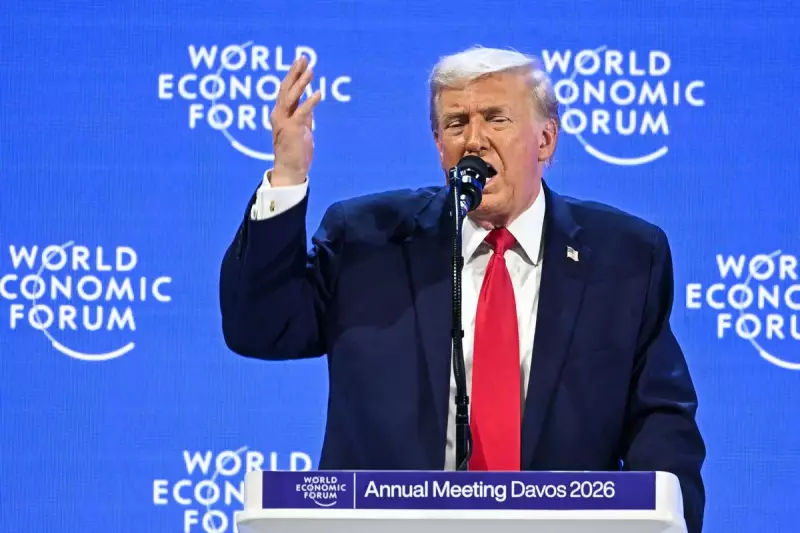
Trump's Davos Address: Unspoken Threats Cast Shadow Over European Security
Donald Trump's appearance at the World Economic Forum in Davos this week provided both temporary relief and lasting anxiety for European leaders. While explicitly ruling out military force to annex Greenland, the former US president delivered a speech heavy with implied threats and ominous warnings that left the Alpine atmosphere thick with geopolitical tension.
The Greenland Gambit: What Wasn't Said Speaks Volumes
"We want a piece of ice for world protection and they won't give it," Trump declared regarding Greenland, the vast Arctic territory that remains part of Denmark. "We've never asked for anything else... so they have a choice: you can say yes and we will be very appreciative, or you can say no – and we will remember."
This repeated phrase – "we will remember" – hung in the Davos air as perhaps the most significant element of Trump's address. European analysts immediately began parsing what the unspoken consequences might be, with many interpreting the warning as potential support for Russia's position in Ukraine should Denmark refuse to negotiate Greenland's transfer.

Notably absent from Trump's remarks was any mention of the specific economic penalties he had previously threatened – the 10 percent tariffs against eight nations supporting Greenland's current status, escalating to 15 percent if the territory wasn't handed over. This omission created what security experts describe as a "deliberate ambiguity" that allows multiple interpretations while maintaining pressure.
Pro-Russian Undertones and NATO Criticism
Trump's speech contained consistent themes that align closely with Kremlin interests. He described both Ukrainian President Volodymyr Zelensky and Russian President Vladimir Putin as "stupid" for not accepting a peace deal that would reward Moscow with Ukrainian territory – a position that contradicts current Western policy supporting Ukraine's territorial integrity.
The former president renewed his longstanding criticism of NATO, incorrectly claiming the United States had paid "100 percent" of alliance costs while receiving nothing in return. This narrative ignores that Denmark – Greenland's sovereign power – suffered proportionally higher casualties supporting NATO operations in Afghanistan than any other member state.
European Degradation Narrative and Conspiracy Theories
Trump painted a bleak picture of contemporary Europe, describing parts of the continent as "not even recognisable anymore" in what he characterized as a negative transformation. This critique extended to his endorsement of the "great replacement" conspiracy theory, which falsely claims European populations are being deliberately replaced by non-European migrants.
"Many parts of our world are being destroyed before our very eyes," Trump asserted, blaming Western governments for what he called "the largest wave of mass migration in human history." This rhetoric aligns with far-right narratives across Europe while distancing the United States from traditional transatlantic solidarity.
Broader Expansionist Vision Beyond Greenland
While Greenland dominated immediate concerns, Trump's speech revealed a broader vision of American expansionism and revived colonialism. He referenced historical territorial acquisitions as precedent for Greenland's potential transfer and praised his administration's actions regarding Venezuela while criticizing former colonial powers for granting independence to their former territories.
Security analysts note that Trump has previously expressed desires to annex Canada, invade Cuba, potentially attack Colombia, and has already taken control of Venezuela's economy through sanctions and political pressure. This pattern suggests Greenland represents just one element in a broader geopolitical realignment.
The Lingering Threat: Ambiguity as Strategy
The most unsettling aspect of Trump's Davos performance may be what he deliberately left unsaid. By avoiding specifics about consequences while maintaining threatening rhetoric, he creates maximum uncertainty for European leaders who must now prepare for multiple potential scenarios.

While immediate fears of military action against Greenland have subsided, the underlying threat remains potent. Trump's combination of pro-Russian positioning, NATO criticism, and expansionist rhetoric suggests a fundamental reordering of transatlantic relations that leaves Europe in a precarious position – uncertain whether the United States remains a reliable ally or has become a potential adversary with colonial ambitions.
The "we will remember" warning now echoes through European capitals, serving as a reminder that in Trump's worldview, might increasingly appears poised to trump international law and diplomatic norms.