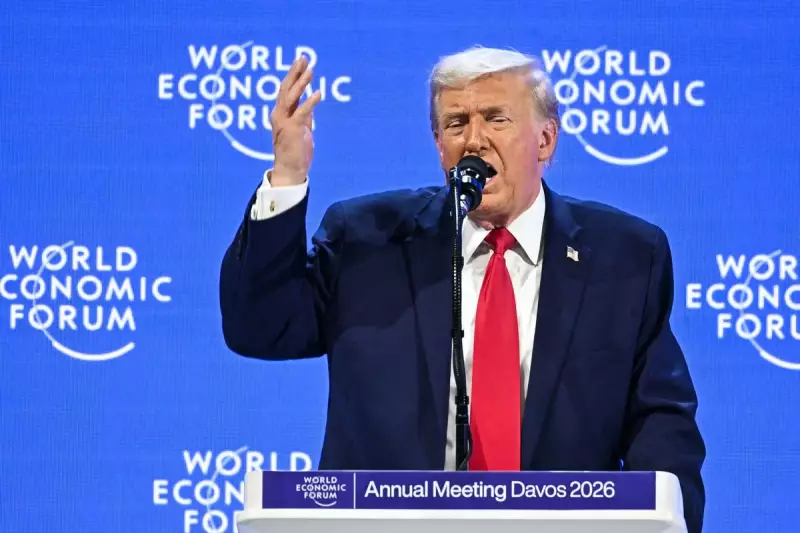
Trump's Davos Address: Unspoken Threats Loom Over Greenland Dispute
Former President Donald Trump delivered a speech at the World Economic Forum in Davos that simultaneously calmed immediate fears while planting seeds of longer-term anxiety among European allies. While explicitly ruling out military force to annex Greenland, Trump's carefully chosen omissions and veiled warnings created what observers describe as a chilling atmosphere of uncertainty regarding future American intentions toward the strategically vital Arctic territory.
The Greenland Ultimatum: What Wasn't Said Speaks Volumes
In his January 21, 2026 address, Trump declared "I won't use force" to take control of Greenland, but immediately followed this assurance with an ominous warning. "They have a choice: you can say yes and we will be very appreciative, or you can say no - and we will remember," he stated, leaving the consequences of refusal deliberately undefined. This strategic ambiguity represents what analysts consider the speech's most dangerous element, as European leaders must now speculate about potential retaliatory measures.
The former president's remarks contained significant geographical confusion, with multiple references mistakenly identifying Greenland as Iceland. Yet these moments of apparent disorientation were among the few instances where listeners could clearly interpret his intended meaning. For the majority of his address, Trump consciously avoided specifying what the "or else" portion of his Greenland ultimatum might entail, creating what one diplomat described as "a cloud of unarticulated threats hanging over transatlantic relations."

Broader Implications for European Security and NATO
Beyond the Greenland question, Trump's Davos speech revealed troubling positions on multiple geopolitical fronts that have alarmed European security experts. His repeated belittling of NATO included the false claim that the United States had paid 100 percent of alliance costs while receiving nothing in return. This narrative ignores historical realities, including that Denmark - Greenland's sovereign authority - suffered proportionally greater troop losses supporting NATO operations in Afghanistan than any other member nation.
Equally concerning was Trump's heavy pro-Russian bias, particularly regarding the ongoing conflict in Ukraine. He described both Ukrainian President Volodymyr Zelensky and Russian President Vladimir Putin as "stupid" for not accepting a peace deal that neither side considers acceptable. The proposed arrangements would essentially reward Russian aggression with territorial gains while leaving Ukraine vulnerable to future invasion, according to security analysts monitoring the situation.
Europe Portrayed as Failing and Unrecognisable
Trump's characterization of Europe as a failing region added another layer of concern for transatlantic relations. "Certain places in Europe are not even recognisable anymore," he claimed, suggesting the continent was heading in the wrong direction. This assessment aligns with his previous endorsements of the Great Replacement conspiracy theory, which alleges that non-European populations are overwhelming native demographics across Western nations.
The former president expanded on these themes by criticizing what he called "the largest wave of mass migration in human history," blaming Western governments for turning their backs on principles that make nations "rich and powerful and strong." These comments reinforced perceptions that Trump views Europe through a lens of civilizational decline rather than as valued strategic partners.
Colonial Ambitions and Power Politics Resurface
Trump's justification for seeking Greenland's acquisition revealed a worldview where might trumps international law and ethical considerations. "It's the United States alone that can protect this giant mass of land, this giant piece of ice," he asserted, claiming American development would benefit both Europe and the United States. This rationale echoes historical colonial arguments while ignoring Greenland's right to self-determination under Danish sovereignty.

The Davos speech comes amid broader concerns about Trump's territorial ambitions, which reportedly include desires to annex Canada, invade Cuba, potentially attack Colombia, and maintain control over Venezuela's economy. Combined with his longstanding support for Russian aggression in Ukraine - including cutting military aid to Kyiv while suggesting Russia has earned territory through force - these positions paint a picture of international relations based primarily on power projection rather than cooperative security frameworks.
The Lingering Shadow of Unresolved Threats
While immediate fears about military action against Greenland have subsided following Trump's explicit denial, European leaders remain deeply unsettled by what wasn't said in Davos. The "we will remember" warning hangs particularly heavy over diplomatic circles, suggesting potential economic or political retaliation against nations opposing American annexation plans.
Trump's conscious avoidance of detailing his threatened tariffs - previously suggested as 10 percent initially, escalating to 15 percent if Greenland isn't transferred - leaves European governments guessing about potential economic consequences. This strategic ambiguity, combined with his dismissive attitude toward NATO and apparent alignment with Russian interests, creates what one analyst described as "the most fragile moment in transatlantic relations since the Cold War."
The Alpine air in Davos may have been cleared of immediate military threat, but it remains thick with political uncertainty as European leaders contemplate how to navigate a potential future where American foreign policy appears increasingly transactional, unpredictable, and dismissive of established international norms.