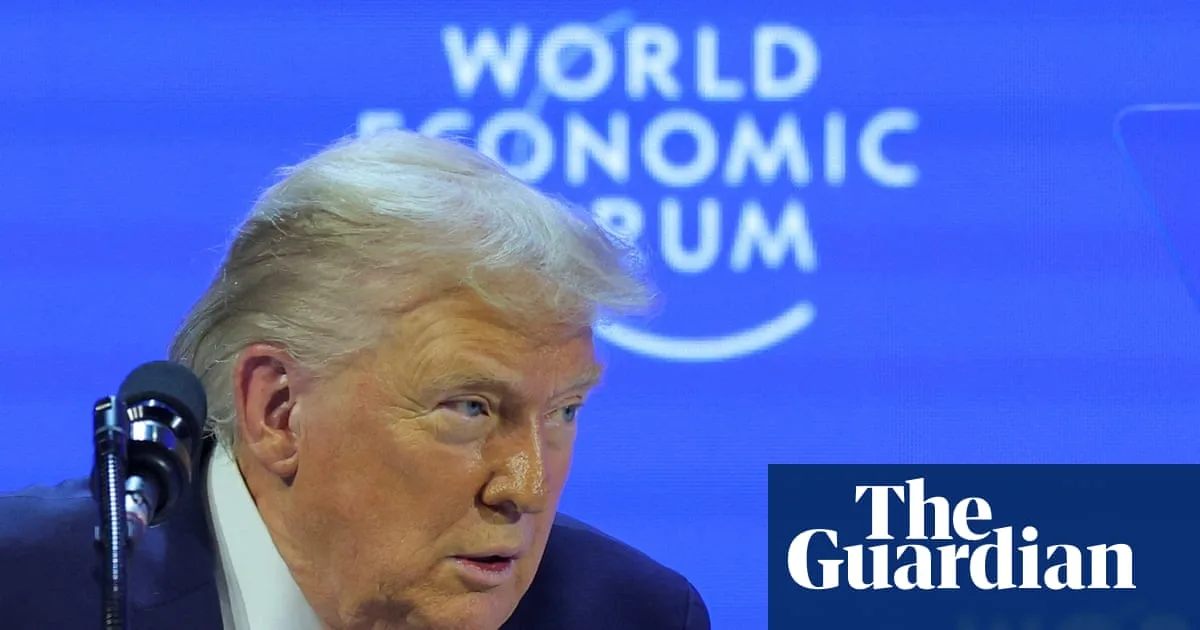
Former US President Donald Trump has used the platform of the World Economic Forum in Davos to launch a series of contentious remarks, reiterating his longstanding demand for the acquisition of Greenland while launching sharp criticisms against NATO and European immigration policies.
Trump's 'Piece of Ice' Demand and NATO Critique
Addressing attendees at the prestigious international forum, Trump doubled down on his interest in the Danish territory of Greenland, characterising it as a modest request. "All I want is a piece of ice," he stated, while explicitly ruling out the use of military force to achieve this goal. He framed the potential acquisition as a "very small ask" when measured against the vast financial and strategic contributions he claims the United States has made to global security and alliances.
Central to his address was a renewed assault on the North Atlantic Treaty Organisation. Trump asserted that the United States has derived no tangible benefit from its membership in the military alliance, a claim that directly challenges decades of established transatlantic security doctrine. This critique forms part of his broader 'America First' foreign policy narrative, which questions the value of traditional multilateral partnerships.
Immigration Comments and European 'Unrecognisable' Claim
Trump's criticisms extended beyond security arrangements to social and demographic issues within Europe. He described the continent as being "unrecognisable" due to immigration, employing rhetoric that closely mirrors that of far-right political movements across Europe. These comments have been interpreted as an endorsement of nationalist immigration policies and a rejection of multicultural models prevalent in many European nations.
Swift UK Political Rebuttals
The remarks prompted immediate and firm responses from prominent British political leaders, highlighting the ongoing sensitivity of transatlantic relations.
Labour leader Sir Keir Starmer issued a strong condemnation of Trump's position. He explicitly opposed the former president's demands regarding Greenland and any associated threats of imposing punitive tariffs to pressure allies. Starmer vowed that Britain would steadfastly refuse to compromise its core principles in the face of such demands, positioning the UK as a defender of international norms and sovereignty.
In a notable divergence of opinion, Reform UK figure Nigel Farage addressed Trump's NATO comments directly. While often aligned with Trump on many issues, Farage contested the characterisation of allied contributions, asserting that Britain and other NATO members have "more than done our bit" for the collective defence of the alliance. This underscores a complex dynamic within right-leaning politics on both sides of the Atlantic regarding the future of NATO.
Broader Implications and Historical Context
Trump's Davos intervention is not an isolated incident but a continuation of themes from his presidency, where he previously expressed interest in purchasing Greenland and frequently criticised NATO allies for insufficient defence spending. His claim that his election prevented "the world from sliding into World War Three" adds a layer of grand historical narrative to his critique, positioning himself as a singular figure of global stability.
The forum, typically a venue for discussing global economic cooperation, thus became a stage for reigniting debates about sovereignty, alliance burdens, and national identity. The strong reactions from UK leaders indicate that these issues remain highly potent in domestic British politics, intersecting with ongoing debates about the UK's post-Brexit global role and its relationships with both Europe and the United States.






