Trump's Board of Peace to Hold Inaugural Washington Summit for Gaza Reconstruction
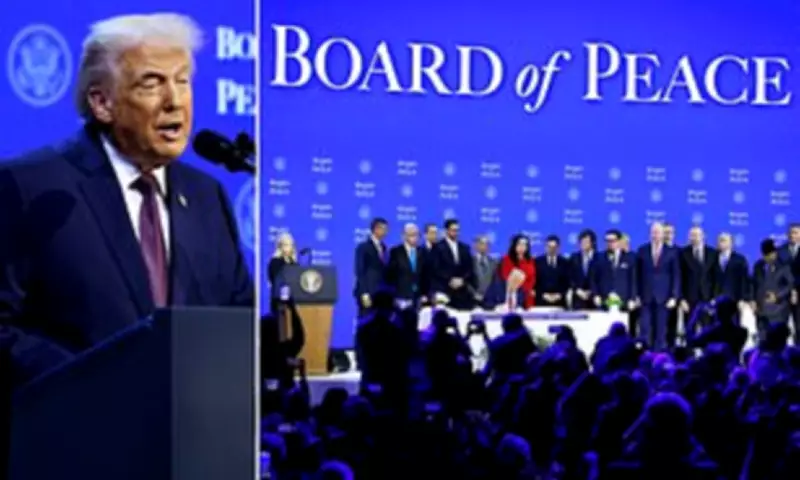
President Donald Trump is set to convene the first official meeting of his newly established Board of Peace later this month in Washington, with a primary focus on raising substantial funds for the extensive reconstruction of Gaza. The summit, scheduled for February 19, will bring together world leaders who accepted Trump's invitation in January to participate in this ambitious international initiative.
Expanding Mandate and Global Ambitions
The meeting will also include members of an executive committee specifically tasked with overseeing the intricate details of Gaza's governance, security arrangements, and comprehensive redevelopment plans, according to two Trump administration officials who spoke on Saturday under condition of anonymity. While the exact number of attending leaders remains uncertain, one official expressed confidence in "robust" participation from invited nations.
The venue for this historic gathering will be the US Institute of Peace, recently renamed the Donald J. Trump US Institute of Peace following the administration's seizure of the facility last year and subsequent dismissal of nearly all its staff members. This location choice underscores the board's break from traditional diplomatic institutions.

From Gaza Focus to Global Peace Framework
Originally conceived as a mechanism to address the Israel-Hamas conflict in Gaza, the Board of Peace has rapidly evolved into a much broader initiative with sweeping global ambitions. The board's founding charter, signed last month in Davos, Switzerland, outlines a mission to "secure enduring peace in areas affected or threatened by conflict," signaling intentions far beyond the Palestinian territory.
This expansion represents the latest American effort to circumvent established international bodies like the United Nations, as Trump seeks to fundamentally reshape the post-World War II global order according to his vision. The Washington meeting marks the most significant step yet in transforming the board from conceptual framework to functioning international organization with worldwide reach.
International Participation and Financial Requirements
Despite skepticism from several key European allies including France, more than twenty countries have already committed to the initiative. Participating nations include Argentina, Hungary, Indonesia, Pakistan, Saudi Arabia, Turkey, the United Arab Emirates, Qatar, and most recently Israel. Hungarian Prime Minister Viktor Orbán has publicly confirmed his attendance, telling supporters: "Two weeks from now we will meet again in Washington because the Board of Peace will hold its inaugural meeting."
The board's charter establishes significant financial requirements for permanent membership, with countries required to contribute $1 billion—a substantial threshold that will likely shape the organization's composition and influence moving forward. Under the charter's provisions, Trump will serve as chairman while simultaneously representing the United States, holding veto power over certain critical decisions.
Immediate Priorities and Geopolitical Context
Rebuilding Gaza remains the board's most pressing immediate priority, with officials confirming that securing financial commitments for reconstruction will be a primary objective of the Washington summit. The extensive damage caused by the recent conflict requires massive investment and coordinated international effort.
The Board of Peace first emerged from Trump's 20-point peace plan announced last September, which contributed to ceasefire negotiations involving Egypt, Qatar, Turkey, and the United States. The Washington meeting signals Trump's determination to advance reconstruction plans despite ongoing fragility in the region's ceasefire arrangements.
Israeli Prime Minister Benjamin Netanyahu, who has accepted Trump's invitation to join the board, is scheduled to meet separately with the American president in Washington next week, with discussions expected to focus on negotiations with Iran—highlighting the complex geopolitical tensions surrounding the initiative.

Executive Leadership and Broader Implications
The board's executive committee will be chaired by Trump himself and includes prominent figures such as US Secretary of State Marco Rubio, US Middle East envoy Steve Witkoff, and Trump's son-in-law Jared Kushner. Former British Prime Minister Tony Blair has participated in related discussions about Gaza reconstruction, though the United Kingdom has not formally joined the board.
Critics and international relations analysts suggest the initiative reflects Trump's longstanding skepticism toward traditional multilateral institutions and his desire to establish alternative diplomatic frameworks. The creation of the Board of Peace has exposed significant divisions among American allies, particularly in Europe where several nations have declined participation over concerns about undermining existing international bodies.
The upcoming Washington summit represents a critical test of whether Trump can translate his vision into a viable global institution and whether sufficient nations will align themselves with this unconventional approach to international peacebuilding and conflict resolution.