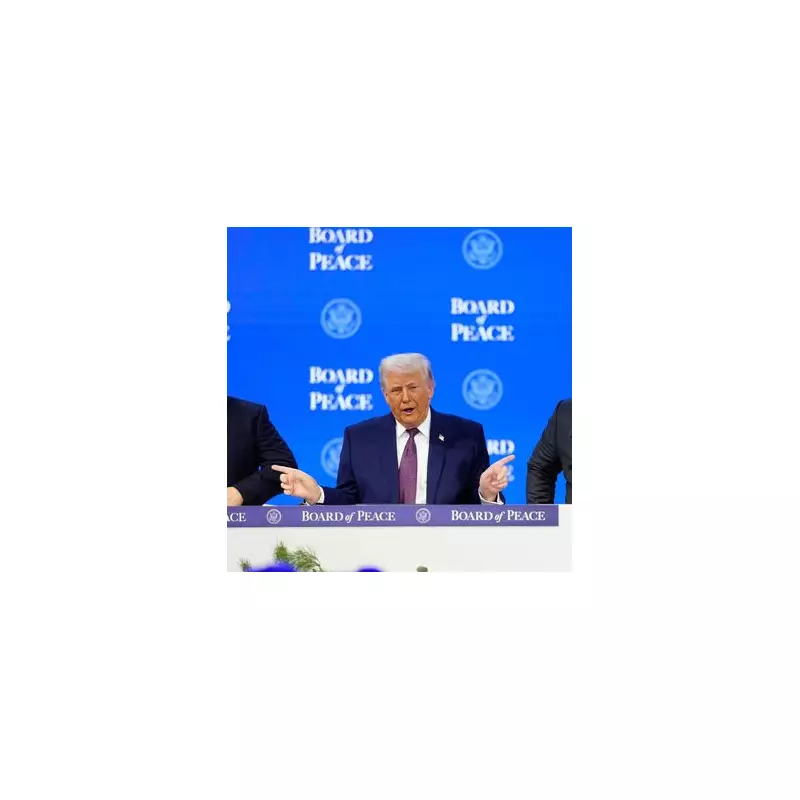
Donald Trump has officially installed himself as chairman of the Board of Peace, a new international body launched today that is being viewed as a direct rival to the United Nations. The controversial initiative was unveiled on the sidelines of the World Economic Forum in Davos, Switzerland, with a signing ceremony marking its formal establishment.
A Gathering of Authoritarian Leaders
Of the twenty nations that have reportedly signed up to join Trump's Board of Peace, only two are classified as "free" countries according to the Freedom House's 2025 Freedom in the World report. These are Argentina and Israel. The remaining eighteen signatories include a significant number of states ruled by hard right-wing, authoritarian leaders often described as 'strongmen'.
Notable nations on the list include Hungary under Viktor Orbán, Saudi Arabia, Turkey, Egypt, Bahrain, and Pakistan. The board's draft constitution, which has raised eyebrows among international observers, would appoint Trump as chairman for life and grant him total control over a substantial $1 billion entry fee demanded from permanent members.

European Allies and the UK Decline Participation
In a significant diplomatic development, the United Kingdom has explicitly ruled out joining the new body. Foreign Secretary Yvette Cooper articulated the government's concerns, particularly regarding the invitation extended to Russian President Vladimir Putin. "We won't be one of the signatories today because this is about a legal treaty that raises much broader issues," Ms. Cooper stated during an appearance on BBC Breakfast.
She further emphasised the UK's scepticism, noting, "We do also have concerns about President Putin being part of something which is talking about peace when we have still not seen any signs from Putin that there will be a commitment to peace in Ukraine." This position aligns with other traditional American allies in Europe, including France, Italy, and Sweden, all of whom have also declined to participate in the group.
Executive Committee and Broader Ambitions
The board's executive committee features a mix of political and business figures. Alongside Trump, it includes former UK Prime Minister Tony Blair as an executive member, US Secretary of State Marco Rubio, and Trump's former son-in-law Jared Kushner. Other notable members are real estate developer Michael Witkoff, Apollo Global Management CEO Marc Rowan, World Bank President Ajay Banga, and Trump’s deputy national security adviser Robert Gabriel.
While the body was originally conceived with a focus on fostering peace in the Middle East, specifically addressing the Israel-Hamas conflict, Trump hinted at much broader ambitions. "I think we can spread out to other things as we succeed with Gaza," Trump declared at the launch event. "Once this board is completely formed, we can do pretty much whatever we want to do."
A Strained Relationship with the UN
In his opening remarks, Trump made a pointed reference to the United Nations, promising to work "in conjunction" with the established global body but criticising its historical effectiveness. "I think the combination of the Board of Peace with the kind of people we have here, coupled with the United Nations, can be something very, very unique for the world," he stated.
However, this assurance has done little to assuage growing international fears that the Board of Peace is being strategically positioned as an authoritarian alternative to the UN. The concentration of power within the chairman's role and the demographic of the initial signatory nations have intensified scrutiny and concern among Western democracies about the group's long-term objectives and governance.