Trump's Board of Peace Emerges as Latest US Challenge to UN Authority
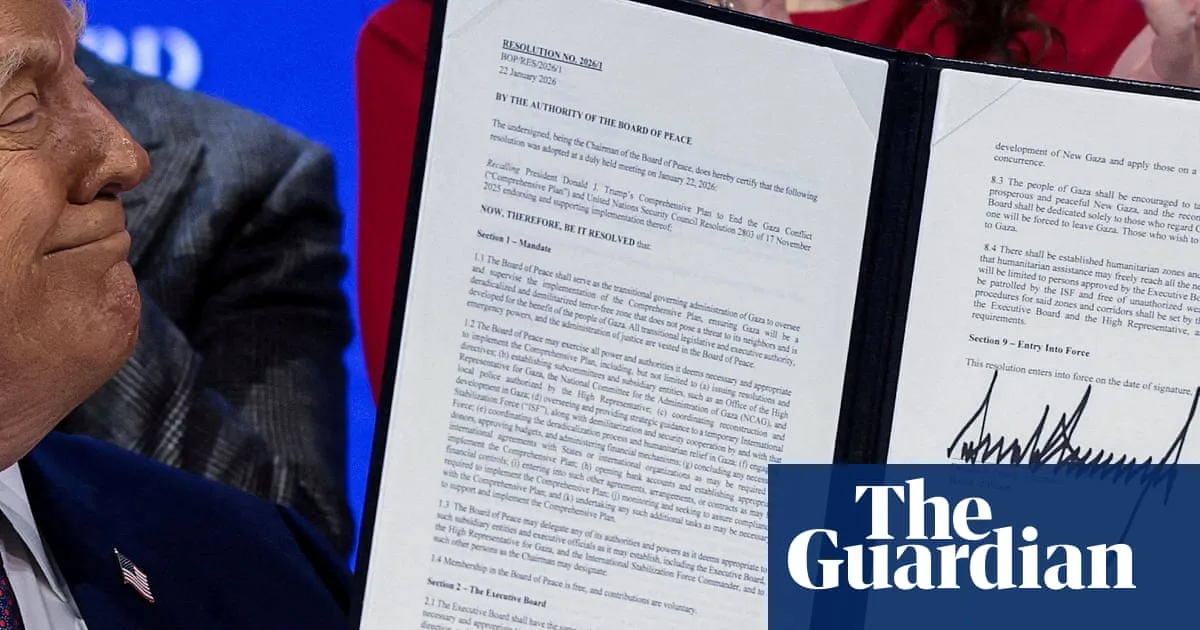
President Donald Trump's ambitions for the newly established "Board of Peace" to mediate global conflicts beyond the Gaza situation appear to represent the latest in a series of calculated American attempts to sidestep the traditional authority of the United Nations Security Council. This development raises profound new questions about the ongoing relevance of the eighty-year-old international institution and creates significant uncertainty regarding its future as the primary global force in brokering peace agreements worldwide.
A Direct Challenge to Established Multilateral Frameworks
Trump is currently establishing this board, which will be composed largely of invited heads of state from various nations. This initiative comes at a particularly sensitive moment, as the United Nations itself has embarked on major reform efforts intended to modernise an organisation that was founded in the aftermath of World War II. The goal of these reforms is to make the UN a more viable and effective global player throughout the twenty-first century.
These long-discussed reform efforts gained renewed impetus after the Trump administration, during the previous year, set out to eliminate billions of dollars in funding traditionally allocated to international organisations and broader humanitarian assistance programmes. In response to this financial pressure, the UN has implemented several significant changes, including cutting certain life-saving humanitarian efforts, consolidating major agencies, and moving personnel away from its iconic New York headquarters. These measures are part of a broader strategy to court continued support from the United States, which has historically been the organisation's largest and most influential donor.
Persistent Criticisms and Financial Withholding
Trump and his political allies have consistently blasted the United Nations for failing to reach its full potential. They have repeatedly accused the organisation of maintaining "bloated" and redundant agencies that allegedly promote what they describe as "woke" ideology. This critical stance culminated last year in the United States refusing to pay its mandatory annual dues to the UN, a move that significantly strained the institution's operational budget.
The Security Council, which is the UN's most powerful body with the unique authority to authorise international military action, has faced widespread criticism in recent years for its perceived failures to end protracted conflicts, including the devastating wars in Gaza and Ukraine. This specific point has been a consistent theme in Trump's rhetoric since the beginning of his second term, and he reiterated it several times during the past week.
"The UN just hasn't been very helpful. I'm a big fan of the UN's potential, but it has never lived up to its potential," Trump told reporters during a White House press briefing. "The UN should have settled every one of the wars that I settled. I never went to them. I never even thought to go to them." Despite these pointed complaints, he notably added that "I believe you got to let the UN continue, because the potential is so great."
The Board's Expanding Mandate and International Skepticism
In a significant procedural move, the Security Council itself authorised the Board of Peace in November to serve as a transitional body. This authorisation was specifically to oversee a US-brokered ceasefire in the Israel-Hamas war in Gaza, exactly as President Trump had proposed. However, in forming the board, Trump has since described its intended role much more broadly, positioning it as a potential mediator for other global conflicts and, by implication, a potential rival to the established authority of the UN Security Council.
Retired US Ambassador Robert Wood, who served at the US Mission to the United Nations under both Republican and Democratic administrations, expressed considerable skepticism about this expanded ambition. "If Trump is trying to replace the Security Council with a Board of Peace dealing with issues beyond Gaza, I don't think there's going to be a lot of interest," Wood stated. He advised that the international community should instead focus on collaborative improvement. "What I would say to UN member states, including the United States: Let's try to work together to try to make the United Nations a better instrument. It really is the best instrument we have, given all its warts," Wood told The Associated Press. "But trying to recreate something new in this type of era, with all the divisions that exist and the fact that most of the developing world puts a lot of emphasis on the United Nations and the conflict resolution mechanism, I just don't see how this would work."
Official UN Response and Broader Geopolitical Reactions
Senior UN officials attempted to dismiss concerns about being sidelined on Wednesday, suggesting it is highly unlikely that decades of established multilateral peacebuilding, involving the participation of more than one hundred and ninety member countries, could be easily replaced by a new initiative. "There have been any number of organisations — regional organisations, defense alliances and others — that have coexisted with the UN over the 80 years that the UN's been in existence," noted Farhan Haq, the UN deputy spokesperson, during a briefing. He cautiously added, "It's too early to tell what the Board of Peace will look like."
The international response to invitations to join the board has been mixed and reveals deep geopolitical divisions. It was not immediately clear how many countries would ultimately accept Trump's invitation. On Wednesday, eight Muslim-majority nations, including Qatar, Pakistan, and the United Arab Emirates, formally accepted the invitation. However, in a carefully worded joint statement, they simultaneously reaffirmed their commitment to support the board's original, narrower mission aimed at advancing peace and reconstruction in Gaza and upholding the Palestinians' right to statehood.
In contrast, France, a permanent, veto-wielding member of the Security Council, has stated definitively that it will not accept Trump's invitation. The three other permanent members with veto power — Russia, China, and Britain — are reportedly still assessing the proposal. As of Wednesday, other nations including Norway, Sweden, and Slovenia had also declined the invitation. Slovenia's government expressed a primary concern that the board's proposed mandate is excessively broad and could seriously undermine the existing international order, which is fundamentally based on the UN Charter.
One European diplomat, speaking anonymously to The Associated Press, revealed that many EU countries "feel a bit awkward" about the entire effort. They would reportedly prefer that substantive discussions first focus on the Board of Peace's specific plan regarding Gaza before engaging with this much broader and more ambitious geopolitical initiative.
Wider Concerns About the International Order
The initiative has sparked broader debates about the stability of the global rules-based system. In a stark speech delivered at the World Economic Forum in Davos on Tuesday, Canadian Prime Minister Mark Carney issued a grave warning that the established rules-based international order is visibly fading. "The multilateral institutions on which the middle powers have relied ... the very architecture of collective problem solving, are under threat," he declared, explicitly singling out the United Nations among other key bodies. "And as a result, many countries are drawing the same conclusions — that they must develop greater strategic autonomy, in energy, food, critical minerals, in finance and supply chains."
Despite these mounting challenges, UN Secretary-General António Guterres expressed resolute confidence in the institution's future. When asked by the BBC on Monday if the United Nations could survive a second Trump presidency, Guterres replied unequivocally: "I have no doubt about it." He elaborated with conviction, "I have a lot of confidence in the future of humankind, and I'm fighting as much as I can in order to make sure the UN is part of that renewal that I believe will become inevitable." This statement underscores the deep ideological and practical battle now underway between traditional multilateralism and newer, unilateral approaches to global governance.