Trump's Dramatic Davos Performance: From Invasion Threats to Economic Coercion
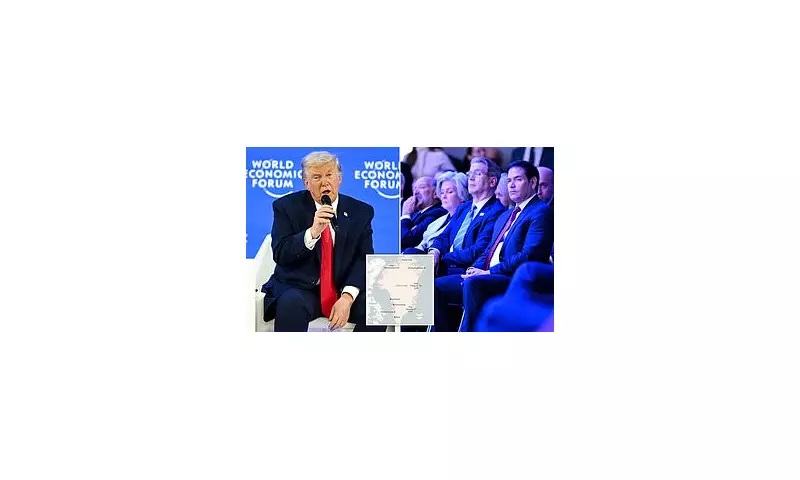
In a characteristically theatrical display at the World Economic Forum in Davos, former President Donald Trump executed a classic negotiating manoeuvre regarding his longstanding ambition to acquire Greenland. Before addressing the global elite at the Swiss ski resort, Trump had set an extreme maximalist position, openly suggesting the possibility of invading the Danish-controlled territory and launching military action against NATO ally Denmark.
The Thunderbolt and the Retreat
Trump allowed this diplomatic thunderbolt to resonate across European capitals, letting allies absorb the shock of potential military confrontation within NATO. European leaders responded with predictable indignation, labelling Trump's behaviour as reminiscent of an "international gangster." Yet in his actual speech, the property magnate turned president performed a dramatic reversal, pulling the rabbit from the hat by explicitly withdrawing the ultimate threat.
"I don't have to use force, I don't want to use force," Trump declared to his visibly relieved audience, delivering the line with a knowing smile that suggested strategic calculation rather than genuine concession. The immediate spectre of military action departed the room, allowing European brows to unfurrow as the catastrophic prospect of internal NATO conflict appeared temporarily averted.

Economic Sword Remains Unsheathed
While the military threat receded, Trump made clear that economic coercion would become his primary instrument of pressure. His message to European allies was ominously clear: "They have a choice. You can say yes, and we will be very appreciative. We will remember." The implication was unmistakable - America's friends must decide whether defending Denmark's sovereignty over Greenland represents a hill worth seeing their own economies destroyed upon.
The economic Sword of Damocles now hanging over Europe takes concrete form through Trump's recent imposition of 10 percent tariffs on eight European allies who declined to support his Greenland ambitions. This could trigger the European Union's so-called "trade bazooka" - officially the Anti-Coercion Instrument - potentially sparking a spiralling trade war that risks millions of jobs across the Atlantic.
Strategic Arguments and Historical Precedents
Trump presented his case for Greenland acquisition in surprisingly reasoned terms, arguing that American ownership would enhance NATO security against Russian and Chinese aggression. He referenced Denmark's rapid fall to Germany during World War II, suggesting only America could properly secure Greenland's strategic position. The former president even proposed building a "golden dome" defence system to protect against incoming attacks.
Historical parallels emerged throughout Trump's justification, with shades of 19th Century policies including the revived "Donroe Doctrine" (his renamed Monroe Doctrine) and echoes of "Manifest Destiny" thinking. He noted that European nations themselves have extensive histories of territorial acquisition, making American expansionism nothing unusual in historical context.
The European Dilemma Deepens
European leaders now face an insidious predicament. Despite public bluster about defending Danish sovereignty and Greenlanders' self-determination rights, each nation recognises America as a vastly more important ally than Denmark. The $1.6 trillion trading relationship between Europe and the United States represents the world's largest economic partnership, making the stakes extraordinarily high.
The crucial question becomes which European leader might break ranks first, siding with Trump in negotiations to demand Denmark relinquish Greenland for what the former president termed a "fair price." The potential rewards for such defection are substantial - avoidance of crippling tariffs, preferential trade treatment, and White House welcome for the turncoat nation.

Obsession Born from Conversation
Trump's Greenland fixation appears to have originated during a 2017 conversation with billionaire Ronald Lauder, heir to the Estée Lauder fortune, according to former national security adviser John Bolton. The former president later recalled examining a map and thinking "Look at the size of this, it's massive," approaching the territorial acquisition as he would a real estate transaction.
Experts suggest Trump may have been viewing a Mercator Projection map, which dramatically exaggerates Greenland's size relative to actual landmasses. While appearing comparable to Africa on such maps, Greenland actually measures approximately one-fourteenth of Africa's area, though still three times larger than Texas at 836,000 square miles.
Legacy and Historical Parallels
Beyond strategic considerations, Trump's determination seems intertwined with securing his presidential legacy through what would represent the largest land acquisition in American history, surpassing even the 1867 purchase of Alaska from Russia. That transaction, initially derided as "Seward's Folly" before gold and oil discoveries validated its wisdom, provides a historical template Trump appears determined to emulate.
Current polling indicates only 17 percent of Americans approve of Trump's Greenland efforts, while most Greenlanders themselves express opposition to becoming part of the United States. Yet the former president appears confident that, like Seward before him, history will ultimately validate his territorial ambitions.
The Path Forward
European leaders currently maintain a stance of outraged denial, but may need to recognise they face a battle unlikely to yield victory. Finding an off-ramp that minimises collateral damage to NATO cohesion and the global economy represents the paramount challenge. With three years remaining in his potential term, Trump's Greenland obsession shows no signs of diminishing, ensuring this extraordinary geopolitical drama will continue unfolding across the international stage.
The Davos showdown ultimately revealed Trump's preferred methodology: establish extreme positions, generate crisis atmosphere, then pivot to more "reasonable" demands while maintaining underlying pressure. As European leaders digest this performance, they must confront uncomfortable realities about alliance politics in an era where traditional diplomatic norms face unprecedented challenge from America's most unconventional former president.