US President Donald Trump is actively considering a range of military options against Iran, with sources indicating that targeted strikes on security forces and key leaders are under discussion. The objective is to inspire protesters to overrun government buildings and catalyse a shift in the country's leadership.
Strategic Objectives and Military Planning
According to two US sources familiar with the deliberations, Trump aims to create conditions conducive to 'regime change' following a brutal crackdown that suppressed a nationwide protest movement earlier this month, resulting in thousands of fatalities. To achieve this, the administration is exploring options to strike commanders and institutions that Washington deems responsible for the violence, thereby boosting protesters' confidence to storm government and security facilities.
One source revealed that the options being debated by Trump's aides include a more extensive strike designed to have a lasting impact, potentially targeting ballistic missiles capable of reaching US allies in the Middle East or Iran's nuclear enrichment programmes. However, the other source emphasised that Trump has not yet finalised a course of action, including whether to pursue a military path.

Naval Deployment and Diplomatic Tensions
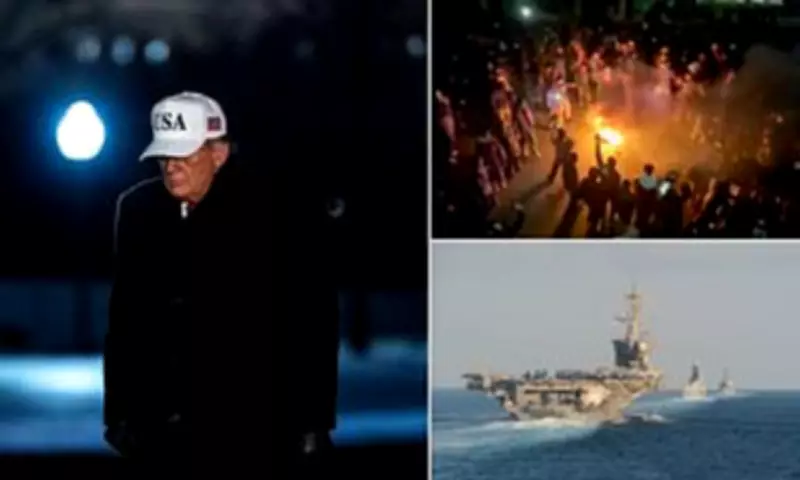
The arrival of the USS Abraham Lincoln and several guided-missile destroyers in the Middle East this week has significantly expanded Trump's military capabilities, following repeated threats of intervention over Iran's crackdown. In a post on Truth Social, Trump described the ships as an 'armada' sailing to Iran, urging Tehran to negotiate a nuclear deal and warning that any future US attack would be more severe than previous operations.
Meanwhile, a senior Iranian official stated that Iran is preparing for a military confrontation while utilising diplomatic channels, though Washington has not shown openness to diplomacy. The European Union is poised to sanction Iran's paramilitary Revolutionary Guard over the deadly crackdown, a move that could further strain Iran's economy, with its rial currency hitting a record low.
Regional Concerns and Expert Analysis
Four Arab officials, three Western diplomats, and a senior Western source briefed on the discussions expressed concern that such strikes might weaken the protest movement rather than galvanise it, given the shock from the bloodiest repression since the 1979 Islamic Revolution. Alex Vatanka, director of the Iran Program at the Middle East Institute, noted that without large-scale military defections, Iran's protests remain 'heroic but outgunned'.
A senior Israeli official with direct knowledge of US-Israel planning argued that airstrikes alone are unlikely to topple the Islamic Republic, suggesting that ground forces would be necessary for regime change. He added that only a combination of external pressure and organised domestic opposition could alter Iran's political trajectory, with the leadership weakened by unrest but still firmly in control.
Internal Dynamics and Future Scenarios
Supreme Leader Ayatollah Ali Khamenei, who has acknowledged several thousand deaths during the protests, has retreated from daily governance, with day-to-day management shifting to figures aligned with the Islamic Revolutionary Guard Corps (IRGC). Despite this, Khamenei retains final authority over war, succession, and nuclear strategy, making political change difficult until he exits the scene.
Multiple US intelligence reports indicate that the conditions that sparked the protests persist, weakening the government but without major fractures. The Western source suggested that Trump's goal appears to be engineering a change in leadership rather than a complete regime overthrow, similar to the outcome in Venezuela.
Regional Risks and International Reactions
Across the region, from the Gulf to Turkey, officials favour containment over collapse, fearing that turmoil in Iran could unleash instability beyond its borders. Gulf states, including Saudi Arabia, Qatar, Oman, and Egypt, have lobbied Washington against a strike, concerned about Iranian retaliation such as missile or drone attacks.

Analysts warn that a fractured Iran could spiral into civil war, reminiscent of post-2003 Iraq, leading to refugee influxes, increased Islamist militancy, and disruptions to oil flows through the Strait of Hormuz. The gravest risk, according to Vatanka, is fragmentation into an 'early-stage Syria,' with rival units fighting for territory and resources.
Ultimately, the most likely outcome may be a gradual erosion of the system through elite defections, economic paralysis, and contested succession, fraying Iran's political fabric until it snaps under sustained pressure.