
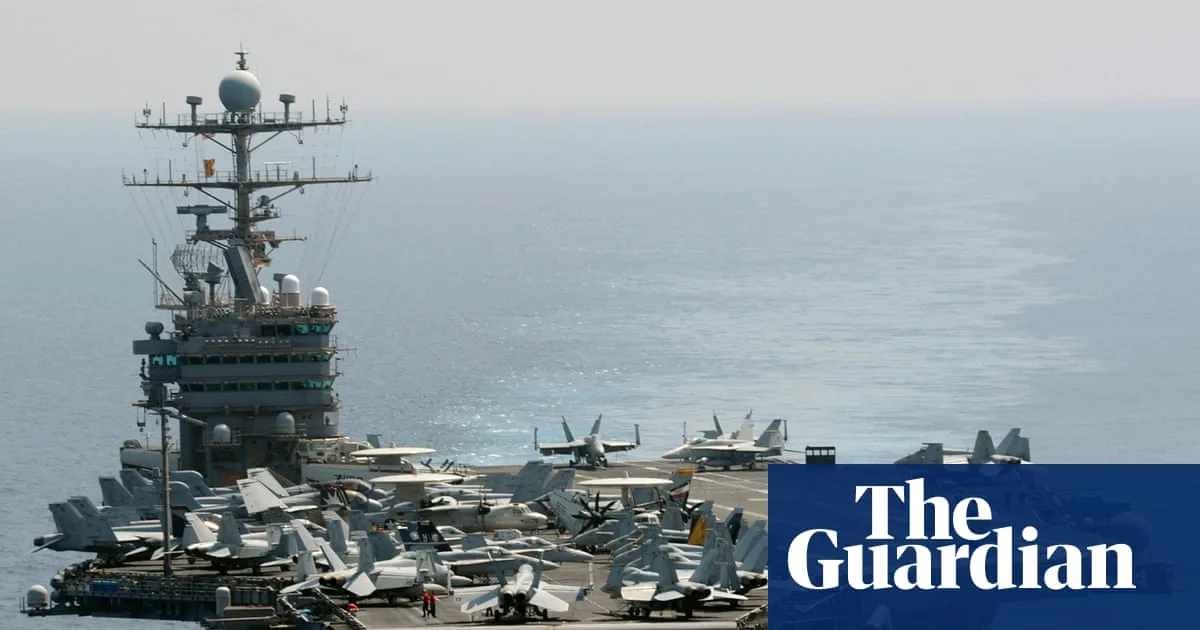
Donald Trump has said an American “armada” is heading towards the Middle East and that the US is monitoring Iran closely, as activists put the death toll from Tehran’s crackdown on protesters at 5,002. Speaking on Air Force One as he returned from the World Economic Forum in Davos overnight, he said: “We have a lot of ships going that direction, just in case. I’d rather not see anything happen, but we’re watching them very closely … we have an armada … heading in that direction, and maybe we won’t have to use it.”
The aircraft carrier USS Abraham Lincoln and several guided-missile destroyers are due to arrive in the Middle East in the coming days. Additional air defence systems are being deployed, most likely around US and Israeli airbases. The UK said it would send RAF Eurofighter Typhoon jets from 12 Squadron to Qatar, at Doha’s request.
Iran will treat any attack “as an all-out war against us, and we will respond in the hardest way possible”, a senior Iranian official, speaking on condition of anonymity, told Reuters on Friday ahead of the arrival of the US carrier strike group. The US president pulled back from attacking Iran two weeks ago, despite promising “help is on its way”, largely because he felt he had been given no military option that would prove decisive in securing regime change in Tehran. He was also urged to hold back by the Gulf states.
In an update on Friday, the US-based Human Rights Activists News Agency (HRANA) said the death toll from the Iranian crackdown on protesters had reached 5,002 – comprising 4,716 demonstrators, 203 government-affiliated people, 43 children and 40 civilians not taking part in the protests. HRANA said at least 26,541 people had been arrested. The protests started on 28 December when traders took to the streets in Tehran in response to a sudden dip in the value of the rial. As they spread, demands expanded to include calls for an end to the country’s government.
Speaking at an emergency session of the UN Human Rights Council in Geneva, Volker Türk, the UN commissioner for human rights, said thousands of people, including children, had been killed on the streets and in residential areas. He urged Iran to “end their brutal repression”, including summary trials, and urged a complete moratorium on the use of the death penalty. Mai Sato, the UN special rapporteur on human rights in Iran, demanded to be able to visit Iran for a thorough investigation. The protest movement has largely petered out in the face of the crackdown, which was accompanied by an unprecedented internet shutdown.




