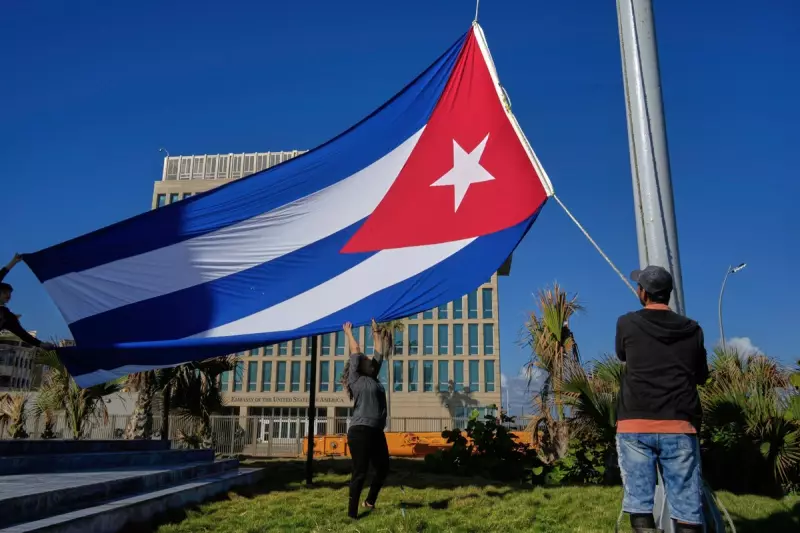
The administration of President Donald Trump is actively planning to orchestrate a regime change in Cuba before the conclusion of this year, according to a detailed report from The Wall Street Journal. This ambitious initiative has reportedly gained momentum following the successful capture of Venezuelan leader Nicolas Maduro in a dramatic raid earlier this month.
Searching for Insiders in Havana
Administration officials are said to be engaged in a concerted effort to identify Cuban government insiders who might be willing to collaborate with the United States. The goal is to find individuals within the Communist regime who can "see the writing on the wall" and are prepared to negotiate a deal to remove the current leadership from power.
Meetings have allegedly taken place with Cuban exile groups and civic organisations in both Miami and Washington, D.C., as part of this outreach. However, the report notes that the Trump team does not currently possess a concrete plan for achieving this political upheaval in Havana.

Historical Context and Significant Challenges
The Cuban Communist government, established following Fidel Castro's revolution in 1959, presents a formidable challenge. Former Obama administration official Ricardo Zuniga highlighted the difficulty, stating to the WSJ, "These guys are a much tougher nut to crack. There's nobody who would be tempted to work on the U.S. side."
President Trump has been vocal about his intentions since Maduro's fall. In a Truth Social post on January 11th, he declared an end to Venezuelan oil and financial support for Cuba, writing, "I strongly suggest they make a deal, BEFORE IT IS TOO LATE."
Key Figures Driving the Policy
Secretary of State Marco Rubio, a prominent figure with deep ties to Miami's Cuban exile community, has long advocated for regime change in his ancestral homeland. He has spent much of his political career criticising leftist governments in South America and their perceived hostility towards U.S. interests.
Rubio has publicly insisted that the administration's Venezuela policy is not being improvised, countering suggestions that they are "winging it." This assertion underscores a more calculated approach being applied to the Cuban situation.
Perceived Window of Opportunity
The administration reportedly believes the current moment is opportune due to Cuba's severe economic distress. The nation is grappling with:
- Chronic shortages of essential goods and medicines
- Frequent and debilitating power outages
- The loss of subsidised Venezuelan oil, a crucial lifeline under Maduro and his predecessor Hugo Chavez
With the U.S. now influencing terms with Venezuela's Acting President Delcy Rodriguez, Washington is positioned to completely sever that oil supply, potentially crippling the Cuban economy further and weakening the government's hold.
Caution Against a Direct Venezuela Blueprint
While the success in Venezuela may provide inspiration, analysts caution against viewing it as a direct template for Cuba. Venezuela, despite Maduro's authoritarian rule, maintained a nominal democracy with a tolerated political opposition and regular elections. Cuba, in contrast, is a single-party state with no such formal opposition structure, making internal collaboration far more challenging to cultivate.
A White House official reiterated the administration's stance to the WSJ, describing Cuba's rulers as "incompetent Marxists who have destroyed their country" and emphasising they have suffered a major setback with the fall of the Maduro regime they supported.
The State Department framed the issue as a matter of national security, stating U.S. interests require Cuba to be "competently run by a democratic government" and to cease hosting military and intelligence services from adversarial nations.
As the year progresses, the Trump administration's focus on Havana represents a significant escalation in its foreign policy objectives for the Western Hemisphere, aiming to capitalise on recent gains and apply maximum pressure on one of America's longest-standing geopolitical adversaries.