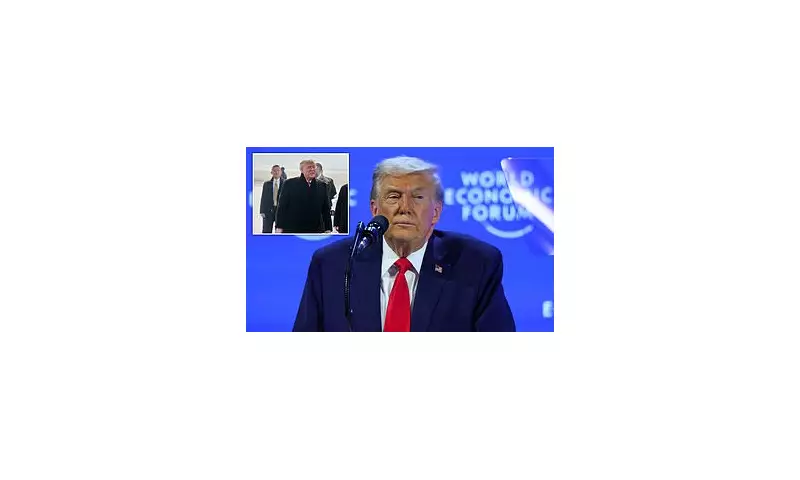
Former US President Donald Trump launched a scathing attack on European leaders during his address at the World Economic Forum in Davos, Switzerland, declaring parts of the continent had become 'unrecognisable' in a negative sense. He coupled this criticism with a renewed push for the United States to acquire Greenland, framing it as a vital strategic necessity.
A Continent 'Unrecognisable' and Ungrateful Allies
In his Wednesday speech, Trump painted a bleak picture of Europe's trajectory. 'Certain places in Europe are not even recognisable. Here in Europe, we've seen the fate that the radical left tried to impose upon America,' he stated. He elaborated that friends returning from visits report not recognising locales, 'and that's not in a positive way. That's in a very negative way.' Trump asserted his affection for Europe but insisted, 'it's not heading in the right direction.'
His remarks took a historical turn, accusing European leaders of ingratitude for American protection. He controversially suggested that without US intervention in the Second World War, Europeans would be 'speaking German and a little Japanese.' This underscored his broader theme that the continent owes its security and sovereignty to American power.

The Greenland Gambit: A 'Big Beautiful Piece of Ice'
The core of Trump's address centred on his ambition for the United States to take possession of Greenland. He described the Arctic territory as a 'strategic piece of ice' and a 'uninhabited, underdeveloped big beautiful piece of ice' sitting vulnerably in a key region between the US, Russia, and China.
Trump expressed regret over historical US policy, noting, 'After the war, we gave Greenland back. How stupid were we to do that? But we did it.' He argued this past generosity has led to present ingratitude and increased global risk due to advanced weaponry.
He was adamant that only the United States is capable of properly securing the island: 'No nation is in any position to secure Greenland than the United States... every NATO ally has an obligation to defend their own territory.' He dismissed the idea of a lease, demanding 'full ownership' because 'you need the ownership to defend it.'
Plans for Defence and a Pledge Against Force
Outlining potential development, Trump mentioned plans to build the 'greatest golden dome ever built' on Greenland to deter 'potential enemies at bay.' However, he sought to temper concerns about aggression.
'We probably won’t get anything unless I decide to use excessive strength and force, where we would be, frankly, unstoppable,' Trump conceded. But he added, 'But I won’t do that. Okay. Now everyone says, oh, good.' This statement served as an assurance that military force would not be employed in the pursuit, framing the acquisition as a matter of negotiation and strategic imperative rather than conquest.
Ultimately, Trump framed the issue as one of national security and alliance strength. 'We want strong allies, not seriously weakened ones. We want Europe to be strong. These are matters of national security,' he concluded, tying his critique of Europe's direction directly to his argument for American control of Greenland.