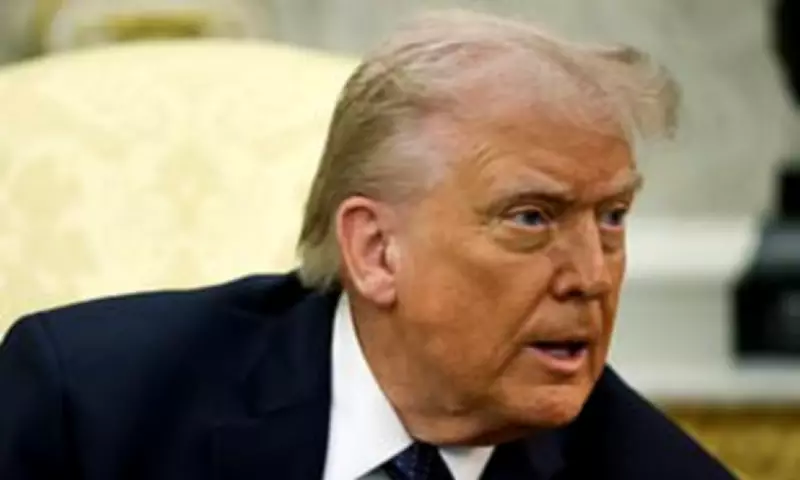
President Donald Trump has asserted that it was his personal initiative for the United States and Israel to execute coordinated military strikes against Iran over the weekend. In his first press engagement following the operation, Trump firmly rejected suggestions that Israel had drawn the US into the conflict, instead claiming he was the driving force behind the decisive action.
Contradictory Accounts Emerge
The president's remarks directly conflict with statements made by Secretary of State Marco Rubio on Monday. While briefing lawmakers on Capitol Hill, Rubio indicated that the US anticipated an Israeli action would provoke an Iranian attack on American forces, leading to a preemptive strike to minimise casualties. Trump, however, painted a different picture of the decision-making process.
'I Might Have Forced Their Hand'
'No,' Trump insisted when questioned about being dragged into the conflict by Israel. 'I might have forced their hand.' He elaborated that, based on the trajectory of negotiations with Iran, he strongly believed the regime was poised to attack first. 'You see we were having negotiations with these lunatics and it was my opinion that they were going to attack first,' the president explained. 'They were going to attack first, I felt strongly about that. So if anything I might have forced Israel's hand.'

Operation Midnight Hammer Executed
The president authorised Operation Midnight Hammer, which commenced in the early hours of Saturday morning. The strikes resulted in the deaths of dozens of Iranian leaders, including Supreme Leader Ayatollah Ali Khamenei and other high-ranking regime officials. Trump reported that a significant portion of Iran's military infrastructure and missile systems were also destroyed in the bombings.
Casualties and Conflict Duration
Thus far, four US service members have lost their lives in the operation, and Trump has warned that additional casualties may occur as the conflict continues. He estimated that the military engagement could persist for four to five weeks, indicating a prolonged period of instability in the region.
Growing Backlash from Conservative Commentators
Despite Trump touting the operation as a strategic victory, he faces mounting criticism from prominent conservative voices. Megyn Kelly and Tucker Carlson have both expressed reservations about the US involvement in the strikes.
On her programme, Kelly remarked, 'There is nothing unpatriotic or unsupportive of one's conservatism or general adherence to MAGA-type principles to say, 'I would like to be better convinced that this is worth the sacrifice of American blood and treasure.''
Carlson was more direct in his assessment, stating, 'This is Israel's war. This is not the United States' war. This war is not being waged on behalf of American national security objectives, to make the United States safer or richer... This war is waged purely because Israel wanted it to be waged.'
The divergent narratives from Trump and Rubio, coupled with the internal conservative dissent, highlight the complex political and strategic dimensions of the joint military action against Iran.