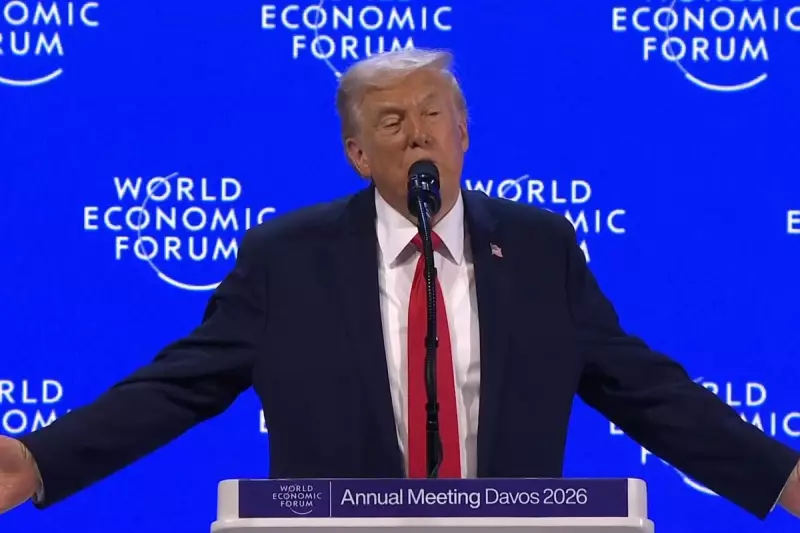
In a significant diplomatic shift, former US President Donald Trump has reversed his position on imposing punitive tariffs against several Nato member states, including the United Kingdom. This change follows what he described as productive discussions with Nato Secretary General Mark Rutte regarding the future of Greenland and the wider Arctic region.
A Swift Change in Stance
Earlier on Wednesday, President Trump had emphatically reiterated his ambition to secure control over Greenland, a self-governing territory under Danish sovereignty and a Nato ally. He explicitly stated his intention to pursue "immediate negotiations" for the acquisition of the mineral-rich Arctic island during his address at the World Economic Forum in Davos.
However, he firmly ruled out the use of military force to achieve this goal, telling the assembled global leaders and business executives: "We probably won't get anything unless I decide to use excessive strength and force, where we would be, frankly, unstoppable. But I won't do that. I don't have to use force, I don't want to use force, I won't use force."

From Threats to a Proposed Framework
The initial threat involved imposing new 10% tariffs on eight Nato countries that opposed his Greenland ambitions. This list notably included the United Kingdom. The tariffs were scheduled to come into effect on February 1st, creating a potential rift within the Western military alliance.
The turning point came after a "very productive meeting" with Nato's Mark Rutte on the sidelines of the Davos summit. Subsequently, on his Truth Social platform, President Trump announced a major policy reversal.
"We have formed the framework of a future deal with respect to Greenland and, in fact, the entire Arctic Region," he wrote. "This solution, if consummated, will be a great one for the United States of America, and all Nato Nations. Based upon this understanding, I will not be imposing the tariffs that were scheduled to go into effect on February 1st."
Strategic Discussions and the 'Golden Dome'
President Trump's statement also revealed that talks extended beyond territorial claims to include strategic defence considerations. He referenced ongoing discussions about creating a missile defence system, which he has dubbed the "Golden Dome," intended to protect against potential threats from Russia and China across the Arctic.
"Additional discussions are being held concerning The Golden Dome as it pertains to Greenland," he noted, adding that further information would be provided as talks progress.
He appointed a high-level negotiation team, including Vice President JD Vance, Secretary of State Marco Rubio, and Special Envoy Steve Witkoff, to handle the matter, with instructions to report directly to him.
British Resistance and Diplomatic Stance
Amidst these developments, British Prime Minister Sir Keir Starmer took a firm stance during Prime Minister's Questions. He vowed to resist President Trump's demands and defend the UK's principles.
Sir Keir stated unequivocally that "the future of Greenland is for the people of Greenland and the Kingdom of Denmark alone" and that "threats of tariffs to pressurise allies are completely wrong."
With the Danish Prime Minister scheduled to visit the UK on Thursday, Sir Keir reinforced his position: "I will not yield, Britain will not yield on our principles and values about the future of Greenland under threats of tariffs, and that is my clear position."
This episode highlights the complex interplay of geopolitics, resource competition in the Arctic, and alliance diplomacy, with the UK maintaining a clear, principled opposition to economic coercion against sovereign allies.