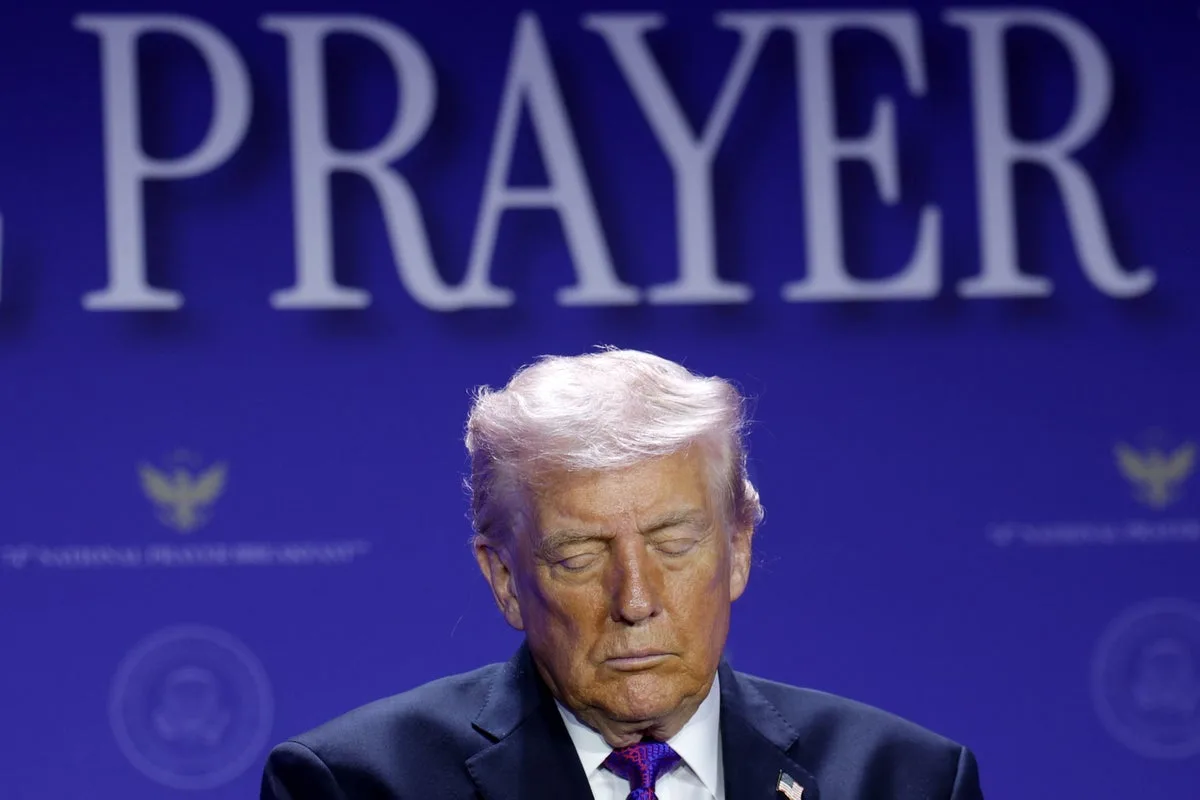
Trump Rejects Putin's Offer to Extend New START Nuclear Treaty
Trump Rejects Putin's Offer on New START Nuclear Treaty

Trump Declines Putin's Proposal to Extend New START Nuclear Arms Treaty

President Donald Trump has formally rejected an offer from Russian President Vladimir Putin to voluntarily extend the caps on strategic nuclear weapons deployments. This decision comes after the expiration of the New START treaty, which had regulated these arsenals for over two decades.

"Rather than extend 'NEW START' (A badly negotiated deal by the United States that, aside from everything else, is being grossly violated), we should have our Nuclear Experts work on a new, improved, and modernized Treaty that can last long into the future," Trump stated in a Truth Social post.

Putin's Proposal and Treaty Background

Trump was responding to Putin's suggestion that both sides adhere for one year to the limits established by the 2010 New START agreement. This treaty set restrictions on deployments of strategic nuclear warheads and the missiles, aircraft, and submarines that carry them.

Wide Pickt banner — collaborative shopping lists app for Telegram, phone mockup with grocery list

New START represented the final arms control pact between the world's two largest nuclear powers. It permitted only a single extension, which Putin and former U.S. President Joe Biden agreed upon for five years in 2021.

Kremlin spokesman Dmitry Peskov earlier indicated that Russia remained prepared to engage in dialogue with the United States if Washington responded constructively to Putin's proposal. "Listen, if there are any constructive replies, of course we will conduct a dialogue," Peskov told reporters.

Historical Context and Security Implications

New START was the last in a series of nuclear agreements between Moscow and Washington that spanned more than half a century, originating during the Cold War era. These treaties not only established numerical limits on weapons but also included inspection regimes that experts say fostered trust and confidence between the nuclear adversaries, contributing to global safety.

Security analysts warn that without a replacement treaty, the world faces a more perilous environment with heightened risks of miscalculation. Forced to rely on worst-case assumptions about each other's intentions, both the U.S. and Russia would have incentives to expand their arsenals, particularly as China accelerates its own nuclear buildup.

International Reactions and Concerns

U.N. Secretary-General Antonio Guterres expressed grave concern on Wednesday, stating that the dissolution of decades of arms control achievements "could not come at a worse time – the risk of a nuclear weapon being used is the highest in decades." He urgently called for resumed negotiations to establish a successor framework with verifiable limits.

U.N. spokesperson Stephane Dujarric emphasized the danger during a briefing in New York: "This is a very dangerous period not to have a framework dealing with these nuclear weapons. We hope very much that the talks will be positive and will be fruitful."

China's Position and Future Negotiations

Trump has previously expressed a desire to replace New START with a superior agreement that includes China. However, Beijing has consistently declined to participate in trilateral negotiations with Moscow and Washington. China possesses significantly fewer warheads—approximately 600 compared to around 4,000 each for Russia and the United States.

Reiterating its stance on Thursday, China described the treaty's expiration as regrettable and urged the U.S. to resume dialogue with Russia on "strategic stability."

Confusion Over Timing and Russian Stance

There was some confusion regarding the precise timing of the treaty's expiry, but Peskov clarified it would occur at the end of Thursday. Former Russian President Dmitry Medvedev, who signed the treaty with then U.S. President Barack Obama in 2010, remarked on Wednesday that New START and its predecessors were now "all in the past."

Russia's Foreign Ministry stated that Moscow assumes the treaty no longer applies, freeing both parties to determine their next steps. The ministry indicated Russia was prepared to take "decisive military-technical countermeasures to mitigate potential additional threats to national security" while remaining open to diplomatic solutions.

Pickt after-article banner — collaborative shopping lists app with family illustration

Ukrainian Perspective and Strategic Weapons Distinction

Ukraine, which has been engaged in conflict with Russia since Moscow's 2022 invasion, criticized the treaty's expiration as a consequence of Russian efforts to achieve the "fragmentation of the global security architecture" and labeled it "another tool for nuclear blackmail to undermine international support for Ukraine."

Strategic nuclear weapons are long-range systems designed to strike an adversary's capital, military, and industrial centers in a nuclear war. These differ from tactical nuclear weapons, which have lower yields and are intended for limited strikes or battlefield use.

Expert Analysis and Future Projections

Experts suggest that without any agreement constraints, Russia and the U.S. could each deploy hundreds more warheads beyond the New START limit of 1,550 within a few years. Karim Haggag, director of the Stockholm International Peace Research Institute, noted: "Transparency and predictability are among the more intangible benefits of arms control and underpin deterrence and strategic stability."

The White House confirmed this week that Trump would determine the future direction of nuclear arms control, stating he would "clarify on his own timeline." Peskov affirmed that Russia would adopt a responsible approach to the evolving situation.




