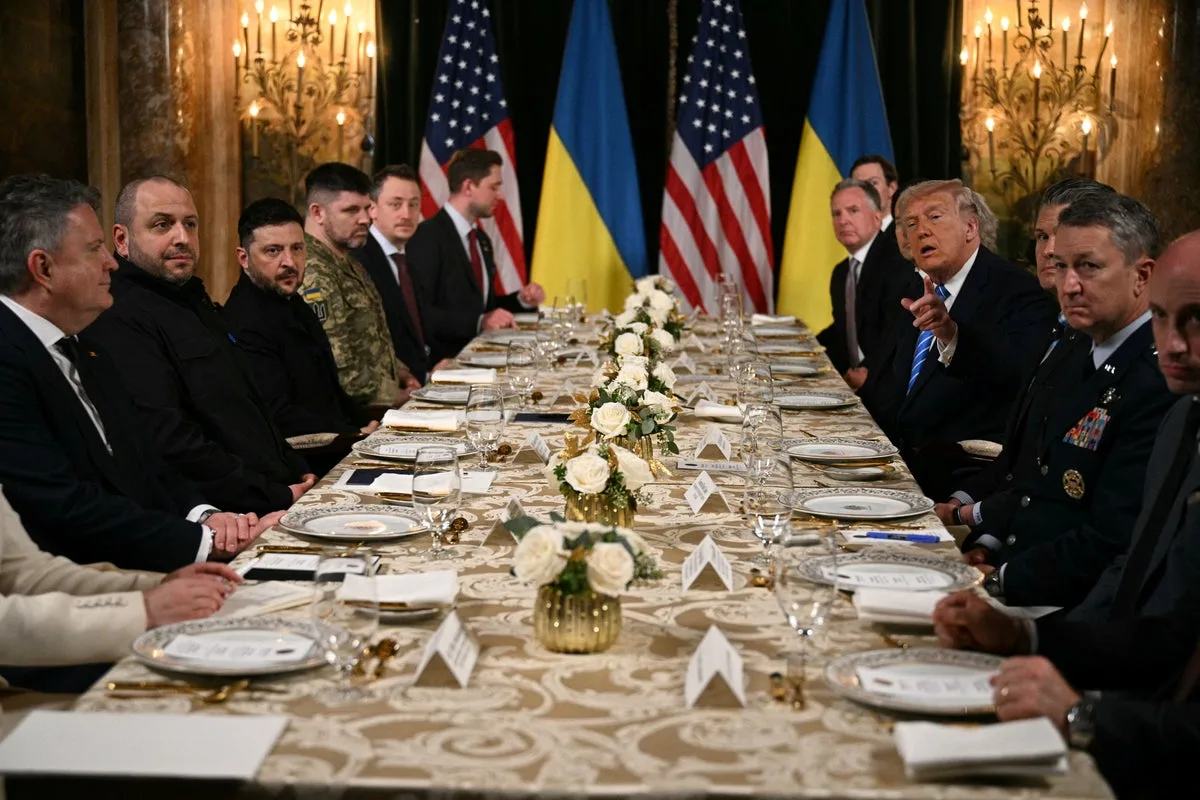
President Donald Trump joked with reporters covering his dinner with Ukrainian counterpart Volodymyr Zelensky at Mar-a-Lago on Sunday that they were welcome to some of the food being served. Still, he warned it could be considered a bribe.
Trump was hosting Zelensky and his delegation at his Florida estate for talks on ending the Russian war, which is approaching its fourth anniversary. The American emerged afterwards to say that “a lot of progress” had been made towards securing peace but that a number of “thorny issues” remained outstanding.
At the meal, Trump was flanked by Secretary of State Marco Rubio, Secretary of Defense Pete Hegseth, and Chairman of the Joint Chiefs of Staff Dan Caine, plus advisers including Susie Wiles, Stephen Miller, Steve Witkoff, and Jared Kushner, who lined up across the table from Zelensky’s team.
Turning his attention to the press, the president said, “I think you could sit outside and have some food. Would you like to have food or do you consider that a bribe, and therefore you cannot write honestly? Or therefore you have to write a bad story?” When one of the journalists spoke up to accept the offer on behalf of his colleagues, Trump instructed his aide, Margo Martin: “Take them outside and tell the chef to serve them a little lunch.”
As the press corps expressed their thanks, the president commented to his guests: “That should guarantee you good stories, but it won’t. It’ll only get worse. They’ll go out of their way to make them worse.” Politico reporter Alex Gangito subsequently wrote in a pool report: “Pool did in fact get lunch and we are seated at small round tables on the club patio. For those wondering at home, we were served sliced steak, pigs in a blanket, coconut shrimp, fries and chocolate chip cookies. And water bottles with a Trump label.”
Trump and Zelensky were discussing a 20-point peace plan for ending hostilities with Russia, with the Ukrainian commenting afterwards that security guarantees involving the U.S. and his country were “100 per cent agreed” and that an arrangement between America, Europe, and Ukraine was “almost agreed.” The deal would see Ukraine give up on its aspirations to join NATO but receive “NATO-style” defensive support from allied nations forming a “coalition of the willing.” However, Ukraine is continuing to refuse to yield any territory to Moscow’s invading forces.