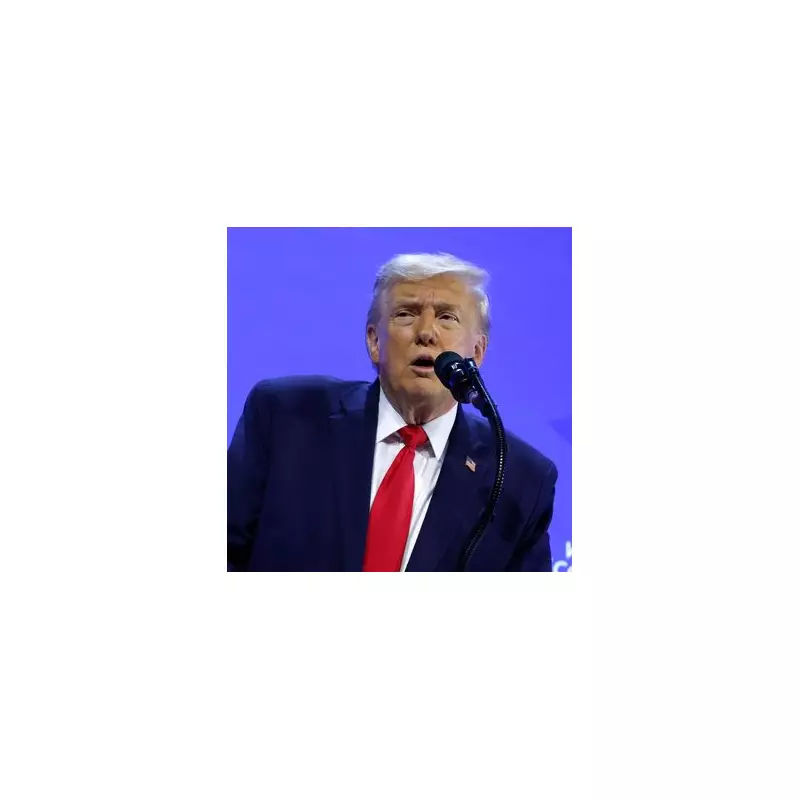
In a remarkable address to global leaders at the World Economic Forum in Davos, former US President Donald Trump launched into an extraordinary tirade, demanding that Denmark should hand over Greenland to the United States and issuing thinly-veiled threats about using American military power to secure it.
A History Lesson and a Demand
Trump centred his argument on the United States' role during the Second World War. He told the assembled economic and political elites that America "won World War II," asserting that without US intervention, the world would be speaking German and Japanese. He specifically highlighted the US protection of Greenland after Denmark fell to Nazi Germany.
"The United States was compelled to send our own forces to hold Greenland. And hold it we did at great expense," Trump stated, framing the post-war return of the territory as a foolish act of generosity.

'How Ungrateful Are They Now?'
Trump's rhetoric turned sharply accusatory towards Denmark. He labelled the Danish government "ungrateful" for refusing to cede the vast, icy territory back to the US. "After the war we gave Greenland back to Denmark, how stupid were we to do that? But we gave it back and how ungrateful are they now?" he questioned the silent Davos audience.
He downplayed Greenland's significance, referring to it as a "big piece of ice" that scarcely qualifies as an island, while simultaneously arguing its strategic importance could only be defended by the United States.
Veiled Threats of Military Action
The speech took a more ominous turn as Trump hinted at the potential use of force. He suggested that while he prefers not to use it, America's military might could make the acquisition of Greenland straightforward.
"We probably won't get anything unless I decide to use excessive strength and force," he said, adding, "We would be frankly unstoppable, but I won't do that. That's probably the biggest statement I made."
This commentary was presented as a revelation of restraint, with Trump claiming others expected him to use force, but he was choosing not to. His underlying message, however, clearly positioned military action as a viable, if currently dormant, option for securing what he called America's rightful claim.
An Unrelated Attack on UK Energy Policy
In a divergent segment of his wide-ranging speech, Trump also targeted British energy policy. He criticised the UK's reliance on wind power, directly blaming wind turbines for high energy prices facing British consumers. This critique appeared disconnected from his primary focus on territorial claims but formed part of a broader pattern of challenging allied nations' domestic policies.
The Davos address has sent shockwaves through diplomatic circles, raising fresh concerns about the former president's approach to international relations and territorial sovereignty. The combination of historical revisionism, demands for territory, and ambiguous threats marks a significant escalation in rhetoric concerning US interests in the Arctic region.