

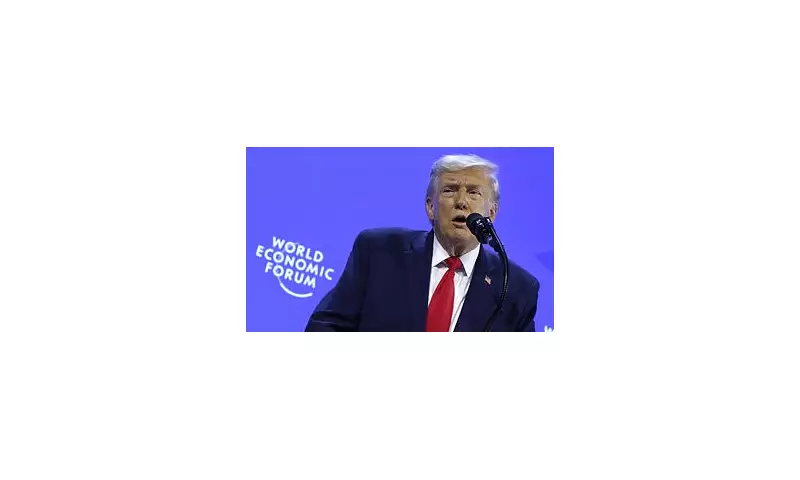
In a remarkable address at the World Economic Forum in Davos, former US President Donald Trump unveiled his demand for the United States to purchase Greenland, delivering stark warnings to America's NATO allies while explicitly ruling out military action to seize the Arctic territory.
An Extraordinary Hour-Long Declaration
Speaking for seventy-two minutes to a packed congress hall, Trump arrived directly from a delayed flight from Washington, appearing weary yet captivating the Swiss business forum with his characteristic deviation from prepared remarks. The centrepiece of his lengthy speech emerged as a renewed push for what he termed the "acquisition" of Greenland, home to nearly 60,000 people.
"No current issue makes the situation more clear than what's going on with Greenland," Trump declared, adding with theatrical pause, "I was going to leave it out of the speech, but thought I was going to be reviewed very negatively."

Historical Justifications and Contemporary Demands
Drawing heavily on Second World War history, Trump argued that America had saved Greenland from German occupation before foolishly returning it to Denmark after the conflict. "How stupid were we to do that?" he questioned the audience, describing the territory as "right smack in the middle" of strategic competition between the US, China, and Russia.
Despite this historical framing, the former president insisted his motivation was international security rather than Greenland's valuable rare earth metals, stating: "Only the United States can make it safe for Europe and good for us." He called for "immediate negotiations" regarding what he repeatedly referred to as a "big beautiful piece of ice."
Warning to Allies: "We Will Remember"
Trump delivered an unambiguous message to NATO partners regarding the proposed acquisition. "You say no, and we will remember," he warned, while offering that allies had "a chance to say yes and we will be very appreciative." He particularly emphasized what he perceived as unequal burden-sharing within the alliance, complaining: "We give so much and we get so little in return."
In a significant concession, however, Trump explicitly ruled out using military force to obtain Greenland, stating: "I don't have to use force. I don't want to use force. I won't use force." He described this as potentially "the biggest statement" made during his address.
Geographical Confusion and Broader Criticisms
Despite the speech's focus on Greenland, Trump mistakenly referred to the territory as "Iceland" on four separate occasions, at one point blaming market fluctuations on the misidentified nation. "Our stock market took the first dip because of Iceland," he claimed erroneously.
The address ranged far beyond Arctic geopolitics, featuring:
- Mockery of French President Emmanuel Macron's aviator sunglasses, worn due to an eye infection
- Criticism of European energy policies, particularly Britain's North Sea oil usage
- Attacks on "Somali bandits" and allegations of diaspora fraud in Minnesota
- Complaints about Swiss watch exports and pharmaceutical pricing
- Scathing remarks about Canadian Prime Minister Mark Carney's perceived ingratitude
Post-Speech Developments and Reactions
Following his marathon address, Trump met with NATO Secretary General Mark Rutte, emerging to claim a deal had been struck regarding Greenland—though no details of this apparent "framework" were provided. Meanwhile, Reform UK leader Nigel Farage offered qualified support, suggesting the world would be "more secure" under US ownership while emphasizing the need to respect Greenlanders' views.
Most residents of the semi-autonomous Danish territory have previously expressed opposition to becoming part of the United States, with protests occurring in Nuuk featuring crossed-out American flags. Trump acknowledged this sentiment indirectly, stating he had "tremendous respect for both the people of Greenland and the people of Denmark" while nevertheless pursuing what he framed as a strategic necessity.

The Davos speech represents Trump's most comprehensive articulation of his Greenland ambitions since his presidency, blending historical revisionism, alliance politics, and personal grievance into a singular geopolitical demand that continues to reverberate through diplomatic channels.





