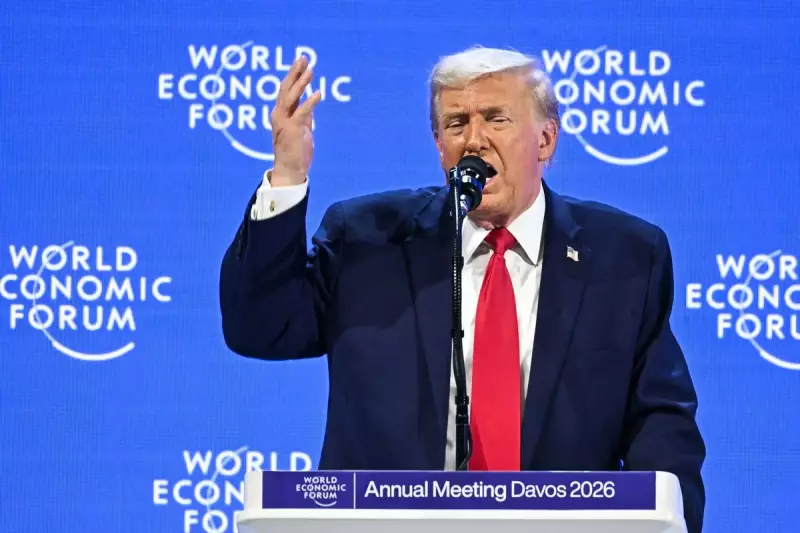
Former US President Donald Trump has launched a renewed offensive demanding American acquisition of Greenland while delivering scathing criticism of NATO allies and European immigration policies, creating fresh diplomatic tensions across the Atlantic.
"All I Want Is a Piece of Ice"
In a remarkable address delivered at the World Economic Forum in Davos, Trump insisted on immediate negotiations regarding US acquisition of the Danish territory, though he notably pledged he would "not use force" to seize it. The controversial figure described Greenland as "a piece of ice, cold and poorly located" while arguing it could "play a vital role in world peace and world protection."
NATO Under Fire
Trump directed particularly harsh criticism toward the NATO alliance, claiming the United States has "never gotten anything" from its membership. He framed the proposed Greenland acquisition as "a very small ask" compared to what America has allegedly provided fellow members over decades.

"The problem with NATO is that we'll be there for them 100 per cent, but I'm not sure that they'd be there for us," Trump declared during his wide-ranging speech.
Diplomatic Framework Emerges
Hours after his inflammatory remarks, Trump announced a significant development following discussions with NATO Secretary General Mark Rutte. The former president revealed they had "formed the framework of a future deal" regarding Greenland and the broader Arctic region.
As a consequence of this progress, Trump indicated he would scrap planned 10% tariffs on eight NATO countries including the United Kingdom that were scheduled to take effect on February 1st. These punitive measures had been threatened in response to allied opposition to his Greenland ambitions.
"Golden Dome" Defence System
Trump elaborated on his vision for enhanced Arctic security, reviving his proposal for a missile defence system he has dubbed the "Golden Dome." He suggested this system would have its outer edge positioned in Greenland to counter potential threats from Russia and China.
"All we want from Denmark, for national and international security and to keep our very energetic and dangerous potential enemies at bay, is this land on which we're going to build the greatest golden dome ever built," Trump explained to reporters.
British Resistance Strengthens
Prime Minister Sir Keir Starmer delivered his strongest rebuke yet to Trump's Greenland ambitions during Prime Minister's Questions, declaring Britain "will not yield" on principles regarding the territory's future. Starmer connected Trump's criticism of Britain's Chagos Islands agreement with Mauritius directly to pressure tactics over Greenland.
"He deployed those words yesterday for the express purpose of putting pressure on me and Britain in relation to my values and principles on the future of Greenland," Starmer told Parliament. "He wants me to yield on my position, and I'm not going to do so."
European Immigration Criticism
Trump expanded his critique to include European immigration policies, claiming the continent has become "unrecognisable" due to what he described as "unchecked mass migration." He asserted Europe was importing "entirely different populations from faraway lands" while warning that "bad things will happen" without policy changes.
These comments echo rhetoric frequently employed by far-right movements on both sides of the Atlantic, further complicating diplomatic relations between Washington and European capitals.
Allied Pushback Emerges
In a rare moment of disagreement, Reform UK leader Nigel Farage challenged Trump's characterization of NATO contributions. Speaking in Davos following Trump's address, Farage noted that Britain had "more than done our bit" for the alliance, particularly referencing joint military engagements in Afghanistan.
"We stayed by America for the whole 20 years, we proportionately spent the same money as America, we lost the same number of lives as America pro rata," Farage stated, offering a counterpoint to Trump's claims of disproportionate American burden-sharing.
The escalating diplomatic situation continues to develop as world leaders navigate Trump's renewed territorial ambitions alongside his criticisms of established international alliances and policies.